

TL;DR:
- Small and medium-sized businesses can successfully adopt AI by focusing on high-ROI, rule-based workflows to automate repetitive tasks. Proper preparation, including workflow audits, goal setting, and staff buy-in, is essential for effective AI implementation. Starting with small wins and continuously measuring results fosters sustainable growth and builds internal confidence in AI capabilities.
Small and medium-sized businesses face a defining moment: competitors are deploying AI to automate workflows, improve customer experiences, and operate leaner, while many business owners still struggle to find a practical entry point. Productivity gains from AI are no longer theoretical. They are measurable, documented, and happening across industries right now. This guide cuts through the noise and delivers a realistic, step-by-step path to AI adoption that fits the scale, budget, and goals of real businesses. Each section builds on the last, moving from understanding core value to selecting tools, deploying them, and measuring results that matter.
Table of Contents
- Understanding the real value of AI for businesses
- Preparing your organization for AI adoption
- Selecting and implementing the right AI tools
- Measuring success and optimizing AI workflows
- The real-world lesson: Why small wins matter most
- Unlock your business's AI potential with SimplyAI
- Frequently asked questions
Key Takeaways
| Point | Details |
|---|---|
| Start with targeted workflows | Focusing on areas like customer service leads to measurable productivity gains quickly. |
| Pilot before scaling | Small-scale trials are safer and deliver more reliable results than big-bang implementations. |
| Track key performance indicators | Monitoring metrics like efficiency and customer satisfaction is essential to optimize AI impact. |
| Stakeholder buy-in is critical | AI adoption works best when staff and leadership are engaged and supportive. |
| Iterate and celebrate small wins | Continuous improvement and recognition of incremental progress help sustain momentum. |
Understanding the real value of AI for businesses
For most small business owners, the term "artificial intelligence" conjures images of massive tech companies with unlimited budgets and teams of engineers. That picture is outdated. Today, AI tools are accessible, affordable, and designed to plug into existing workflows without requiring a complete systems overhaul. Understanding what AI actually does in a business context is the first step to using it effectively.
At its core, AI for small business means software that can perform tasks that previously required human judgment. Large language models (LLMs) like the ones powering modern chatbots can answer customer questions, draft communications, and summarize data. Workflow automation tools can route leads, update CRM records, and send follow-up emails without manual input. Computer vision systems can inspect product images or verify documents. The range is wide, but the principle is consistent: AI takes on repetitive, rule-based, or pattern-driven work so your team can focus on higher-value tasks.
The benefits extend well beyond saving time. Businesses that integrate AI into customer-facing processes report faster response times, higher satisfaction scores, and lower churn. Customer service and search workflows consistently rank among the areas with the largest measurable productivity improvements in field experiments. When customers receive accurate answers within seconds rather than waiting hours for an email reply, retention improves in a meaningful way.
The automation benefits for SMBs go beyond customer service too. Internal operations like invoice processing, scheduling, inventory alerts, and employee onboarding can all be streamlined. A business processing 200 customer inquiries per week could realistically handle that volume with a fraction of the staff effort, redirecting those hours toward growth activities.
Key AI benefits for small and medium-sized businesses:
- Reduced manual labor in repetitive administrative tasks
- Faster response times in customer service and sales
- More consistent quality in content creation and communications
- Improved data accuracy in CRM and reporting systems
- Scalable operations without proportional headcount increases
One critical misconception to address: AI adoption does not mean replacing your team. It means augmenting their capacity. A two-person customer service team with an AI chatbot fielding routine queries can effectively perform the work of a much larger team, with the humans focused on complex or sensitive interactions that genuinely require judgment and empathy.
| Business function | Before AI | After AI |
|---|---|---|
| Customer inquiry response time | 4 to 24 hours | Under 2 minutes |
| Lead follow-up | Manual, often delayed | Automated, immediate |
| Content drafting | 2 to 3 hours per piece | 20 to 30 minutes |
| Invoice processing | Manual entry, error-prone | Automated, near-instant |
| Reporting and analytics | Weekly manual pulls | Real-time dashboards |
With the benefits and basic concepts in mind, the next step is to prepare for AI adoption in your organization.
Preparing your organization for AI adoption
Even the best AI tools will underperform without proper groundwork. Preparation is not glamorous work, but it is where successful AI projects are won or lost. Companies that skip this phase often experience the "big bang" failure: a large investment in technology that produces minimal results because the underlying workflows were never defined clearly enough.

The first task is a workflow audit. Walk through every major business process and ask two questions: How often is this done, and how much of it follows predictable rules? High-frequency, rule-based tasks are ideal AI candidates. Customer intake forms, appointment scheduling, lead scoring, and order confirmations are classic examples. Creative strategy sessions, complex negotiations, and client relationship management are not, at least not yet.
Next, set measurable goals before choosing a single tool. Vague objectives like "improve efficiency" are a recipe for disappointment. Specific targets like "reduce customer response time from 6 hours to under 15 minutes" or "automate 80% of recurring invoice approvals within 90 days" give your team a clear finish line and make it possible to evaluate performance honestly. Choosing areas where AI can drive tangible improvements requires recognizing that not every workflow will benefit equally, and that is perfectly normal.
Securing buy-in from leadership and frontline staff is equally important. Employees who fear that AI threatens their jobs will resist adoption, find workarounds, or provide incomplete data that undermines the system. A transparent conversation about how AI will change their roles, not eliminate them, goes a long way. Leaders who champion AI adoption publicly signal to the entire organization that this is a strategic priority, not a side experiment.
Building an AI-first organization strategy requires revisiting how decisions are made, how data is stored, and how processes are documented. If your customer data lives in spreadsheets scattered across email threads, you need to consolidate it before an AI tool can use it effectively. Clean, structured data is the foundation that every AI solution depends on.
| Preparation step | Why it matters | Common pitfall |
|---|---|---|
| Workflow audit | Identifies high-ROI automation targets | Trying to automate everything at once |
| Goal setting | Creates measurable benchmarks | Setting vague or unmeasurable goals |
| Staff buy-in | Drives adoption and reduces resistance | Overlooking frontline employee concerns |
| Data consolidation | Enables AI tools to function accurately | Using fragmented or inconsistent data sources |
| Tool research | Ensures fit with business needs | Selecting tools before defining needs |
Following the AI integration steps that leading experts recommend consistently emphasizes this preparation phase as the single biggest differentiator between projects that succeed and those that stall.
Pro Tip: Start with one workflow, get it working well, then expand. The businesses that see the fastest and most sustainable results are not the ones that automate everything in month one. They are the ones that pick a single process, prove the value clearly, and use that win to fund and justify the next phase.
Having laid the groundwork, it's now time to select and deploy the right AI tools.
Selecting and implementing the right AI tools
With goals defined and workflows mapped, the process of selecting AI tools becomes far less overwhelming. The market offers hundreds of options, but for most small and medium-sized businesses, the decision comes down to a few core categories.
AI-powered chatbots handle customer inquiries, qualify leads, and provide support around the clock. They integrate with websites, social platforms, and messaging apps. For businesses where customer questions follow predictable patterns, chatbots deliver immediate, measurable ROI. Customer service and search workflows consistently show the largest productivity boosts from AI, making chatbots one of the highest-return entry points available.
Workflow automation tools connect your existing software stack and eliminate manual handoffs. When a form is submitted, an automation can create a CRM record, assign a task to a team member, send a confirmation email, and schedule a follow-up, all without human input. These tools support digital transformation with AI in a tangible, day-one-visible way.
AI agent frameworks represent a more advanced tier. AI agents can autonomously execute multi-step tasks, such as researching a prospect, drafting a personalized outreach email, and logging the interaction in a CRM. They operate with greater independence than simple automation tools and can adapt their behavior based on context. Deploying agents effectively requires clearer boundaries and more robust testing, but the payoff in time saved is significant.
Step-by-step AI implementation process:
- Define the specific workflow you are targeting and document every step currently performed manually.
- Identify the outcome you are measuring and establish a baseline metric before deploying anything.
- Research tools in the relevant category and request demos or free trials from two or three options.
- Configure the tool using real data from your business, not generic templates, to test actual performance.
- Run a pilot with a small segment of your workload, perhaps 20% of incoming customer inquiries or one department's workflow.
- Gather feedback from staff and customers. Identify friction points and resolve them before expanding.
- Scale the deployment once the pilot demonstrates consistent performance against your target metric.
- Document what was built, how it was configured, and how it should be maintained going forward.
"The most effective AI implementations we observe are not the most technically complex. They are the ones aligned most precisely to a defined business need, with a clear owner and a clear success metric from day one."
Exploring custom AI workflow solutions becomes relevant at the scaling stage, when off-the-shelf tools start showing their limitations and a business needs logic tailored specifically to its processes and customer journey.
Pro Tip: Always pilot before scaling. A tool that performs beautifully in a demo may behave differently with real customer data, real staff interactions, and real edge cases. A four-week pilot on a contained workflow will surface 80% of the issues you would otherwise discover after full deployment, when fixes are more costly and disruptive.
Once AI tools are up and running, monitoring and optimizing for consistent results is crucial.
Measuring success and optimizing AI workflows
Deploying AI is not a one-time event. It is the beginning of an ongoing cycle of measurement, learning, and adjustment. Businesses that treat AI as a "set and forget" system consistently underperform compared to those that actively manage and refine their implementations.
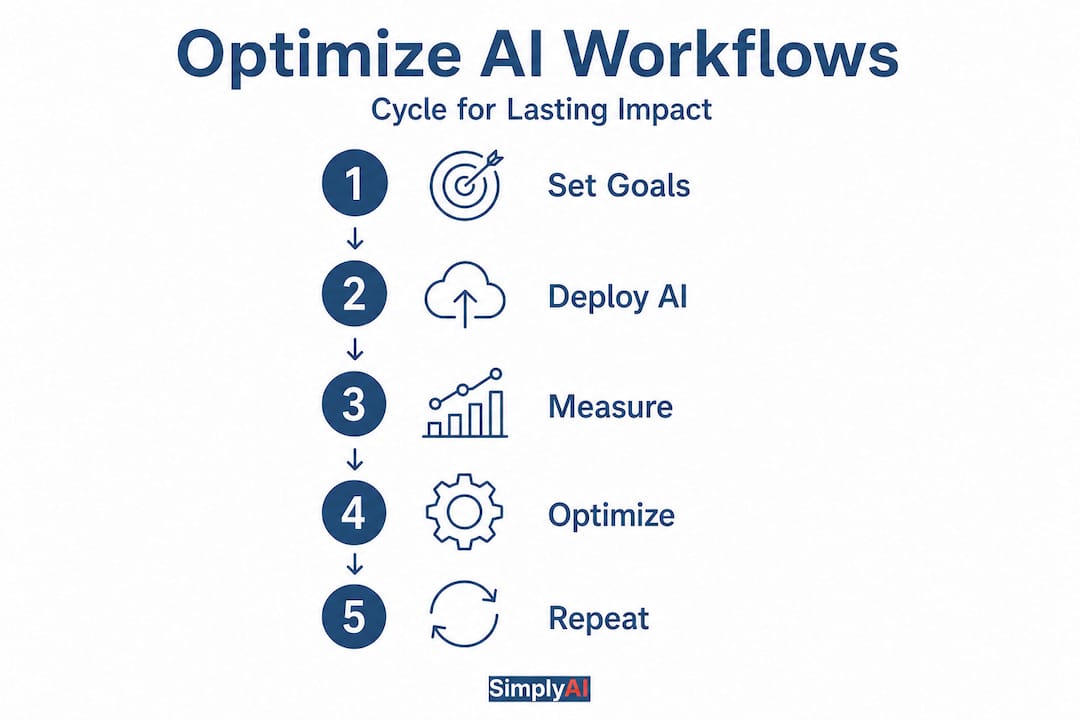
The first step in measurement is confirming that the baseline you established during preparation is being tracked consistently. If your goal was to reduce customer response time, your reporting dashboard should capture that metric daily, not just monthly. Productivity gains from AI are measurable and most pronounced in customer-facing workflows, but only if you are tracking the right data at the right frequency.
Essential KPIs for AI adoption in SMBs:
- Average customer response time before and after AI deployment
- Volume of tasks handled autonomously versus escalated to humans
- Error rate in automated processes compared to manual processes
- Employee hours redirected from automated tasks to higher-value work
- Customer satisfaction scores tracked against pre-AI benchmarks
- Cost per interaction or cost per transaction in AI-assisted workflows
A common challenge in early AI deployments is over-escalation. The AI handles only the simplest cases and routes everything else to a human, negating much of the efficiency gain. This typically means the training data or decision logic is too conservative. Reviewing escalation logs weekly and refining the AI's decision thresholds is a routine part of optimization that pays dividends quickly.
| Metric | Before AI | Three months after AI | Six months after AI |
|---|---|---|---|
| Customer response time | 5.5 hours average | 45 minutes average | Under 10 minutes average |
| Staff hours on routine queries | 18 hours per week | 6 hours per week | 3 hours per week |
| Customer satisfaction score | 72% | 81% | 88% |
| Lead follow-up rate | 65% within 24 hours | 100% within 5 minutes | 100% within 5 minutes |
Finding ways to boost efficiency with AI consistently requires treating optimization as a scheduled activity, not an afterthought. Monthly reviews of AI performance, combined with quarterly assessments of whether the original goals still reflect business priorities, keep implementations aligned with real needs. The role of AI agents in the workplace is also evolving rapidly, and staying current with new capabilities allows businesses to expand what their existing AI infrastructure can do without starting from scratch.
Stepping back, here's a candid perspective on what actually drives effective AI adoption in business.
The real-world lesson: Why small wins matter most
There is a persistent myth in AI adoption circles that success requires a bold, sweeping transformation. Executives read case studies from large enterprises and conclude that meaningful AI value only comes from large-scale projects. This belief leads small businesses to either delay action indefinitely while planning a perfect strategy, or invest heavily in an ambitious rollout that fails because the organization was not ready to absorb that level of change.
The reality, observed consistently across hundreds of SMB implementations, is almost the opposite. The businesses achieving the most durable results are the ones that started with a single chatbot, a single automation, or a single AI-assisted report. They shipped something small, watched it work, fixed what broke, and then expanded.
Small wins matter for reasons beyond the obvious efficiency gains. They build internal credibility for the AI program. When a skeptical employee watches the chatbot handle 40 customer inquiries on a busy Monday morning without intervention, their resistance softens. When a manager sees that the automated lead follow-up system is converting at a higher rate than the manual process ever did, the conversation about expanding AI investment becomes far easier.
Practical AI adoption tips from practitioners in the field almost universally emphasize iteration over perfection. The goal in the first 90 days is not a flawless AI system. It is a working, measured, improving AI system, however modest in scope.
There is also a compounding effect worth noting. Each small AI win generates data, experience, and organizational knowledge that makes the next implementation faster and more effective. A business that has successfully automated customer intake has already solved the integration challenges, staff training challenges, and data quality challenges that would otherwise slow down the next project. The first win is the hardest. Every subsequent one is easier, faster, and more impactful.
Avoid the instinct to celebrate only major milestones. Recognizing incremental progress keeps teams motivated and creates a culture of continuous improvement that sustains AI adoption well beyond the initial excitement of launch.
Unlock your business's AI potential with SimplyAI
The path from reading about AI to operating a genuinely AI-powered business is shorter than most business owners expect, especially with the right guidance and tools in place. SimplyAI was built specifically to help small and medium-sized businesses move from interest to implementation without the confusion, wasted budget, or failed projects that come from going it alone.
Whether your priority is deploying AI automation services to reduce manual workloads, building intelligent AI agent solutions that operate autonomously on your behalf, or equipping your team through AI corporate education programs, SimplyAI offers a clear, practical path forward. Every engagement starts with understanding your specific workflows and goals, not with pushing a generic product. If your business is ready to move from planning to action, the expertise and tools to make it happen are already within reach.
Frequently asked questions
What is the simplest way to start AI adoption in a small business?
Identify a single workflow, such as customer service, and pilot an AI tool before expanding, because customer service delivers some of the most measurable productivity gains available to small businesses.
How can I measure the ROI of AI tools in my company?
Track key performance indicators like response time, task volume, and customer satisfaction before and after deployment, since productivity gains are measurable and most visible in customer-facing workflows.
What are common mistakes when adopting AI?
Attempting to overhaul all workflows simultaneously is the most frequent error, because incremental improvements yield more reliable and sustainable results than large-scale rollouts for most small and medium-sized businesses.
Do I need technical expertise to start using AI in my business?
No. Most modern AI tools are designed with business owners in mind, offering user-friendly interfaces and setup processes that require no coding or engineering background.
How long does it usually take to see improvements from AI?
Most businesses notice measurable gains within weeks to a few months after deploying AI in targeted workflows, as field experiments show quick improvements particularly in customer service and search applications.