

TL;DR:
- AI enhances customer engagement for SMBs, delivering quick ROI within 60 to 90 days.
- Successful AI use requires proper data quality, governance, and balanced human-AI collaboration.
- Transparency and human fallback are essential to build customer trust and prevent frustration.
Many small and medium-sized business owners assume AI-powered customer engagement is a luxury reserved for large enterprises with deep pockets and dedicated tech teams. That assumption is increasingly costly. Quick wins in 60 to 90 days are now a realistic outcome for SMBs that deploy AI with the right data and strategy behind them. This guide cuts through the hype, addresses the real risks, and maps out practical steps any SMB can take to use AI for customer engagement that actually moves the needle on efficiency, satisfaction, and revenue.
Table of Contents
- What is AI for customer engagement?
- How SMBs are deploying AI for engagement now
- Risks, common pitfalls, and how to avoid AI missteps
- Human-AI collaboration: Getting the balance right
- Why most SMBs get AI for engagement wrong—and how to fix it
- How SimplyAI helps SMBs drive engagement with smarter AI
- Frequently asked questions
Key Takeaways
| Point | Details |
|---|---|
| AI for all SMBs | Small businesses get fast, measurable gains from AI-driven customer engagement with the right data foundation. |
| Balancing risks and rewards | Combining AI efficiency with human empathy is the key to customer trust and satisfaction. |
| Avoiding common pitfalls | Governance, escalation procedures, and regular reviews prevent AI missteps and sustain long-term engagement. |
| Quick wins with integration | AI automation shows ROI in as little as 2–3 months when deployed in integrated, practical use cases. |
What is AI for customer engagement?
AI for customer engagement refers to using artificial intelligence to automate, personalize, and enhance every interaction a business has with its customers. This covers a wide spectrum, from AI-powered chatbots that handle routine inquiries to recommendation engines that surface the right product at the right moment, smart ticketing systems that route issues intelligently, and automated follow-up sequences that keep customers engaged between purchases.
Not long ago, SMBs relied entirely on manual outreach: phone calls, generic email blasts, and front-desk staff fielding every question. The shift to AI-powered engagement has been a seismic one. Today, businesses can deploy tools that operate 24/7, respond in seconds, and learn from every interaction to become more accurate over time. The core benefits are clear: operational efficiency, round-the-clock support, data-driven personalization with AI, and the ability to scale without proportionally scaling headcount.
The momentum is real. According to SMB AI adoption trends, 70% of SMB leaders hold a positive outlook on AI's impact on their business. That optimism is grounded in tangible results, though it comes with practical challenges around data quality, staff readiness, and integration complexity.
The AI use cases for engagement available to SMBs today span industries from retail and hospitality to professional services and healthcare. The common thread is that AI handles the repetitive, high-volume interactions autonomously, freeing human staff to focus on the complex, high-value conversations that truly require judgment and empathy.
"AI for customer engagement is not about replacing your team. It is about giving your team the leverage to do more of what humans do best."
How SMBs are deploying AI for engagement now
The gap between theory and practice is closing fast. SMBs are actively deploying AI across four primary engagement channels: chatbots for real-time support, AI-powered email campaigns that adapt content based on user behavior, personalized product or service recommendations, and automated follow-up sequences triggered by customer actions.
The results are measurable. Empirical data confirms that well-executed AI deployments deliver ROI within 60 to 90 days, provided the underlying data and knowledge bases are organized and accurate. This timeline is achievable for most SMBs that start with a focused use case rather than trying to automate everything at once.

| AI Tool | Response Time Improvement | Customer Satisfaction Lift | Typical ROI Window |
|---|---|---|---|
| AI chatbot | Up to 80% faster | 15 to 25% increase | 60 to 90 days |
| Automated email campaigns | 3x more sends per week | 10 to 20% open rate lift | 30 to 60 days |
| Personalized recommendations | Real-time delivery | 20 to 35% conversion lift | 60 to 90 days |
| Automated follow-ups | Instant trigger | 12 to 18% retention gain | 45 to 75 days |
For SMBs focused on AI marketing efficiency, automated email campaigns powered by large language models are often the fastest entry point. They require minimal technical setup and deliver visible results quickly. Personalization success stories from SMBs in e-commerce and services show that recommendation engines can lift average order value significantly within the first quarter of deployment.
Conversational AI for service is another high-impact area, with chatbots resolving the majority of tier-one support queries without human involvement. The SMB AI integration case studies consistently show that businesses achieving the fastest ROI are those that invest in clean, well-structured data before deployment, not after.
Pro Tip: Before selecting any AI engagement tool, audit your existing customer data. Incomplete or inconsistent records will undermine even the most sophisticated AI system and delay your path to ROI.
Risks, common pitfalls, and how to avoid AI missteps
AI for customer engagement delivers genuine value, but it also introduces risks that SMBs must anticipate. The most common failure points involve AI confusion on complex tasks, privacy missteps, and the absence of clear human escalation paths.
AI edge case risks are well documented. AI systems struggle with billing disputes, emotionally charged conversations, industry-specific jargon, and situations that require nuanced judgment. When an AI agent encounters these scenarios without a fallback, it can loop endlessly or provide responses that erode customer trust. Gartner projects that 40% of agentic AI projects will be scrapped by 2027 due to inadequate governance and edge case management.
The customer impact is significant. Research shows 72% of consumers worry about not being able to reach a human, and 55% report frustration from being trapped in automated loops. These are not abstract concerns. They represent real churn risk for SMBs.
| Engagement Task | AI Strength | Human Strength |
|---|---|---|
| Routine FAQs | Excellent | Inefficient |
| Billing disputes | Poor | Essential |
| Emotional support | Limited | Critical |
| Product recommendations | Strong | Moderate |
| Complex complaint resolution | Weak | Irreplaceable |
To mitigate these risks, SMBs should follow a structured approach:
- Define clear "red lines" for topics that always require human handling, such as billing, security, and emotionally sensitive issues.
- Build confidence-based escalation into every AI workflow so the system hands off when it is uncertain, not just when it fails.
- Conduct weekly reviews of AI interaction logs to identify recurring failure patterns and retrain models accordingly.
- Maintain audit trails for every AI-driven customer interaction to support compliance and governance requirements.
- Use domain-specific AI models where possible, as general-purpose models often lack the precision needed for specialized industries.
Transparent automation, as explored in intent recognition for communication, is a foundational principle. Customers who know they are interacting with AI and understand how to reach a human are significantly more forgiving of AI limitations. Reviewing AI automation tips and learning from process automation pitfalls can help SMBs build more resilient engagement systems from the start.
"Governance is not a constraint on AI. It is the foundation that makes AI trustworthy enough to scale."
Pro Tip: Always keep a human-readable audit trail of AI decisions in customer interactions. This protects your business legally, helps you improve the system faster, and builds internal confidence in the technology.
Human-AI collaboration: Getting the balance right
The most effective AI engagement strategies are not fully automated. They are hybrid, combining AI's speed and consistency with human empathy and contextual judgment. Getting this balance right is where most SMBs either succeed or stumble.
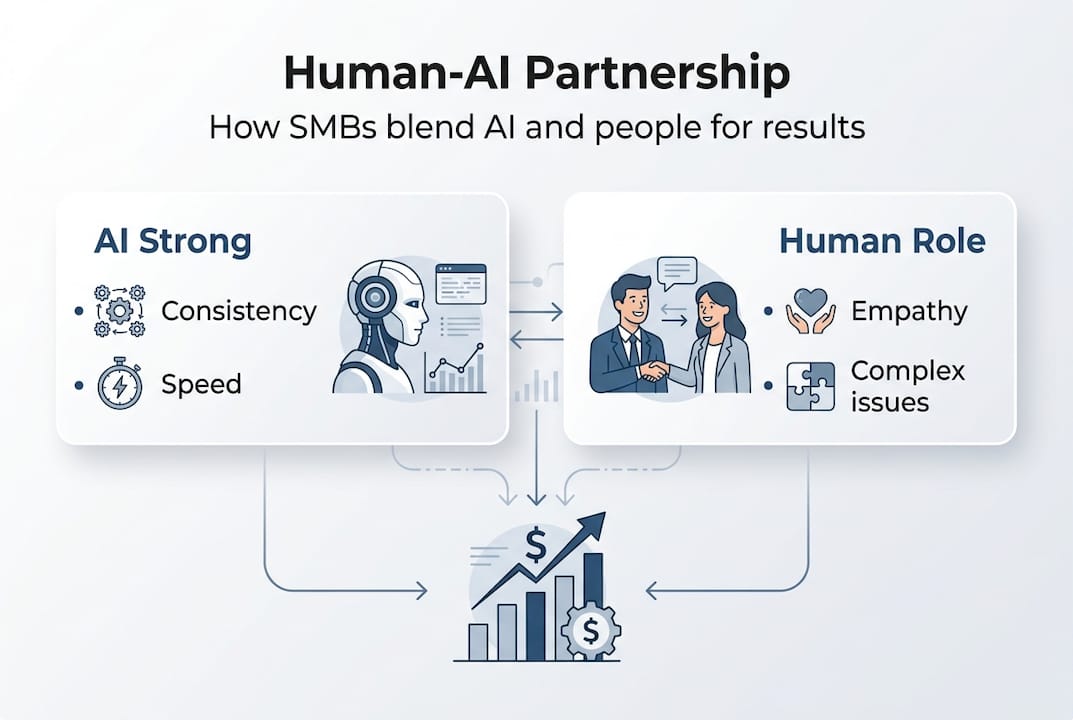
AI excels at processing large volumes of data, responding instantly, maintaining consistency across thousands of interactions, and identifying behavioral patterns that humans would miss. Humans excel at reading emotional subtext, navigating ambiguous situations, building genuine rapport, and resolving conflicts that require creative problem-solving. Neither operates at peak effectiveness without the other.
Hybrid models deliver best results in customer engagement, and the data supports this consistently. Even after automation is in place, 72% of consumers still demand access to a human agent. Ignoring this expectation is a fast path to customer attrition.
Building effective human-AI handoff workflows requires deliberate design. Key steps include:
- Map every customer journey to identify which touchpoints are safe to automate and which require human judgment.
- Set explicit escalation triggers based on sentiment signals, topic categories, and interaction duration.
- Train staff to receive AI handoffs with full context, so customers never have to repeat themselves.
- Review escalated interactions weekly to refine AI thresholds and reduce unnecessary handoffs over time.
- Communicate clearly to customers when they are speaking with AI and how to reach a human instantly.
The conversational AI and human collaboration model that works best treats AI as a capable first responder and humans as the specialists brought in when the situation demands it. This framing also makes it easier to get staff buy-in, since the AI is positioned as a tool that supports their work rather than replaces it.
Why most SMBs get AI for engagement wrong—and how to fix it
The most common mistake we see SMBs make is chasing full automation as the end goal. They deploy a chatbot, set it loose, and assume the work is done. It rarely is. Full hands-off automation is neither achievable nor desirable for customer engagement at the SMB level, where relationships and reputation are everything.
The businesses that see lasting results treat AI as a system that requires ongoing management. Edge cases multiply at scale, and without human-in-the-loop (HITL) oversight, weekly failure reviews, and clear red lines for high-stakes interactions like billing and security, the system degrades. Audit trails are not optional. They are how you catch problems before they become customer experience crises.
Many SMBs also over-trust vendor hype and under-invest in data quality and governance. An AI system is only as good as the information it is trained on. Businesses that prioritize clean data, transparent escalation rules, and routine review cycles consistently outperform those that prioritize feature count. Tracking measuring AI ROI through concrete metrics, not vanity stats, is what separates sustainable AI programs from expensive experiments. The future of SMB customer engagement is practical, well-integrated, and human-supported AI. Not hands-off bots.
How SimplyAI helps SMBs drive engagement with smarter AI
Putting these principles into practice requires more than good intentions. It requires the right infrastructure, the right expertise, and a partner who understands the specific pressures SMBs face. That is where SimplyAI comes in.
SimplyAI designs and implements AI automation solutions tailored to each business, from AI-powered chatbots and CRM automations to full AI agents for SMBs that handle complex multi-step workflows. Every engagement includes onboarding support, governance guidance, and access to AI training for staff so your team is equipped to manage and improve the system over time. If you are ready to move from strategy to measurable results, SimplyAI is built for exactly that.
Frequently asked questions
What is the fastest way to deploy AI for customer engagement in an SMB?
Start with AI chatbots or automated email for common queries, using your existing data for training to achieve meaningful ROI in 60 to 90 days. Quality data and knowledge bases are the single biggest factor in how quickly you see results.
What are the main risks of using AI for customer engagement?
AI struggles with complex emotional issues, can frustrate users with loops, and increases privacy risks, so always plan for human oversight and governance. Research confirms 72% of consumers worry about losing access to a human agent when AI is in place.
How do I know if my business is ready for AI in customer engagement?
If you handle repetitive customer interactions and have organized data, you are ready to see rapid gains from AI-driven solutions. With 70% of SMB leaders already optimistic about AI, the barrier to entry has never been lower.
Will my customers trust AI for engagement?
Consumer trust rises with transparency and the clear option to reach a human. 72% of consumers express concern when only bots are available, making human fallback a non-negotiable design element.
What's the best way to balance automation and human touch?
Set up escalation rules so high-stakes or emotional interactions always reach a human, while routine queries are automated. Hybrid models consistently outperform fully automated systems in both satisfaction scores and long-term retention.