

TL;DR:
- Most ecommerce managers primarily see AI as a content generator, but operational AI embeds decision-making intelligence into workflows. It automatically optimizes inventory, routing, support prioritization, and personalizes customer interactions by relying on connected, high-quality data. Implementing responsible governance and focusing on workflow integration are essential for sustaining AI’s value over time.
Most ecommerce managers think of AI as a content generator. Feed it a prompt, get a product description, done. But this ai in ecommerce guide exists to challenge that assumption directly. Operational AI, the kind that actually moves the needle, embeds intelligence into the decisions your business makes dozens of times per hour: which support ticket gets answered first, how inventory gets redistributed across warehouses, which product surfaces for which shopper at which moment. This guide walks you through that layer of AI, plus conversational automation, agentic commerce, and the governance frameworks that keep it all responsible.
Table of Contents
- Understanding operational AI: embedding intelligence in ecommerce workflows
- AI-powered customer interactions: chatbots, personalization, and real-time support automation
- Agentic commerce: AI agents as autonomous shoppers and new sales channels
- Implementing AI risk governance: lifecycle management and compliance frameworks
- Why operational AI integration and behavioral validation matter more than model hype
- How SimplyAI helps ecommerce managers harness AI automation and agents
- Frequently asked questions
Key Takeaways
| Point | Details |
|---|---|
| Operational AI automates workflows | Embedding AI into daily ecommerce operations helps businesses make faster, data-driven decisions in real time. |
| AI enhances customer interactions | Conversational AI and personalization reduce support costs and improve shopper satisfaction by resolving queries quickly. |
| Agentic commerce expands channels | AI shopping agents autonomously guide and complete purchases, creating new discovery and sales opportunities. |
| Risk governance is essential | Managing AI responsibly throughout its lifecycle protects customer trust and ensures regulatory compliance. |
| Integration and validation drive success | Focus on integrating AI tightly into operational workflows and validating performance against real customer behavior. |
Understanding operational AI: embedding intelligence in ecommerce workflows
The term "AI in ecommerce" gets stretched to cover everything from a spell-checker to a demand forecasting engine. The distinction that matters most for your operations is between generative AI and operational AI. Generative AI creates content: copy, images, email subject lines. Operational AI makes decisions inside live workflows, often without human input at each step. As Shopify describes it, "operational AI in ecommerce embeds intelligence directly into workflows to support or automate decisions in real time."
Think about what that looks like concretely. A customer submits a return request while a high-priority VIP query sits unresolved in the same queue. Operational AI reads both tickets, scores urgency against account value and issue complexity, and routes them accordingly. A flash sale drives unexpected demand in one product category. Operational AI detects the velocity shift, adjusts product ranking on the category page to promote in-stock variants, and flags low inventory to your warehouse management system. No manual intervention required.
For this to work reliably, the underlying data architecture matters enormously. Operational AI depends on clean, connected data across your catalog, inventory, CRM, and support systems. Without a unified source of truth, the AI makes decisions based on outdated or conflicting signals, and the results degrade fast. This is why optimizing ecommerce workflows with AI always starts with data integration, not model selection.
Humans still play a critical role. Automation executes the decisions AI triggers, but experienced operators define the rules, set the thresholds, and review outcomes at designated checkpoints. AI accelerates decision velocity; your team retains accountability.
Key operational AI applications in ecommerce:
- Support ticket prioritization based on customer lifetime value and issue severity
- Dynamic product ranking adjusted to real-time inventory and demand signals
- Order fulfillment routing optimized by carrier performance and regional stock levels
- Price adjustment triggers based on competitive signals and margin thresholds
- Churn risk scoring to flag at-risk accounts for proactive outreach
Pro Tip: Before selecting any AI tool, map the specific decisions in your workflow that are currently made manually and repeatedly. Those are your highest-ROI targets for operational AI deployment.
AI-powered customer interactions: chatbots, personalization, and real-time support automation
Customer interaction is where artificial intelligence in online retail becomes visible to the shopper. Done well, it feels invisible. Done poorly, it erodes trust faster than any other operational failure. The difference lies in how you design and connect your AI systems to live operational data.
Modern AI chatbots are far removed from the rule-based bots that frustrated shoppers a decade ago. Today's conversational AI uses hybrid retrieval and generative layers, meaning it can pull exact order data from your backend and generate a natural-language response in the same step. As research from Truly.cloud confirms, "conversational AI uses hybrid retrieval and generative layers with human escalation to handle ecommerce customer queries efficiently." The escalation part is not a fallback; it is a designed feature that protects customer trust when complexity exceeds the AI's reliable range.

Personalization in ecommerce has moved well beyond "customers who bought X also bought Y." The most effective systems combine three layers: collaborative filtering (what similar shoppers did), contextual signals (time of day, device type, browsing session behavior), and business rules (margin targets, overstock priorities). The result is a recommendation that feels genuinely relevant rather than algorithmically obvious.
How to design effective AI customer interaction flows:
- Identify your top five inbound customer intents, typically order status, returns, product questions, shipping estimates, and discount inquiries.
- Build AI flows trained specifically on your product catalog and support history for those five intents.
- Define clear escalation triggers: sentiment detection, unresolved loops, or explicit customer requests for a human.
- Feed chatbot intent data into your recommendation engine so that browsing and support behavior inform product suggestions.
- Implement dynamic bundling, where the AI surfaces complementary products based on what is currently in the customer's cart.
- Apply privacy-preserving personalization techniques such as on-device processing or differential privacy to protect customer data while maintaining relevance.
Real-time feedback loops are where AI customer engagement compounds its value. Every resolved query, abandoned bundle, or clicked recommendation trains the next iteration of your model. Over time, the system adapts to your specific customer base rather than a generic retail population. This is also why AI chatbot use cases in ecommerce consistently outperform generic deployments when the AI is trained on domain-specific data.
Pro Tip: Never deploy a chatbot that cannot access live order and inventory data. A bot that says "I'm not sure about your order status" is worse than no bot at all. Tight integration with your backend is the minimum viable requirement.
Agentic commerce: AI agents as autonomous shoppers and new sales channels
Agentic commerce represents the next seismic shift in how AI transforms ecommerce. Rather than assisting a human shopper, AI agents act on behalf of the shopper. They discover products, compare options, and complete purchases autonomously, often operating inside chat platforms or AI-native interfaces the customer already uses daily.
Shopify describes it clearly: "agentic shopping means AI agents autonomously shop for human buyers, maintaining merchant responsibility for customer relationships and post-purchase experience." That final clause matters enormously. When an AI agent places an order in your store, you still own the fulfillment, the returns process, and the relationship. The channel changes; the accountability does not.
For merchants, the practical preparation involves structured product data. AI agents rely on machine-readable catalog information to make accurate comparisons and purchase decisions. Solutions that syndicate your catalog in structured formats ensure that your products appear accurately across AI shopping platforms. Merchants can also configure whether AI agents can complete direct checkout or must hand off to a human-reviewed cart, giving you control over the experience quality at conversion.
Key agentic commerce platforms ecommerce managers should monitor:
- ChatGPT with shopping integrations for product discovery and purchase assistance
- Microsoft Copilot with retail-focused agent capabilities across Microsoft 365 environments
- Google AI Mode offering AI-driven product comparison and merchant-linked checkout
- Perplexity Shopping with real-time web retrieval and merchant data integration
Agentic commerce platform comparison:
| Platform | Discovery method | Checkout capability | Merchant control |
|---|---|---|---|
| ChatGPT Shopping | Catalog API and web retrieval | Partner-enabled direct checkout | Opt-in product feed configuration |
| Microsoft Copilot | Bing product index integration | Redirect to merchant cart | Product schema and feed control |
| Google AI Mode | Merchant Center data | Google-facilitated checkout | Merchant Center controls |
| Perplexity Shopping | Real-time web and structured feeds | Merchant redirect | Structured data and feed submission |
Agentic commerce reduces decision fatigue for customers dramatically, particularly for replenishment purchases or considered purchases in categories with high comparison complexity. For merchants, it expands discovery reach without requiring new storefronts or additional marketing spend. The AI agent use cases that deliver value fastest are those aligned with clear customer jobs: find the best price, reorder last month's items, or compare shipping options. Connect your AI integration examples to those specific use cases before broader deployment.
Implementing AI risk governance: lifecycle management and compliance frameworks
Deploying AI without a governance framework is the operational equivalent of running a warehouse without safety protocols. The risks are invisible until they are not. For ecommerce managers, AI risk management covers three intersecting areas: technical performance, regulatory compliance, and customer trust.
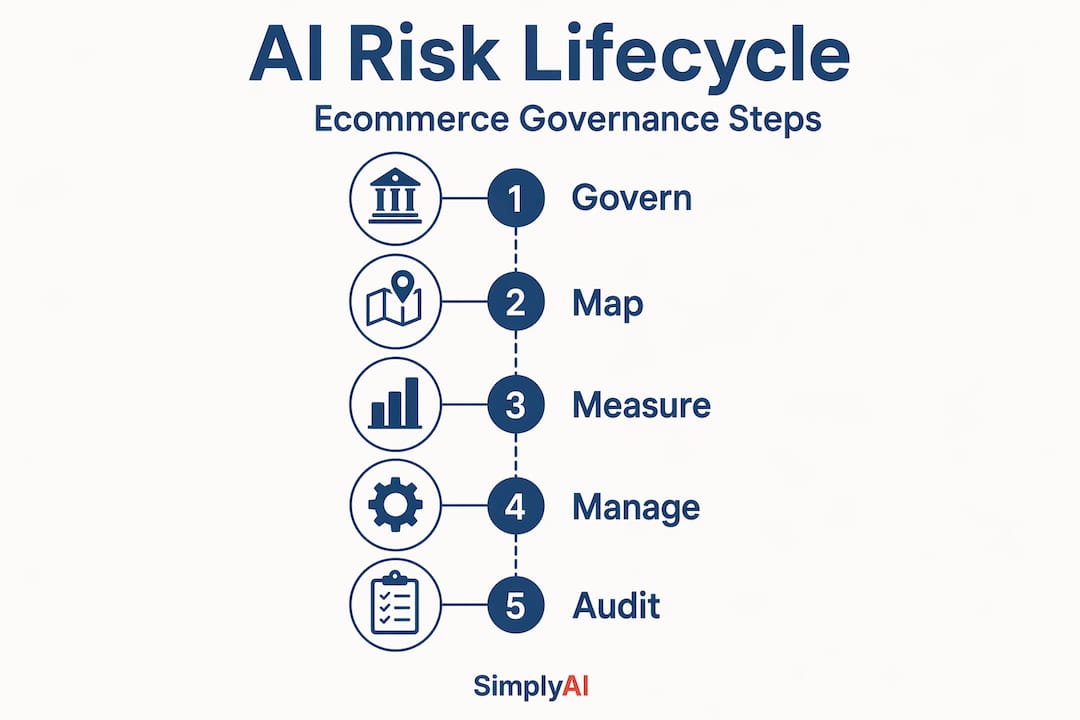
The NIST AI Risk Management Framework provides a lifecycle approach built around four core functions. Govern establishes the organizational culture, policies, and roles that make responsible AI possible. Map identifies context, risks, and potential impacts before deployment. Measure tests and monitors AI behavior against defined performance thresholds. Manage responds to identified risks and adapts systems accordingly. These are not one-time exercises. They run continuously across every AI system you operate.
GDPR adds a parallel obligation. Under GDPR, you must reassess the lawful basis for personal data processing at each stage of an AI system's lifecycle, and document that reassessment through Data Protection Impact Assessments for high-risk applications. If your AI personalization engine processes behavioral data to make inferences about purchase intent, that qualifies as a high-risk processing activity under most interpretations.
The European AI Act adds transparency requirements specifically relevant to customer-facing AI. Effective August 2026, systems that interact with consumers must disclose that the customer is engaging with an AI. This applies directly to chatbots and AI shopping assistants in your store.
NIST AI RMF functions applied to ecommerce:
| NIST function | Focus area | Ecommerce application example |
|---|---|---|
| Govern | Policies, roles, accountability | Assign AI system owners for chatbot, recommendation, and pricing tools |
| Map | Risk identification, context analysis | Document data inputs, decision points, and potential failure modes per system |
| Measure | Testing, monitoring, benchmarking | Track chatbot resolution rates, recommendation click-through, and escalation frequency |
| Manage | Response, adaptation, decommissioning | Define rollback procedures and retraining triggers when performance drops |
Pro Tip: Treat your AI governance documentation as a living operational record, not a compliance checkbox. Auditors and regulators increasingly expect evidence of continuous monitoring, not a one-time risk assessment completed at launch.
The predictive analytics and risk management frameworks that apply to other areas of your business translate directly to AI governance. The discipline is the same: define what good looks like, measure against it, and respond when you drift.
Why operational AI integration and behavioral validation matter more than model hype
There is a persistent belief in ecommerce circles that the path to AI advantage runs through model selection. Find the most powerful large language model, deploy it, watch results improve. This framing is understandable, but it consistently leads to disappointing outcomes because it prioritizes the technology over the workflow integration that determines whether any technology delivers value.
Measurable AI value comes from "defining specific workflow decisions automated and validating AI against real consumer behavior at scale." That validation requirement is where most deployments fall short. Scripted test scenarios run by internal teams do not replicate the variability of real customer behavior across different devices, intent states, and seasonal contexts. Validation must be designed to expose edge cases, not confirm expected behavior.
Traditional A/B testing also carries underappreciated risk when applied to AI agents that influence customer trust. A chatbot that handles 90% of queries well but catastrophically mishandles the remaining 10% can do lasting brand damage before a statistically significant test reaches confidence. The smarter approach is staged rollout with real-time behavioral monitoring and clear rollback thresholds defined in advance.
Continuous lifecycle governance, following the NIST AI RMF structure, is what separates organizations that sustain AI performance from those that see initial gains erode over six to twelve months. Models drift as customer behavior shifts. Catalog changes create gaps in chatbot knowledge. New product lines introduce inventory patterns the demand forecasting model was not trained on. Governance frameworks catch these issues systematically.
The operational discipline required here is the same discipline that makes workflow-driven AI optimization work: tight integration between AI outputs and the systems that act on them. A recommendation engine disconnected from live inventory will confidently suggest out-of-stock products. A support chatbot without access to your returns portal will create more frustration than it resolves. Integration is not an implementation detail. It is the entire point.
How SimplyAI helps ecommerce managers harness AI automation and agents
If this guide has clarified where AI's real operational value lives, the natural next question is how to actually build and deploy it without disrupting your existing stack or requiring a team of machine learning engineers.
SimplyAI designs and implements AI automations for ecommerce that embed directly into your existing workflows, connecting your catalog, CRM, support systems, and fulfillment operations without costly platform overhauls. For merchants preparing for agentic commerce, SimplyAI's AI agents solutions deliver autonomous shopping assistants configured to your product data and business rules, giving you a presence on emerging AI-driven sales channels with full control over the customer experience. And because governance matters, SimplyAI offers AI corporate education to help your team build the literacy and frameworks, including NIST AI RMF alignment, needed to manage AI responsibly at every stage of its lifecycle.
Frequently asked questions
What is operational AI in ecommerce?
Operational AI embeds intelligence directly into ecommerce workflows to automate real-time decisions like inventory management, support ticket prioritization, and dynamic product ranking. It differs from generative AI, which creates content rather than driving workflow decisions.
How do AI chatbots improve ecommerce customer service?
AI chatbots handle routine queries efficiently using hybrid conversational designs with escalation to human agents for quality control, while simultaneously feeding intent data into recommendation engines to personalize the shopping experience.
What is agentic commerce and how does it affect ecommerce stores?
Agentic commerce allows AI agents to shop autonomously on behalf of customers, comparing products and completing purchases, while merchants retain full responsibility for fulfillment, returns, and the post-purchase customer relationship.
How can I manage AI-related risks in my ecommerce business?
Apply the NIST AI RMF lifecycle approach covering Govern, Map, Measure, and Manage functions continuously across all deployed AI systems, while maintaining GDPR documentation and preparing for EU AI Act transparency requirements effective August 2026.