

TL;DR:
- AI-driven marketing automation enhances timely, personalized engagement, replacing manual follow-ups.
- Building, reviewing, and optimizing workflows consistently improves engagement metrics and revenue.
- Ongoing human oversight and disciplined audits are essential for maintaining effective automation.
Picture this: a prospective customer fills out your contact form at 9 PM on a Friday. By Monday morning, three competitors have already followed up, and your lead has gone cold. This scenario plays out daily for small and medium-sized businesses that rely on manual marketing processes. The good news is that AI-driven marketing automation workflows eliminate this problem entirely, replacing reactive, error-prone follow-ups with precise, timely, personalized engagement. In the sections ahead, you will find a practical, step-by-step guide to building, launching, and continuously improving automation workflows that genuinely move the needle.
Table of Contents
- Understanding marketing automation workflows
- Preparation: What you need to get started
- How to build your first AI marketing automation workflow
- Avoiding common mistakes in marketing automation
- Measuring and optimizing your automated workflows
- Why most guides get SMB marketing automation wrong
- Ready to put automation to work for your business?
- Frequently asked questions
Key Takeaways
| Point | Details |
|---|---|
| Start with high-impact workflows | Prioritize automating lead nurture, onboarding, and cart recovery for the biggest gains. |
| AI boosts efficiency | Personalization, predictive scoring, and smart triggers help drive better results with less manual effort. |
| Continuous review is key | Quarterly audits and regular testing keep your automation effective and aligned with business goals. |
| Avoid common pitfalls | Neglecting segmentation and workflow maintenance leads to declining engagement and wasted effort. |
Understanding marketing automation workflows
A marketing automation workflow is a structured sequence of automated actions triggered by a specific customer event or behavior. When a visitor subscribes to your newsletter, downloads a resource, or abandons a shopping cart, the workflow fires immediately, delivering the right message at the right moment without any manual intervention.
The architecture most SMBs use follows what practitioners call a trigger-action-feedback loop: an event such as a form submission or a purchase triggers automated actions like email sends, lead scoring updates, or internal notifications, and performance data from those actions feeds back into the system for optimization. This structure is elegant because it turns customer behavior into a reliable signal rather than a missed opportunity.
Consider three workflows that deliver immediate value for small businesses. First, an onboarding sequence that greets new customers with a warm welcome email, followed by a product tutorial on day three and a check-in message on day seven. Second, a cart recovery workflow that sends a personalized reminder within one hour of abandonment, then a discount incentive 24 hours later if the cart remains unconverted. Third, a lead nurture sequence that delivers educational content over two weeks, gradually building trust until a prospect is ready to speak with your sales team.
Businesses that apply continuous optimization in automation consistently outperform those that treat workflows as static configurations. The performance gap compounds over time, making early investment in well-structured workflows a genuine competitive advantage.
"Marketing automation is not about removing the human touch. It's about ensuring every human touch happens at exactly the right moment, with exactly the right message."
Pairing these workflows with data-driven marketing strategies amplifies results further, since every automated action generates behavioral data that sharpens your audience understanding.
| Workflow type | Primary trigger | Key benefit |
|---|---|---|
| Welcome sequence | Newsletter signup | Immediate brand impression |
| Lead nurture | Content download | Trust-building over time |
| Cart recovery | Abandoned cart event | Revenue recovery |
| Re-engagement | 90-day inactivity | List health and retention |
Preparation: What you need to get started
Building on the concept of automation workflows, let's look at what it takes to launch your first automated campaigns. Preparation determines whether your automation delivers consistent results or creates more problems than it solves.
Start with a data readiness audit. Your automation platform is only as effective as the contact data feeding it. Check that your CRM or email list contains clean, correctly segmented records with fields like industry, purchase history, and engagement status. Without these data points, your triggers will misfire and your personalization will feel hollow.
Next, prioritize which workflows to build first. A proven small business automation methodology recommends starting with your highest-impact bottleneck, whether that is slow lead response, poor onboarding completion, or abandoned cart recovery, and proving the process manually before automating it. This approach prevents you from automating a broken process and accelerating poor results.
The toolkit landscape for SMBs is robust and accessible. Mailchimp remains the friendliest starting point for email-focused automation. ActiveCampaign provides deeper behavioral triggers and lead scoring at a cost-effective price point. HubSpot suits businesses that need CRM-integrated automation with room to scale into enterprise territory. Zapier serves as a critical connective layer, linking your marketing platform to your CRM, ecommerce store, and customer support tools without requiring custom development.
Pro Tip: Before selecting a platform, map your three most important workflows on paper first. Then evaluate tools based on whether they support those specific trigger types natively, rather than being swayed by feature lists you may never use.
Plan your rollout in phases. In phase one, pilot a single workflow, typically a welcome or lead nurture sequence, measure it for 30 days, and establish baseline KPIs. In phase two, expand to cross-channel workflows that span email, SMS, and retargeting. In phase three, integrate automation with your sales team's CRM so that marketing-qualified leads flow directly into sales pipelines.
KPIs to track from day one include email open rates, click-through rates, lead-to-customer conversion rates, and time-to-first-response for new inquiries. These metrics tell you whether your workflows are performing or need refinement long before you feel the impact on revenue. Exploring AI-powered business strategies alongside your automation setup accelerates this preparation phase significantly.
How to build your first AI marketing automation workflow
With tools and KPIs in place, you are ready to build workflows that make an immediate impact. The build process follows a repeatable sequence that works whether you are creating a simple welcome series or a sophisticated multi-stage lead nurture campaign.
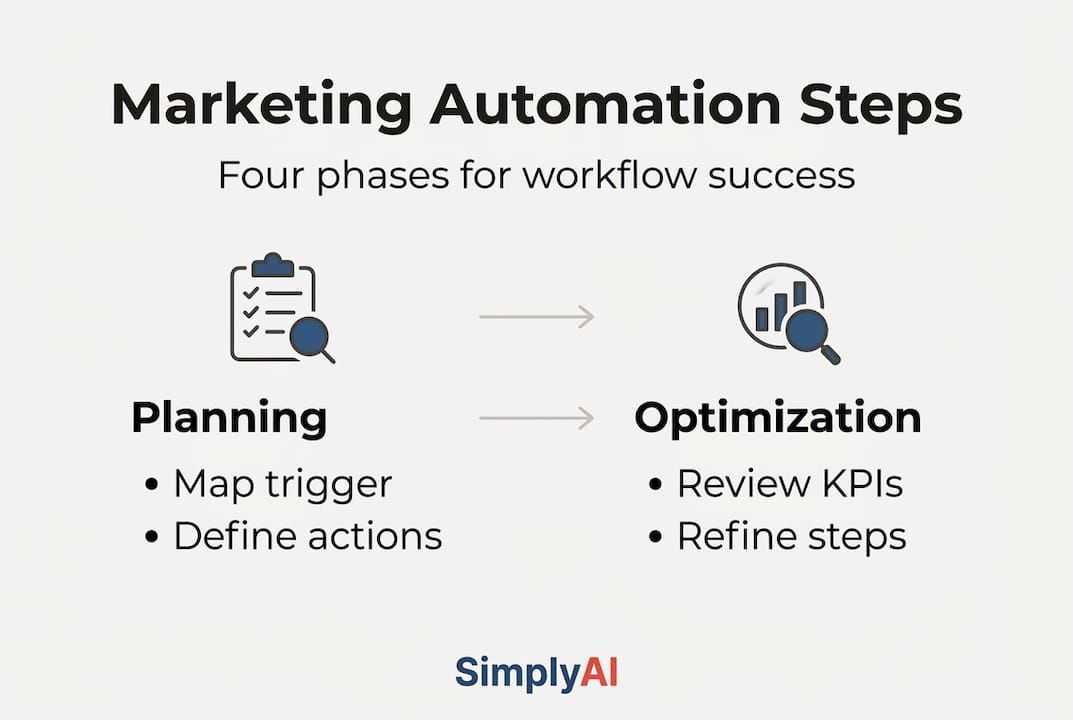
Step 1: Map your trigger. Define the precise customer action that starts the workflow. Examples include submitting a contact form, clicking a specific link, making a first purchase, or reaching a lead score threshold. Be specific: "submitted the contact form on the pricing page" is far more actionable than "visited the website."
Step 2: Define your automated actions. List every action the system should take in sequence. This could be sending an email at T+0, updating a CRM field at T+1 hour, notifying a sales rep at T+24 hours, and sending a follow-up email at T+72 hours if no response has been recorded.
Step 3: Insert human approval checkpoints. Not every action should fire without human review. For high-value prospects, build in a notification that pauses the sequence and asks a sales rep to approve personalized outreach before it sends. This preserves the warmth of human contact where it matters most.
Step 4: Close the feedback loop. Connect your workflow's performance data back to your planning process. If the T+72 email shows a 10% open rate while industry benchmarks sit at 39%, that is a clear signal to test a new subject line or send time.
AI integration transforms these workflows from rule-based sequences into adaptive systems. AI-driven enhancements include predictive lead scoring, dynamic content personalization, send-time optimization, and agent-based decisioning that replaces rigid if-then logic with probabilistic judgment. In practical terms, this means your workflow can identify that a particular lead resembles your highest-value customer segment and automatically escalate them to a priority nurture track.
Studying proven AI marketing tips alongside your build process reveals nuances that most first-time builders miss, such as the importance of content variety across workflow stages. Equally, referencing a structured workflow optimization guide ensures you are not reinventing approaches that are already tested and documented.
Statistic: Well-maintained automated workflows increase email open and click rates by 15 to 25% compared to manually sent broadcast campaigns, making the investment in proper workflow construction clearly worthwhile.
Avoiding common mistakes in marketing automation
After building your workflow, it is critical to sidestep the mistakes that can undermine your success. Even well-intentioned automation configurations decay over time if they are not actively managed.
The most consequential mistake is building without segmentation or behavior-based triggers. Sending the same message to every contact regardless of their behavior produces irrelevant communication that damages trust and increases unsubscribe rates. Building without segmentation or behavior triggers leads to irrelevance: behavior-led automation consistently outperforms time-based automation because it responds to what customers actually do rather than when they joined your list.
Suppression lists are an underused tool that prevents disengaged contacts from receiving messages that will never convert them. If a contact has not opened any email in six months, continuing to send them weekly campaigns hurts your sender reputation and inflates your list size without adding value.
Common automation errors include forgetting filters that prevent duplicate messages or overwritten tracking parameters, operating without human oversight which can allow thin or irrelevant content to flood customer inboxes, creating notification overload with more than 300 internal alerts per week, and allowing workflows to run unmaintained as performance typically degays 30 to 40% within 12 months.
The solution to most of these pitfalls follows a straightforward framework. Review every workflow entry condition and exit condition quarterly. Confirm that filters preventing duplicate enrollment are still functioning correctly. Check that suppression lists include all contacts who have unsubscribed, bounced, or explicitly opted out of specific content types. Pair this with thoughtful customer segmentation with AI to ensure your audience definitions remain relevant as your business evolves.
"Automation amplifies whatever process it is built on. If the underlying process is poorly designed, automation simply delivers poor results faster and at greater scale."
Human oversight is not a sign that your automation is failing. It is a sign that your team understands the limits of any system and chooses to protect customer relationships at decision points where nuance matters most. Build review checkpoints into your calendar rather than waiting until a problem surfaces in your metrics.
Measuring and optimizing your automated workflows
Once your automations are live and running, ongoing assessment is what turns good results into great ones. Measurement is not a one-time activity. It is a continuous practice that keeps your workflows accurate, relevant, and effective as market conditions shift.

Industry benchmarks give you a baseline for evaluating your performance. ActiveCampaign's 2025 data shows an average email open rate of 39.26% and an average click rate of 6.21% across all industries. However, performance varies meaningfully by sector: media companies average a 43.16% open rate and 7.32% click rate, while ecommerce sits at 35.66% open and 5.07% click. Knowing your industry benchmark prevents you from celebrating mediocre performance or panicking over numbers that are actually normal for your sector.
| Industry | Average open rate | Average click rate |
|---|---|---|
| Media | 43.16% | 7.32% |
| All industries (avg) | 39.26% | 6.21% |
| Ecommerce | 35.66% | 5.07% |
Continuous improvement requires a systematic testing approach. Run A/B tests on subject lines, email copy length, call-to-action placement, and send times. Test one variable at a time so that results are attributable to a specific change. Rotate winning variants into production, then immediately begin testing the next hypothesis.
A quarterly workflow review should follow this sequence. First, pull performance data for every active workflow. Second, identify the bottom 20% of workflows by click rate and either pause or rebuild them. Third, analyze the top performers for patterns you can replicate elsewhere. Fourth, document what changed and why, creating an institutional record that survives team turnover.
Continuous optimization principles confirm that success in automation requires data readiness, scalable design, and active refinement. Treating any workflow as permanent is a path to declining results. The businesses that win are those that revisit their automation architecture regularly, approaching it with the same discipline they apply to product development or financial planning. Making informed decisions through data-driven AI methodologies provides a structured framework for these quarterly reviews.
Pruning underperforming flows is just as valuable as building new ones. A cluttered automation system becomes harder to audit, more prone to conflicts between overlapping workflows, and more expensive to maintain. Simplicity in your automation architecture is a strategic asset, not a limitation.
Why most guides get SMB marketing automation wrong
Most articles about marketing automation focus overwhelmingly on tools and templates. They recommend platforms, list workflow types, and describe trigger configurations as if selecting the right software is the primary challenge. It is not.
The central challenge is discipline. The temptation to configure a workflow and move on is almost irresistible, especially for resource-constrained SMB teams. Yet automation without ongoing audits amplifies bad processes rather than fixing them: a tool-agnostic workflow built on clear logic will outperform a sophisticated platform running on faulty assumptions every single time.
Human oversight and regular iteration matter more than any tool feature. The businesses that achieve dramatic results from automation are not the ones with the most advanced software. They are the ones that treat their workflows as living systems, reviewing performance data monthly, pruning outdated sequences, and testing new approaches systematically. Real ROI comes from workflow quality, not automation volume. Scaling ten excellent workflows produces far more value than maintaining fifty mediocre ones. Examining how marketing efficiency through AI is actually achieved reinforces this point: the organizations that benefit most are those that combine AI tools with rigorous human review, never one without the other.
Ready to put automation to work for your business?
Understanding the principles of marketing automation is one thing. Implementing them effectively within the constraints of a growing business is another challenge entirely. That is where expert support makes a measurable difference.
SimplyAI designs and deploys AI workflow automation tailored to your business's specific triggers, customer segments, and growth goals. From your first welcome sequence to advanced multi-channel nurture campaigns, our team builds automation architectures that perform from day one and improve over time. Our AI agents for marketing handle personalization, lead scoring, and behavioral routing autonomously, so your team focuses on strategy rather than manual follow-up. When you are ready to automate smarter, SimplyAI is the partner that turns these frameworks into measurable business results.
Frequently asked questions
What is a marketing automation workflow?
A marketing automation workflow is an automated process where software triggers and executes marketing actions based on customer behavior or events, following a trigger-action-feedback structure that enables efficient, personalized engagement without manual intervention.
Which marketing automation tool is best for small businesses?
ActiveCampaign suits SMBs needing automation depth at a lower cost, Mailchimp works well for beginners, and HubSpot fits teams that need CRM-integrated growth at an enterprise-ready scale.
How can I make sure my automation workflow stays effective over time?
Review performance quarterly, audit for filter errors and suppression list accuracy, and update workflow logic regularly, since performance degrades without review and even strong workflows lose effectiveness when left unattended.
What common mistakes should I avoid when setting up automation?
Avoid ignoring behavioral segmentation, skipping filters that prevent duplicate sends, and neglecting periodic audits, as unmaintained flows decay 30 to 40% in performance within 12 months.
What kind of performance boost can SMBs expect from automation?
SMBs consistently see engagement rates increase 15 to 25% when well-maintained automated workflows replace manual broadcast campaigns, with results improving further as workflows are optimized over time.