

TL;DR:
- Most SMBs have scattered customer data that hinders actionable insights and growth opportunities.
- A structured analysis process, starting with data auditing and clear questions, transforms signals into decisions.
- Prioritizing identity resolution and implementing AI automations enhances data quality, efficiency, and customer personalization.
Most small and mid-sized businesses are sitting on a gold mine of customer data and doing almost nothing useful with it. Purchase histories live in one system, website behavior in another, support tickets somewhere else entirely. The result is a fragmented picture that makes it nearly impossible to answer even basic questions like "which customers are about to churn?" or "what triggered our last revenue spike?" A structured customer data analysis process changes that entirely, turning scattered signals into decisions that drive measurable growth. This guide covers every critical phase, from preparation and execution to validation and activation.
Table of Contents
- Preparing for the customer data analysis process
- Executing the customer data analysis process step-by-step
- Avoiding common pitfalls and troubleshooting your data analysis workflow
- Verifying and actioning customer insights for business growth
- A practical take: Why SMBs should focus on identity resolution first and iterate analytics
- How SimplyAI empowers your customer data analysis with AI-driven automations
- Frequently asked questions
Key Takeaways
| Point | Details |
|---|---|
| Prepare before analysis | Audit your data and define specific questions to ensure focused and effective customer analysis. |
| Follow structured steps | Use a step-by-step workflow from data collection to insight activation for reliable, actionable outcomes. |
| Prioritize data cleaning | Spend sufficient time cleaning data to avoid inaccuracies and poor decision-making. |
| Resolve customer identity | Build unified profiles to enable consistent personalization and accurate segmentation. |
| Translate insights into action | Turn data patterns and feedback into concrete business decisions for growth and engagement. |
Preparing for the customer data analysis process
Before you write a single query or open a dashboard, preparation determines whether your analysis will produce trustworthy insights or just confident-looking noise. Most SMBs skip this phase and pay for it later with metrics they cannot act on.
Start with a full audit of your existing first-party customer data. First-party data is information you collect directly from your customers through your own channels, such as your website, CRM, email platform, and point-of-sale system. Map out every source, assess data quality, and identify gaps. You may find that your CRM has email addresses but no purchase history, or that your web analytics tool is firing duplicate events. Knowing your starting point is not optional; it is the foundation everything else depends on.
Next, define specific analytical questions before you touch any data. Vague objectives like "understand our customers better" produce vague outputs. Strong analytical questions sound like "which customer segments have the highest 90-day repeat purchase rate?" or "at what point in the checkout flow do mobile users drop off most?" The question shapes the entire analysis.
Once your questions are defined, build a tracking plan. A tracking plan acts as a blueprint for measurement, linking business goals to key user actions to track, and it is critical for SMB web analytics success. Think of it as your measurement contract: it specifies which events matter, what properties to capture with each event, and which business goal each event supports.
A useful tracking plan for an SMB e-commerce business might look like this:
| Business goal | Event to track | Key properties |
|---|---|---|
| Increase purchases | Purchase completed | Product ID, revenue, customer ID |
| Reduce cart abandonment | Cart abandoned | Cart value, items count, user segment |
| Grow email list | Form submitted | Form type, page URL, source channel |
| Improve support efficiency | Support ticket opened | Issue category, customer tier |
Quality matters far more than quantity here. Tracking 15 high-impact events cleanly outperforms tracking 80 events with inconsistent naming conventions and missing properties. The signal-to-noise ratio in your data directly affects the quality of every insight downstream.
Pro Tip: Before finalizing your tracking plan, run it by the team members who will actually use the insights, such as your marketing manager or sales lead. If they cannot immediately connect an event to a business decision, that event probably does not belong in the plan yet.
With these foundational preparations in place, you are ready to move into the core execution phases of the customer data analysis process.
Executing the customer data analysis process step-by-step
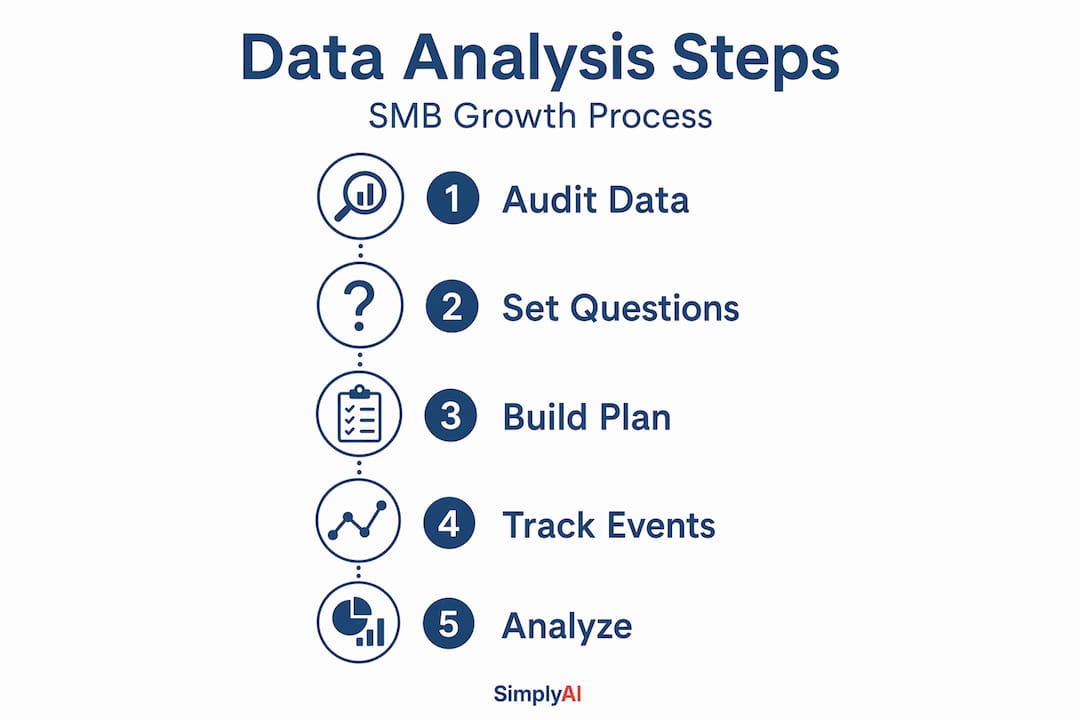
Good preparation makes execution far less chaotic. The customer analytics process typically follows an end-to-end workflow covering data collection, integration and unification, enrichment, analytics and modeling, and finally insight activation. Each phase builds on the last, and cutting corners at any stage compounds errors forward.
Here is the full execution sequence:
-
Collect data from every relevant touchpoint. Pull from your CRM, website analytics, transaction records, email engagement data, and customer support logs. The goal is not exhaustiveness for its own sake, but coverage of the channels that matter most to your specific business model.
-
Integrate and unify customer identities. This is where most SMBs lose significant ground. When a customer visits your site anonymously, then creates an account, then calls support, those three interactions often live as three separate records. Identity resolution stitches them into a single customer profile by matching on shared identifiers like email address, phone number, or a device fingerprint. Without this step, you are analyzing three imaginary customers instead of one real one.
-
Clean and prepare the data. Data cleaning can consume 60 to 80% of project time, but it is essential to avoid flawed conclusions. This includes removing duplicate records, standardizing date formats, fixing misspelled product categories, and flagging null values that could distort aggregate calculations.
-
Apply analytics in the right sequence. Begin with descriptive analytics, which tells you what happened, such as total revenue by segment last quarter. Then move to diagnostic analytics to understand why it happened, for example identifying that a revenue dip coincided with a shipping delay. Only after you understand your baseline patterns does it make sense to invest in predictive analytics models that forecast future behavior.
-
Activate insights through decision systems. Analysis without action is just reporting. Build dashboards that surface key metrics daily, set automated alerts for anomalies, and connect your findings to marketing automation workflows so that insights drive personalized campaigns in near real time.
The table below compares a reactive analytics approach, which many SMBs default to, against a proactive, structured one:
| Dimension | Reactive analytics | Structured process |
|---|---|---|
| Data freshness | Pulled on demand, often stale | Automated ingestion, near real-time |
| Identity accuracy | Fragmented profiles | Unified customer view |
| Analysis depth | Descriptive only | Descriptive, diagnostic, predictive |
| Business impact | Lagging decisions | Proactive, growth-driving actions |
Pro Tip: When running your first predictive model, test it against a holdout segment of customers the model has never seen. If it performs well on training data but poorly on the holdout group, the model is overfitting to noise rather than learning genuine patterns.
Having prepared well, following these execution steps ensures your data analysis is reliable and leads to actionable insights.
Avoiding common pitfalls and troubleshooting your data analysis workflow
Even well-intentioned analysis workflows break down in predictable ways. Understanding these failure modes before they occur is far cheaper than diagnosing them after you have already acted on bad data.
The most damaging pitfall is fragmented customer identity. If your identity resolution setup does not account for customers who use multiple email addresses or switch between mobile and desktop, you will build segments on incomplete profiles. This cascades into personalization errors and skewed lifetime value calculations.
"Skipping or rushing data cleaning often leads to unreliable conclusions and wasted effort later." This is not a minor inconvenience. It means campaigns built on that analysis will underperform, and the business may draw the wrong strategic conclusions from the results.
A second major risk is inconsistent KPI definitions across teams. When your marketing team defines "active customer" as anyone who opened an email in the last 90 days, but your product team defines it as anyone who logged in during the last 30 days, your joint analyses will never agree. Align on shared definitions before any cross-functional reporting begins.
Here are the most common issues to watch for and how to address them:
- Missing event data: Validate your tracking implementation monthly using tag auditing tools. A single misconfigured trigger can silently drop data for weeks before anyone notices.
- Inflated session counts: Check for bot traffic and internal team sessions being counted as customer behavior. Filter known IP ranges and use bot detection middleware.
- Stale segments: Customer behavior shifts over time. Refresh your segmentation logic at least quarterly to account for lifecycle changes, such as loyal customers who have lapsed.
- Privacy compliance gaps: GDPR and CCPA requirements affect what data you can collect and retain. Implement a consent management platform (CMP) and run PII (personally identifiable information) detection scans on your data warehouse regularly.
Investing in data quality practices upfront reduces the investigative work required later and preserves the credibility of your analytics program with leadership.
Understanding potential challenges helps you safeguard your analysis process and preserve the integrity of your insights.
Verifying and actioning customer insights for business growth
Raw insights sitting in a spreadsheet do not grow revenue. The final phase of a strong customer data analysis process is translating validated findings into decisions, and then tracking whether those decisions worked.
Follow this sequence to move from insight to impact:
-
Consolidate quantitative and qualitative signals. Behavioral data tells you what customers did. Survey responses and support transcripts tell you why. Combining both creates themes you can act on with confidence. For example, if your data shows high cart abandonment on mobile and your support tickets mention confusion about shipping costs, you have a clear, validated problem to solve.
-
Quantify every insight you plan to act on. Vague insights produce vague actions. "Mobile checkout is underperforming" becomes actionable when you can state that "mobile checkout conversion is 2.3% versus 5.1% on desktop, representing an estimated $18,000 in monthly lost revenue." That framing secures budget and prioritization.
-
Build a prioritized insight roadmap. Not every finding deserves immediate action. Rank insights by potential revenue impact and implementation complexity. High-impact, low-complexity changes ship first.
-
Implement dashboards for ongoing monitoring. The customer insights analysis cycle does not end when you ship a change. Set up dashboards that track the specific metrics your intervention targeted, with alert thresholds that notify you when performance moves outside expected ranges.
-
Measure against defined success metrics. Every action taken on an insight should have a corresponding success metric defined in advance. Did the simplified mobile checkout flow increase mobile conversion by at least 15%? Measuring this closes the loop and builds the case for continued investment in data-driven decision-making.
Customer insight analysis should end with translating signals into decisions and actions that drive revenue and growth. The businesses that treat this as a continuous loop rather than a one-time project consistently outperform those that treat analytics as an occasional report.
A practical take: Why SMBs should focus on identity resolution first and iterate analytics

Here is an uncomfortable truth that most analytics guides avoid: the majority of SMBs who invest in advanced analytics before fixing their identity resolution do not get better insights. They get faster access to wrong answers.
Identity resolution is often treated as a foundation for personalization and segmentation logic, and without it, customer experience becomes fragmented. But beyond personalization, broken identity fundamentally corrupts your churn models, lifetime value calculations, and cohort analyses. A customer who is counted as three separate users will appear to have one-third the value they actually represent.
The practical recommendation is to treat identity resolution not as a backend infrastructure task assigned to engineering, but as the first analytical priority your business resolves. It is the precondition for every meaningful customer behavior analysis process that follows.
After identity is stable, resist the urge to build predictive models immediately. Start with descriptive and diagnostic analytics to establish a factual baseline about your customers. Who are they? What do they buy? When do they disengage? Only after you understand these patterns does predictive modeling deliver genuine returns rather than sophisticated guesswork. Iterate your analytics maturity deliberately, anchored to stable measurement and refreshed segmentation cadence aligned to your customer lifecycle.
How SimplyAI empowers your customer data analysis with AI-driven automations
Knowing the steps in customer data evaluation is one thing. Having the systems to execute them at scale, without hiring an army of analysts, is another challenge entirely. That is where purpose-built AI makes the difference for SMBs operating with lean teams and real growth ambitions.
SimplyAI designs and implements AI automations that handle data collection, integration, and insight activation automatically, so your team spends less time wrangling spreadsheets and more time acting on findings. Our AI agents engage customers in real time, personalized by unified customer data, driving better experiences and higher conversion rates without manual intervention. From CRM automation to predictive campaign triggers, SimplyAI builds practical AI solutions calibrated to SMB workflows and budgets, delivering measurable results from day one.
Frequently asked questions
What is the first step in a customer data analysis process?
The first step is defining a clear analytical question tied to a specific business objective, because every analysis begins with a clearly scoped question, not a dataset. Without this, data collection and analysis lack direction and rarely produce actionable outcomes.
Why is data cleaning so important in customer data analysis?
Data cleaning prevents flawed conclusions by fixing errors, removing duplicates, and standardizing formats across your dataset. Skipping data cleaning can lead to unreliable conclusions and consumes 60 to 80% of project time when addressed reactively rather than proactively.
How does identity resolution improve customer analysis and personalization?
Identity resolution connects customer identifiers across all channels into a single, unified profile, enabling consistent personalization and accurate segmentation. Without it, customer experience becomes fragmented and critical metrics like lifetime value are significantly understated.
What are common customer events small businesses should track?
Small businesses typically track form submissions, button clicks, purchases, and booking completions as part of their customer behavior analysis process. A well-structured tracking plan maps each of these events directly to a measurable business goal, ensuring that every data point collected has a clear purpose.