

TL;DR:
- AI-driven segmentation dynamically updates customer groups based on behavior and transaction data.
- It improves marketing efficiency, customer retention, and personalization at scale for SMBs.
- Proper data quality, human oversight, and cautious implementation are essential to avoid risks.
Most small and medium-sized businesses today still rely on segmentation that was built for a different era. Grouping customers by age, zip code, or purchase category might have worked when data was scarce, but it consistently fails to capture how real buying behavior actually unfolds. AI-driven customer segmentation changes the equation entirely. Using machine learning algorithms like clustering, predictive analytics, and natural language processing, these systems group customers dynamically based on behavior, intent, and transaction history. This guide breaks down what AI segmentation means in practice, how the mechanics work, and what concrete steps you can take to apply it in your business today.
Table of Contents
- What is AI-powered customer segmentation?
- How AI-driven segmentation works for SMBs
- The real-world benefits for your business
- Pitfalls, risks, and how to avoid them
- Why the real AI edge is smarter human decisions, not just smarter machines
- Ready to unlock the power of AI for your business?
- Frequently asked questions
Key Takeaways
| Point | Details |
|---|---|
| Dynamic grouping advantage | AI segments adapt to real-time behavior for smarter marketing decisions. |
| SMBs can start today | User-friendly tools on platforms like Shopify and HubSpot make adoption simple. |
| Balance tech and human input | The best results come from blending AI insights with business intuition and ongoing monitoring. |
| Beware common pitfalls | Watch out for poor data quality, privacy issues, and relying too heavily on 'black-box' algorithms. |
What is AI-powered customer segmentation?
Traditional segmentation has always had a fundamental flaw: it freezes customers in place. When you manually assign someone to a "35 to 44, suburban, mid-income" bucket, that label stays until someone on your team decides to revisit it, which often means months or years of drift between the label and reality. AI-powered customer segmentation solves this by treating customer data as a living, continuous stream rather than a static snapshot.
At its core, AI segmentation groups customers dynamically using behavioral, predictive, and transactional data. Machine learning models scan patterns across thousands of interactions, identify clusters of similar behavior, and update those clusters automatically as new data arrives. A customer who bought once six months ago and has since opened three promotional emails and browsed product pages twice this week looks very different to an AI model than to a static demographic filter.
The contrast with traditional methods is stark:
| Factor | Traditional segmentation | AI-powered segmentation |
|---|---|---|
| Data type | Demographics, manual tags | Behavioral, transactional, predictive |
| Update frequency | Manual, infrequent | Automatic, real-time |
| Personalization depth | Broad categories | Individual-level precision |
| Scalability | Limited by team capacity | Scales with data volume |
| Actionability | Slow, campaign-by-campaign | Immediate, dynamic triggers |
What makes this especially relevant for SMBs is that the technology is no longer reserved for enterprise companies with data science teams. Modern platforms like Shopify, HubSpot, and others have embedded AI segmentation features directly into their interfaces. You can explore AI customer segmentation examples across multiple industries to see how businesses of various sizes are applying these tools right now.
For SMBs looking to build a stronger data foundation before jumping into segmentation, a solid grasp of AI data analysis for SMBs is a logical starting point. Understanding what data you have, where it lives, and how reliable it is will directly determine how effective your segments become.
"The shift from static demographics to AI-driven segmentation is not just a technical upgrade. It is a fundamental change in how businesses understand and respond to customer intent."
How AI-driven segmentation works for SMBs
With the fundamentals clear, let's see exactly how AI-driven segmentation unfolds for an SMB, step by step.
The AI segmentation workflow follows a clear and repeatable process that any SMB can adopt with the right tools in place:
- Data collection: Pull data from your CRM, website analytics, purchase history, email engagement, and social media activity. The more touchpoints you connect, the more accurate your segments become.
- Pattern recognition: Machine learning algorithms scan the collected data to detect behavioral patterns, purchase cycles, and preference signals that human analysts would likely miss.
- Dynamic segment creation: Based on the patterns detected, the system creates and updates customer groups in real time, meaning a customer can move between segments as their behavior evolves.
- Predictive modeling: The AI forecasts outcomes like churn risk, lifetime value, and next likely purchase, giving you forward-looking intelligence rather than just historical context.
- Actionable targeting: With segments defined and predictions in hand, you trigger personalized campaigns, offers, or outreach sequences tailored to each group's specific needs.
To give you a practical picture of what these segments actually look like, here is a table of common AI-generated customer types:
| Segment | Behavior profile | Recommended action |
|---|---|---|
| Champions | High recency, frequency, monetary value | Loyalty rewards, early access offers |
| At-Risk | Previously active, now disengaging | Win-back campaigns, personalized check-ins |
| Lost | Long inactive, low engagement | Re-engagement offers or removal from list |
| Potential loyalists | Recent buyers with moderate frequency | Nurture with targeted content and incentives |
| New customers | First purchase, unknown long-term intent | Onboarding sequences, product education |
For a practical breakdown of how to introduce AI tools into an existing workflow, the AI tool implementation guide covers the sequencing in detail. If you are still evaluating which platforms to use, reviewing the best AI tools for small business can help narrow your options. You can also review how Shopify approaches AI segmentation natively within its platform.
Pro Tip: Start with three to five well-defined segments rather than trying to capture every possible customer variation. Over-segmentation at the beginning creates confusion and slows execution. Simplicity at the start builds the habit of acting on AI insights, which matters more than perfect precision.
The real-world benefits for your business
Understanding the technical process is great, but what do SMBs actually gain from AI-driven segmentation?
The most immediate impact shows up in marketing efficiency. When you send the same campaign to your entire list, you are essentially hoping the message resonates with everyone. It rarely does. AI segmentation lets you route specific offers to the customers most likely to act on them, which reduces wasted ad spend and increases the return on every campaign you run.
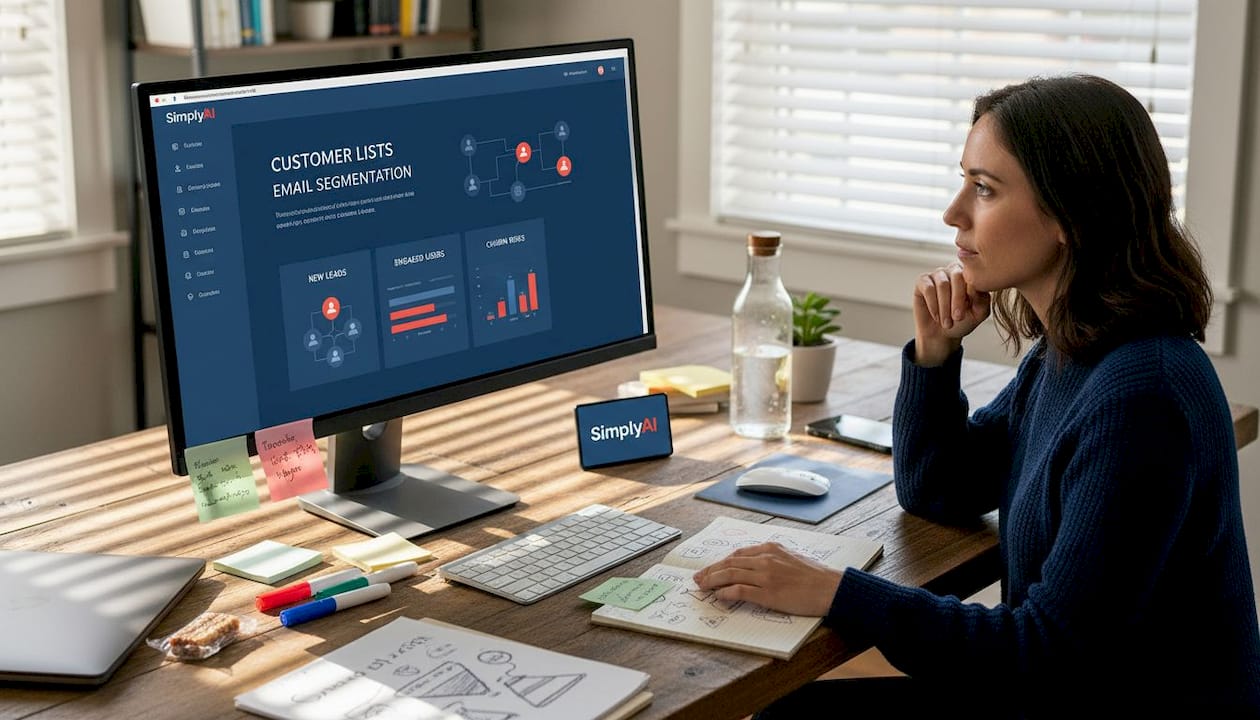
Retention is another area where the results are measurable and often dramatic. Built-in AI tools on platforms like Shopify, HubSpot, Klaviyo, and Mailchimp enable RFM-based segments (Recency, Frequency, Monetary) that let you identify your Champions and At-Risk customers automatically. Champions can receive exclusive loyalty perks that deepen their commitment. At-Risk customers can receive a well-timed, personalized win-back offer before they fully disengage. Both outcomes would be difficult to execute consistently without AI doing the heavy lifting.
The benefits of AI segmentation for SMBs include reduced customer acquisition costs, higher average order values, and better lifetime value across key segments. These are not abstract gains. They translate directly into more predictable revenue and smarter budget allocation.
Personalization at scale also protects your brand. Customers today notice when messaging feels generic, and they respond poorly to it. When an AI-powered system ensures that a loyal customer receives a very different experience than a lapsed one, you signal that your business understands and values the relationship. Applying data-driven marketing strategies alongside AI segmentation amplifies these results significantly. The combination of good data, smart segmentation, and intentional outreach is what drives AI-powered SMB growth over time.
Pro Tip: Measure segment performance on a quarterly basis and adjust your definitions based on what the data shows. Segments that made sense six months ago may no longer reflect actual customer behavior today.
Pitfalls, risks, and how to avoid them
Of course, even smart technology requires vigilance. Let's tackle the biggest risks and how to manage them.
AI segmentation carries real risks that are worth taking seriously: data quality problems, bias amplification, lack of explainability, over-segmentation, privacy concerns, and the ongoing need for human oversight and segment maintenance. Each one can quietly erode the value of an otherwise well-designed system.
Data quality is the most foundational issue. An AI model trained on incomplete, duplicated, or mislabeled customer records will produce segments that look precise but are built on faulty assumptions. Garbage in, garbage out is not a cliche here; it is a description of exactly what happens in production environments.
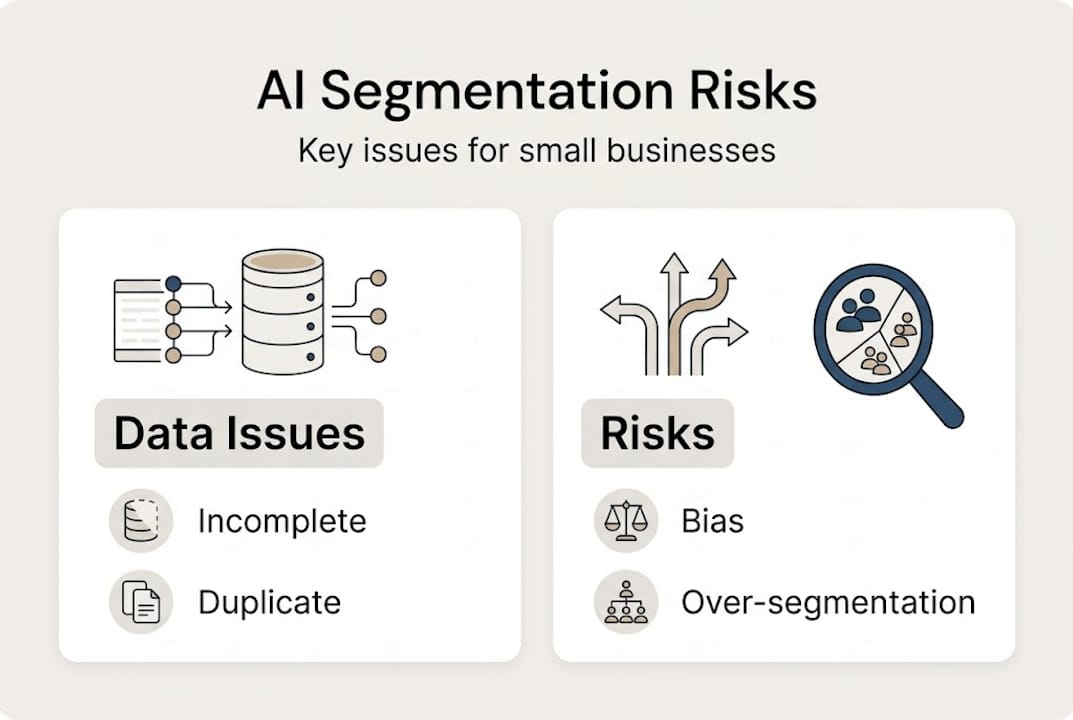
Bias amplification is a subtler risk. If your historical data reflects past biases (for example, underserving certain customer types), the AI will learn and replicate those patterns. The system optimizes for what it sees, not for what is fair or strategically wise.
Over-segmentation creates paralysis. When businesses try to create dozens of micro-segments too early, they generate more questions than answers and struggle to act decisively on any of them. This is a common challenge covered in the context of AI customer engagement pitfalls.
Privacy and customer trust are non-negotiable. Hyper-personalization can cross a line when customers feel surveilled rather than understood. Respecting opt-out preferences, being transparent about data use, and avoiding overly intrusive targeting are essential practices. Understanding how predictive analytics intersects with privacy considerations helps SMBs stay on the right side of that line.
Five must-do checks for safe and effective AI segmentation adoption:
- Audit your data sources for completeness and accuracy before building any model
- Review segment logic regularly to detect drift or outdated assumptions
- Establish clear data governance policies and customer consent frameworks
- Keep a human in the loop for reviewing AI-generated segment recommendations
- Test campaigns on smaller sub-groups before rolling out to full segments
"Technology is only as trustworthy as the data and oversight behind it. AI segmentation rewards discipline and penalizes neglect."
Why the real AI edge is smarter human decisions, not just smarter machines
After exploring the upsides and pitfalls, it is worth pausing on a truth many SMB owners discover in practice. AI segmentation tools generate impressive outputs. But the businesses that see the greatest gains are not the ones that hand everything over to the algorithm. They are the ones that treat AI as a decision-support layer, not a replacement for judgment.
The "set and forget" approach consistently underperforms. Segments drift. Customer behavior shifts seasonally, competitively, and culturally. An AI model that was accurate in March may be misleading by October without ongoing review. Success comes from clean data, deliberate testing with small segments, and human interpretation of what the data actually means for your specific market.
The most effective SMB operators combine AI-driven insights with their own knowledge of customer motivations, local context, and brand positioning. Understanding AI personalization benefits is valuable, but applying those insights with business intuition is what separates average results from genuinely strong ones. The real competitive edge is not just having AI. It is knowing how to act on what it tells you.
Ready to unlock the power of AI for your business?
If you have made it this far, you already understand that AI-driven segmentation is not a future concept. It is a practical, accessible tool that SMBs can deploy today to drive real marketing results.
At SimplyAI, we help small and medium-sized businesses move from curiosity to capability. Whether you need AI automations for SMBs that connect your data sources and trigger personalized campaigns automatically, or AI agents for business that handle customer interactions at scale, we design and implement solutions built specifically for your context. Explore what the SimplyAI platform can do for your business, and let's identify the highest-impact starting point together.
Frequently asked questions
How does customer segmentation AI differ from traditional segmentation?
AI uses real-time machine learning to create dynamic, self-updating groups, while traditional methods rely on static demographic categories that require manual updates to stay relevant.
What types of businesses can benefit most from AI segmentation?
Any SMB with digital customer touchpoints gains from AI segmentation. Retail, e-commerce, and service businesses especially benefit, and platforms like Klaviyo and HubSpot make it accessible without a dedicated data team.
What is the easiest way for SMBs to get started with AI customer segmentation?
Connect your primary data sources, then start with three to five segments using a platform like Mailchimp or HubSpot before expanding into more complex configurations.
Are there risks or downsides to using AI for customer segmentation?
Yes. Data quality issues, bias, and privacy concerns are real, and segments require ongoing maintenance to remain accurate and effective over time.