

TL;DR:
- Most SMBs mistakenly equate enterprise automation with simple bots handling repetitive tasks, resulting in lost efficiency. Modern automation connects people, systems, and AI across entire workflows, enabling smarter, end-to-end processes. Successful automation requires orchestration, careful measurement, and redesigning workflows to eliminate phantom work, rather than just automating isolated steps.
Most business owners think enterprise automation means setting up a bot to handle a few repetitive tasks, like routing emails or filling out forms. That assumption is costing companies real money and real time. Modern enterprise automation is something far more powerful: it connects people, systems, and AI agents across entire workflows, from the first customer touchpoint to the final invoice. This guide cuts through the noise to explain what enterprise automation actually is in 2026, how agentic AI is changing the landscape, why orchestration is the real driver of efficiency, and how small and medium-sized businesses (SMBs) can start building smarter operations today.
Table of Contents
- What is enterprise automation? A modern definition
- Rule-based bots versus agentic AI: Key differences in automation approaches
- The power of orchestration: Why end-to-end matters
- Getting started: Building your enterprise automation foundation
- Why most SMBs get enterprise automation wrong (and how to avoid it))
- Start your automation journey with proven AI solutions
- Frequently asked questions
Key Takeaways
| Point | Details |
|---|---|
| Automation is orchestration | The real power of automation comes from connecting tasks across your business, not just automating individual steps. |
| Measure end-to-end impact | Track results for the whole workflow to avoid hidden manual work and maximize ROI. |
| Start simple but plan for scale | Begin with small wins, but design your automation for expansion and adaptability. |
| Agentic AI adoption is limited | Only a small share of businesses will need advanced agentic AI in the near term. |
| Smarter automation drives growth | When implemented well, automation boosts customer experience and allows efficient scaling. |
What is enterprise automation? A modern definition
Enterprise automation is not a single technology. It is a strategic approach that connects multiple business systems, including customer relationship management (CRM) platforms, finance tools, support desks, and fulfillment software, so that processes flow automatically across departments without constant human intervention. Think of it as replacing disconnected, manual handoffs with a continuous, intelligent pipeline.
In the early days, automation meant scripted bots performing fixed tasks. Today, as AI automation reshapes enterprise in 2026, the definition has expanded dramatically. Modern automation platforms use adaptive workflow engines, large language models (LLMs), and AI agent frameworks to make decisions, handle exceptions, and learn from outcomes. The gap between what was possible five years ago and what is achievable today is striking.
The core benefits that drive businesses toward enterprise automation are clear and measurable:
- Speed: Automated workflows process transactions and requests in seconds rather than hours.
- Accuracy: Removing manual data entry reduces error rates dramatically, often by 60 to 80 percent.
- Customer experience: Faster responses and consistent service quality improve satisfaction scores.
- Scale: Automated systems handle volume spikes without adding headcount.
"True enterprise automation requires orchestration beyond bots; measure full end-to-end (not just visible tasks) to avoid phantom work."
That Forrester insight captures the essential challenge. Many organizations automate isolated steps but neglect the connective tissue between them. The result is a workflow that looks automated on the surface but still depends on hidden manual labor to function. Understanding the full range of data-driven automation types is the first step toward building something that actually works end to end.
Now that we have established the growing importance of end-to-end automation, let us explore how traditional methods compare to newer, AI-powered approaches.
Rule-based bots versus agentic AI: Key differences in automation approaches
Not all automation is created equal. The distinction between rule-based automation and agentic AI is one of the most important concepts any business leader needs to understand before investing in new technology.
Rule-based automation, often implemented through Robotic Process Automation (RPA) tools, follows a strict set of instructions. If condition A is true, perform action B. These systems excel at highly repetitive, predictable tasks: copying data between systems, generating standard reports, or processing invoices that always follow the same format. They are fast, reliable, and relatively easy to implement. The limitation is brittleness. Change the format of an invoice or introduce a new data field, and the bot breaks.
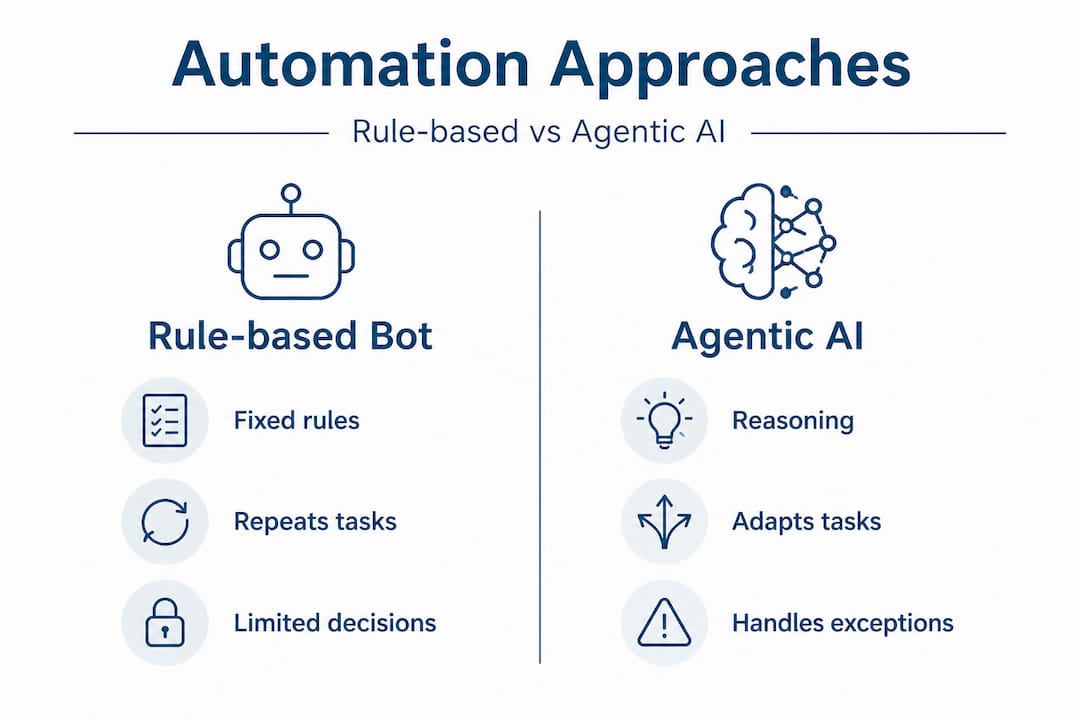
Agentic AI operates on a fundamentally different principle. These systems use large language models and AI agent frameworks to interpret goals, reason through problems, and adapt to new information without requiring explicit reprogramming. An agentic AI system can handle a customer complaint that spans multiple departments, decide which resolution path makes the most sense, and execute that path autonomously. It can flag ambiguous situations for human review rather than failing silently.
The table below summarizes the key differences:
| Feature | Rule-based automation | Agentic AI |
|---|---|---|
| Decision-making | Fixed rules only | Reasoning-based, adaptive |
| Handles exceptions | Poorly, often fails | Yes, with escalation options |
| Setup complexity | Moderate | Higher initial investment |
| Best use case | Predictable, repetitive tasks | Complex, variable workflows |
| Supervision needed | Minimal once configured | Moderate, especially early on |
| Scalability | Limited to defined scenarios | High, learns and adapts |
The distinction matters because fewer than 15% of firms are expected to adopt full agentic AI by 2026, primarily due to return-on-investment (ROI) complexity and governance concerns. Full agentic deployments require strong oversight frameworks, clear accountability for AI decisions, and robust monitoring. Most SMBs are better served by a hybrid approach: rule-based automation for structured tasks combined with targeted AI assistance for judgment-intensive ones.
Pro Tip: Before committing to any automation platform, ask vendors specifically how their system handles exceptions and edge cases. A tool that breaks on unusual inputs will create more manual work, not less. For agencies scaling operations, process automation for agencies offers a practical breakdown of what this looks like in practice.
After understanding the practical differences between automation methods, it is crucial to examine how orchestrating these technologies can supercharge business efficiency.
The power of orchestration: Why end-to-end matters
Orchestration is the concept that separates genuine enterprise automation from a collection of disconnected tools. It refers to the coordination of multiple automated systems, AI agents, and human workflows so that every step in a process connects cleanly to the next.
Consider a common SMB scenario: a customer places an order online. Without orchestration, that order might trigger an automated confirmation email (step one automated), then sit in a queue until someone manually enters it into the fulfillment system (step two manual), then get processed and shipped (step three automated), while a separate team handles any customer questions (step four manual). Two of four steps are automated, but the process is far from efficient.

With proper orchestration, the same order triggers a cascade: the CRM is updated, the fulfillment system receives the order, inventory is checked and adjusted, shipping is scheduled, and the customer receives real-time status updates, all without a single manual handoff. The workflow becomes a single, continuous flow rather than a series of isolated actions.
Here is what a well-orchestrated automation sequence looks like for an SMB:
- Map every step, including the ones that feel too small to matter. Hidden manual steps are where efficiency dies.
- Identify handoff points between departments or systems where data or tasks are passed manually.
- Prioritize the connections that cause the most delays or errors when they break.
- Implement integration layers using tools like iPaaS (Integration Platform as a Service) to connect disparate systems.
- Monitor the full pipeline, not just individual automated steps, to catch bottlenecks as they emerge.
The concept of "phantom work" is central to understanding why orchestration matters. Forrester researchers note that measuring only visible tasks creates phantom work, which is the hidden manual labor that fills the gaps between automated steps. A company might automate 70% of a process and still find that overall efficiency has barely improved, because the remaining 30% represents the most time-consuming parts of the workflow.
Building an AI-first organizational strategy requires thinking in systems, not tools. The organizations that see dramatic results from automation are not those that deploy the most bots. They are the ones that design their processes around seamless, measurable, end-to-end flows. Understanding the full scope of AI automation benefits for SMBs reinforces why this systems-level thinking is so critical to long-term growth.
With orchestration as the backbone, let us move from theory to practical steps SMBs can take to get started with enterprise automation.
Getting started: Building your enterprise automation foundation
Starting an automation initiative can feel overwhelming, especially for SMBs without dedicated technology teams. The good news is that a structured approach significantly reduces both the risk and the learning curve.
Step one: Map your manual workflows. Before selecting any tool, document the processes that consume the most team time. Follow the work through every step, including the ones handled by a single person who "just knows" what to do. These undocumented steps are typically where automation efforts fail because they were never accounted for in the design.
Step two: Classify your workflows. Not all processes are equally good candidates for automation. Highly repetitive tasks with clear, consistent inputs and outputs are ideal for rule-based automation. Processes that require judgment, involve variable data, or need contextual understanding are better suited for AI-assisted or agentic approaches.
Step three: Evaluate tools based on integration readiness. The best automation tool for your business is the one that connects cleanly with the systems you already use. Evaluate platforms on their native integrations, API flexibility, and their ability to grow with your needs. iPaaS platforms like Zapier, Make, or enterprise-grade solutions provide the connective layer that makes orchestration possible.
Step four: Build in measurement from day one. This is the step most SMBs skip, and it is the most important one. Define what success looks like before you launch. Set baselines for process time, error rates, and team hours spent per workflow. Then measure the full end-to-end process after automation, not just the steps the tool directly touches.
Step five: Pilot small, then expand. Choose one workflow, automate it fully, measure it rigorously, and use those results to build the case for broader adoption. Incremental wins create internal confidence and reveal lessons that make subsequent implementations faster and more effective.
The risk of skipping measurement is well-documented. Research shows that automation redistributes work to oversight roles if it is not measured end to end. In other words, automating a task without closing the loop often just moves the manual work rather than eliminating it. A practical step-by-step AI integration guide can help structure this process, and a broader look at how to use AI in business provides the strategic context for making smart decisions at each stage.
Pro Tip: When piloting automation, pick a workflow that has a clear, measurable output. "Customer onboarding takes 3 days" is measurable. "Sales feels less overwhelmed" is not. You need numbers to prove ROI and justify expanding your automation program.
As you lay your automation foundation, keep in mind some lessons from the field and what most SMBs overlook.
Why most SMBs get enterprise automation wrong (and how to avoid it)
The single most common mistake businesses make when starting their automation journey is optimizing for quick wins rather than workflow transformation. It feels productive to automate email sorting or report generation. Those wins are real, but they are also shallow. They rarely move the needle on the metrics that matter: revenue cycle time, customer satisfaction, or team capacity.
The second mistake is underinvesting in measurement. We see organizations that have deployed ten or fifteen automation tools, yet cannot answer the question: "Has our overall operational efficiency improved?" They have automated steps, not outcomes. As Forrester makes clear, automation redistributes work to oversight roles when end-to-end measurement is absent. The manual labor does not disappear; it migrates to whoever is managing the gaps between automated steps.
The third, and perhaps most counterintuitive, mistake is treating automation as a technology project rather than a people-and-process project. The technology is the easy part. The hard part is redesigning how work flows through the organization, getting team members to trust automated systems, and building a culture where AI-first principles guide decisions.
Real growth from automation comes when you orchestrate people, processes, and AI agents as a unified system. It means measuring every step, including the ones that happen between automated tasks. It means being willing to redesign workflows rather than simply automating the existing, broken ones. And it means choosing depth over breadth: one fully orchestrated workflow that eliminates phantom work is worth more than ten partially automated processes that still require constant human intervention to hold together.
Start your automation journey with proven AI solutions
The gap between knowing that automation matters and actually implementing it effectively is where most SMBs lose momentum. The right partner bridges that gap, accelerating your workflow transformation and ensuring that adoption happens in a way that delivers measurable results rather than just adding complexity.
SimplyAI.gr designs and implements enterprise automation solutions tailored to the specific needs of small and medium-sized businesses. From AI-powered chatbots and CRM automations to custom workflow orchestration, the focus is always on end-to-end efficiency and real business impact. For organizations ready to move beyond basic task automation, AI agents for SMBs represent the next level of intelligent, adaptive automation that scales with your business. The path from experimentation to lasting operational impact starts with a clear strategy and the right tools behind it.
Frequently asked questions
What are the biggest barriers to enterprise automation for SMBs?
Typical challenges include securing demonstrable ROI, managing integration complexity across existing systems, and maintaining strong governance over automated decisions, factors that explain why fewer than 15% of firms have adopted full agentic AI by 2026.
Is agentic AI right for every business?
Most SMBs do not need full agentic AI initially, since it demands significant investment and oversight infrastructure. Targeted rule-based automation combined with AI assistance in specific areas delivers faster, more predictable value, as adoption data confirms that governance concerns remain a primary barrier.
What is "phantom work" in automation?
Phantom work refers to hidden manual tasks that persist when automation addresses only the visible steps in a process rather than the entire workflow, a risk that Forrester highlights as a core failure mode of bot-centric automation strategies.
How can SMBs measure the success of automation initiatives?
Success is measured by tracking end-to-end workflow performance against pre-automation baselines, not just individual automated steps, and by actively monitoring for hidden manual tasks that signal phantom work between automated stages.