

TL;DR:
- Automation allows lean startups to scale efficiently with minimal human resources.
- Most automation should start with structured, repetitive processes like customer support and billing.
- Ongoing monitoring and incremental improvements are essential to prevent automation debt and ensure reliability.
Modern startups are rewriting the rules of growth. A two-person team today can operate with the output of a twenty-person company from a decade ago, not because founders work harder, but because they work smarter. AI-native startups scale with minimal headcount by treating automation as a core business function rather than an afterthought, achieving the kind of capital efficiency that was once the exclusive domain of large, well-funded enterprises. This guide breaks down exactly how, where, and why automation gives startups a decisive edge.
Table of Contents
- Why automation is a game changer for startups
- Types of automation: Rule-based vs. AI agents
- Where automation makes the biggest impact in startups
- The limits and risks of startup automation
- Why most startups get automation wrong (and how to do it right)
- Leverage AI automation to power your startup's next phase
- Frequently asked questions
Key Takeaways
| Point | Details |
|---|---|
| Scale with lean teams | Leverage automation so your startup can grow rapidly without ballooning headcount. |
| Choose the right automation | Select rule-based automation for most tasks, using AI agents only for truly complex problems. |
| Target high-impact areas | Start automating in functions like marketing, support, and finance for quick wins. |
| Watch for automation debt | Continually monitor both the benefits and limitations, ensuring humans step in when needed to avoid avoidable errors. |
| Incremental, measurable automation | Deploy automation in small, controlled steps to maximize results and minimize disruption. |
Why automation is a game changer for startups
The conventional wisdom about startup growth tends to focus on fundraising and headcount. Hire fast, build fast, scale fast. But that logic is increasingly being challenged by a new breed of company that reaches profitability with micro teams, lean infrastructure, and automation doing the heavy lifting across operations.
The evidence is hard to ignore. Agentic AI reduces operational costs by up to 38% in mid-market firms, and early-stage startups that adopt automation early are seeing even faster compounding benefits. When you eliminate manual data entry, automate customer communications, and let software handle routine decision-making, your team can redirect energy toward the work that actually moves the business forward.
Consider the operational areas where automation delivers the most immediate returns:
- Customer support: Automated chatbots handle 70 to 80 percent of incoming queries around the clock, without additional staffing costs.
- Marketing: Email sequences, social scheduling, and lead nurturing run on autopilot once configured correctly.
- Finance and billing: Invoicing, payment reminders, and reconciliation happen automatically, reducing errors and late payments.
- Onboarding: New users or clients receive structured, personalized onboarding flows without manual intervention from the team.
"The best startups we've seen aren't the ones with the biggest teams. They're the ones that figured out which workflows should never require a human in the first place."
What separates automation-first startups from their peers is strategic clarity. They examine every repeating process and ask whether a human genuinely needs to be involved. When the answer is no, they automate immediately. Understanding the difference between AI automation vs manual work is the first mindset shift that founders need to make. The cost savings and time recapture compound rapidly over months, making automation not just an efficiency tool but a genuine growth lever.
Types of automation: Rule-based vs. AI agents
Before investing in any automation stack, founders need to understand that not all automation is created equal. There are two fundamentally different categories in play, and choosing the wrong one for a given task wastes both money and engineering time.
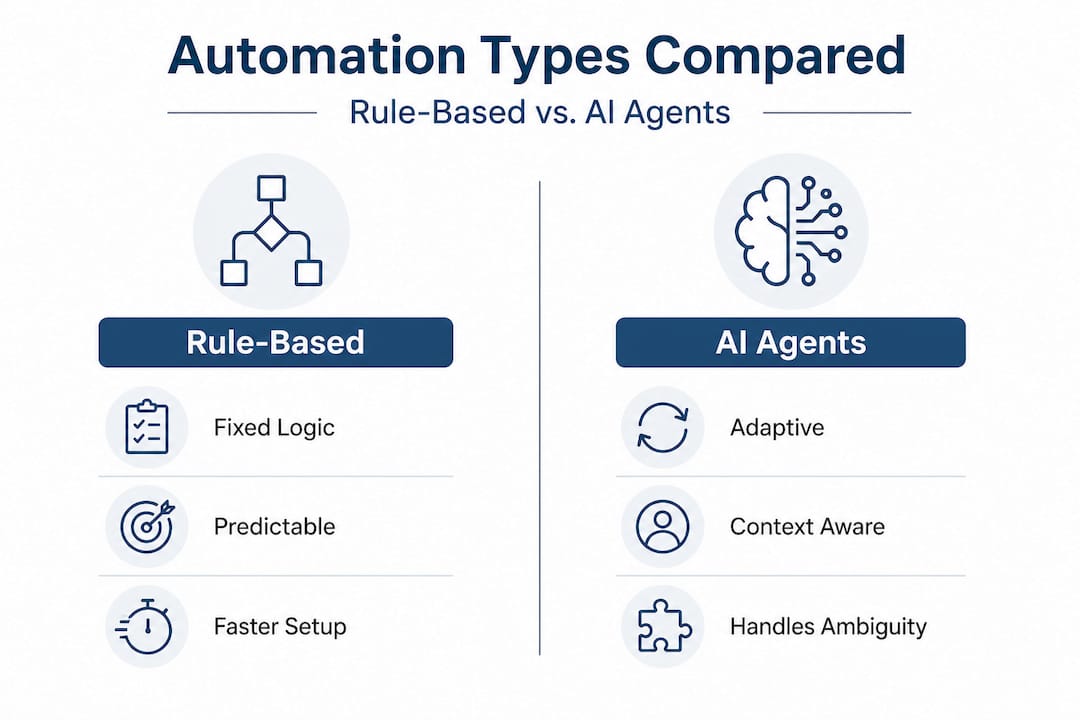
Rule-based automation works on a simple principle: if this happens, then do that. It is deterministic, meaning it always produces the same output for the same input. Tools like Zapier, Make (formerly Integromat), and n8n fall into this category. They connect applications, trigger actions, and move data based on pre-defined conditions. They are fast, reliable, and inexpensive to run. A rule-based workflow that routes a form submission to your CRM and sends an automated confirmation email will work exactly the same way the ten-thousandth time as the first.
AI agents, on the other hand, operate with a degree of autonomy and reasoning. Understanding what is an AI agent is essential before deploying one, because these systems use large language models to process unstructured inputs, make contextual decisions, and complete multi-step tasks without explicit instructions for every scenario. An AI agent might read an incoming email, determine intent, draft a personalized response, check your calendar, and book a meeting, all without a human touching the thread.
The practical guidance from industry analysts is clear: prefer rule-based automation for most tasks due to reliability and cost, and reserve AI agents for complex reasoning only. In practice, a healthy automation stack for a startup looks roughly like this: 80% rule-based workflows, 15% AI agents handling contextual or unstructured tasks, and 5% human oversight for exceptions.
| Feature | Rule-based automation | AI agents |
|---|---|---|
| Decision logic | Fixed, if-then rules | Contextual, adaptive reasoning |
| Best for | Repetitive, structured tasks | Complex, unstructured workflows |
| Cost | Low | Moderate to high |
| Reliability | Very high | Moderate, depends on training |
| Setup complexity | Low | High |
| Example tools | Zapier, Make, n8n | AutoGPT, custom LLM agents |
Pro Tip: Start every automation project by asking whether the task has consistent, predictable inputs and outputs. If yes, use a rule-based tool. If the task involves reading context, generating unique responses, or navigating ambiguity, that is when an AI agent earns its place.
Where automation makes the biggest impact in startups
Once you know what kind of automation to use and why it matters, it is all about choosing your targets wisely. Not every process deserves to be automated on day one. The goal is to identify the workflows that consume the most time, occur most frequently, and carry the highest cost of human error.

For most startups, those workflows cluster in three areas: customer-facing operations, internal marketing, and financial administration. These are not coincidences. They are the highest-volume, highest-stakes functions in any growing business.
| Function | Primary automation type | Estimated time saved weekly | Cost impact |
|---|---|---|---|
| Customer support | AI chatbot + rule-based routing | 8 to 12 hours | Reduces support headcount needs |
| Email marketing | Rule-based sequences | 4 to 6 hours | Higher conversion, lower CAC |
| Lead qualification | AI agent + CRM integration | 5 to 8 hours | Faster pipeline velocity |
| Invoicing and billing | Rule-based triggers | 3 to 5 hours | Fewer late payments, fewer errors |
| Social media scheduling | Rule-based posting tools | 2 to 4 hours | Consistent brand presence |
The operational cost reductions seen in firms that automate these core functions reach as high as 38%, and startups tend to see the impact even faster because their processes are less entrenched and easier to redesign. Learning how to boost business growth with automation starts with targeting these high-ROI areas rather than attempting to automate everything at once.
Here is a practical sequence for automating your first customer-facing process:
- Map the current workflow. Document every step a human currently performs, including the triggers, decisions, and outputs involved.
- Identify the repetitive segments. Find the steps that happen the same way every time and require no unique judgment.
- Select the right tool. Match rule-based tools to structured steps and AI agents to contextual decisions.
- Build a minimum viable automation. Launch with a simple version that handles the majority of cases correctly, and leave edge cases for human review.
- Monitor and measure. Track resolution rates, errors, and time saved for the first 30 days. Use that data to refine.
- Expand incrementally. Once the first automation is stable, identify the next highest-impact process and repeat.
For startups with a customer support function, deploying AI-powered support for small businesses is often the fastest path to tangible ROI. Similarly, founders focused on growth will find that AI for lead generation dramatically compresses sales cycles by qualifying and nurturing prospects automatically.
Pro Tip: Automate the customer touchpoints that happen most often before anything else. The highest-volume interactions carry the most compounding value when handled automatically, because even a small improvement in efficiency multiplies across thousands of interactions per month.
The limits and risks of startup automation
While automation is a powerful force, knowing its limits is just as important as knowing its potential. Many startups sprint toward automation without planning for what happens when things go wrong, and they almost always do at some point.
The concept of automation debt is real and underappreciated. Just as technical debt accumulates when code is written quickly without proper structure, automation debt builds when workflows are created hastily, poorly documented, or left unmonitored. When your business grows and processes change, outdated automation can produce silently wrong outputs for weeks before anyone notices.
Edge cases and automation debt require observability, graceful degradation, and a human-in-the-loop to scale sustainably. That means building automation with monitoring from day one, designing fallback procedures for when a workflow fails, and ensuring that unusual inputs are escalated to a human rather than processed incorrectly.
Consider a common scenario: a startup automates its customer onboarding emails. Everything works perfectly for standard signups. Then a corporate client signs up with an unusual billing structure. The automation sends the wrong email sequence. The client receives irrelevant instructions. No one on the team notices for three days because there is no monitoring in place. By the time a human reviews it, the client is frustrated and disengaged.
The most resilient automation practices include:
- Observability: Log every automated action and build dashboards that surface anomalies quickly.
- Graceful degradation: When automation cannot handle an input, it should fail safely and notify a human rather than proceed incorrectly.
- Human-in-the-loop design: Identify the decisions that carry high stakes or low frequency and keep humans responsible for those, even when most of the workflow is automated.
- Regular audits: Review your automation stack quarterly to ensure workflows still match your current processes and catch any outdated logic before it causes problems.
Understanding adaptive AI systems helps founders build more resilient automation that adjusts to changing inputs, while exploring manual vs automated workflows helps clarify which decisions should always remain human. For startups that are scaling quickly, understanding auto-scaling in AI infrastructure ensures that automation performance holds as transaction volumes grow.
"Automation is not a destination. It is an ongoing discipline that requires the same care and attention as the rest of your business operations."
Why most startups get automation wrong (and how to do it right)
Here is an uncomfortable truth: most founders approach automation as a trophy rather than a tool. They read about AI agents, get excited about the possibilities, and promptly try to automate everything at once. The result is a fragile system of interconnected workflows that breaks under pressure and takes more time to maintain than the manual process it replaced.
The instinct to automate everything is understandable. The promise of a fully automated business is genuinely exciting. But early-stage startups are not mid-market firms with dedicated engineering teams to build and maintain complex automation infrastructure. They are lean operations where reliability matters more than sophistication.
The wiser approach is to treat automation as a progression, not a revolution. Begin with the workflows that are most stable, most repetitive, and most costly in human time. Get those running reliably. Build monitoring. Document everything. Then, and only then, expand to more complex or contextual automation. The startups that achieve durable efficiency gains are the ones that accumulate small, well-maintained wins rather than betting on a single ambitious system.
There is also a culture dimension that founders often overlook. Automation changes how teams work, and not always in ways people welcome. When a team member's workflow is automated, they need clarity on what their new contribution looks like. Without that clarity, automation creates anxiety rather than efficiency. The best founders frame automation as a way to elevate their team's work, removing the tedious and repetitive so people can focus on strategy, creativity, and customer relationships.
The top automation tips shared by practitioners consistently emphasize one principle: start with outcomes, not technology. Identify the business result you want to achieve, then work backward to the automation that delivers it. That sequence produces automation that serves your business. The reverse produces automation that serves your ego.
Reliability, maintainability, and incremental progress are not glamorous. But they are what separates startups that scale sustainably from those that build impressive-looking systems that collapse at the worst possible moment.
Leverage AI automation to power your startup's next phase
Applying these principles in practice requires more than the right mindset. It requires the right execution partner.
At SimplyAI, we design and implement AI & automation solutions tailored specifically to the realities of small and medium-sized businesses. We do not sell generic platforms. We build practical, measurable automation systems that fit your workflows, your team, and your growth goals. Whether you need to automate customer support, streamline lead generation, or deploy AI agents for startups that handle complex, multi-step processes, our team brings the technical depth and strategic clarity to make it work. If you are ready to move from thinking about automation to actually capturing its benefits, we are ready to help you get there.
Frequently asked questions
What is the main advantage of automation for startups?
Automation enables startups to scale with minimal headcount, operating profitably and efficiently without the cost burden of large teams, which accelerates growth and preserves capital.
Which processes should startups automate first?
Startups should prioritize marketing, customer support, and finance workflows, where repetition is highest and operational cost reductions of up to 38% are most achievable.
Are there risks to relying on automation in a startup?
Yes. Edge cases and automation debt can silently produce errors, which is why ongoing monitoring, fallback procedures, and human oversight are essential components of any automation strategy.
When should I use AI agents versus rule-based tools?
Prefer rule-based automation for structured, repetitive tasks where consistency matters most, and deploy AI agents only when a task genuinely requires contextual reasoning, judgment, or handling unstructured inputs.