

TL;DR:
- Successful AI adoption requires defining specific workflows, ensuring data quality, and team involvement.
- Start with one targeted AI pilot, measure results, and expand gradually to avoid common pitfalls.
- Ongoing iteration and discipline are essential for sustained benefits and avoiding implementation failures.
Running a small or medium-sized business means wearing a dozen hats at once. Invoices pile up, customer inquiries go unanswered, and your team spends hours on tasks that feel like they should run themselves. AI tools promise to change all of that, but for most SMB owners, the path from "I've heard about AI" to "it's actually working in my business" is frustratingly unclear. This guide cuts through the noise. You'll find a practical, step-by-step framework for assessing your readiness, selecting the right tools, rolling out a pilot, and avoiding the mistakes that sink most implementations before they deliver real value.
Table of Contents
- Assessing your business needs and readiness
- Choosing the right AI tools and platforms
- Step-by-step: Implementing AI in your workflows
- Common pitfalls and how to avoid them
- What most AI guides get wrong and what actually works
- Ready to automate smarter? Next steps with SimplyAI
- Frequently asked questions
Key Takeaways
| Point | Details |
|---|---|
| Start small | Begin with one workflow and scale once you see results and team buy-in. |
| Track metrics | Set clear goals and measure outcomes to avoid wasted effort. |
| Choose practical tools | Pick user-friendly AI solutions that fit your business workflows and technical capacity. |
| Prepare your team | Involving staff early and providing training greatly increases your success rate. |
| Monitor and improve | Continuous learning and feedback loops keep your AI implementation effective as business needs evolve. |
Assessing your business needs and readiness
Understanding the challenges and opportunities AI presents starts with knowing your business's unique needs. Before choosing a tool or platform, lay the groundwork for success by preparing your organization properly.
The most common mistake SMBs make is jumping straight to a tool before defining the problem. Start by mapping your workflows and identifying where time is genuinely wasted. Is your team manually entering data from emails into a spreadsheet? Are customer inquiries piling up because no one is available after hours? Are you losing leads because follow-up emails take too long? These are the friction points where AI delivers the fastest, most measurable results.
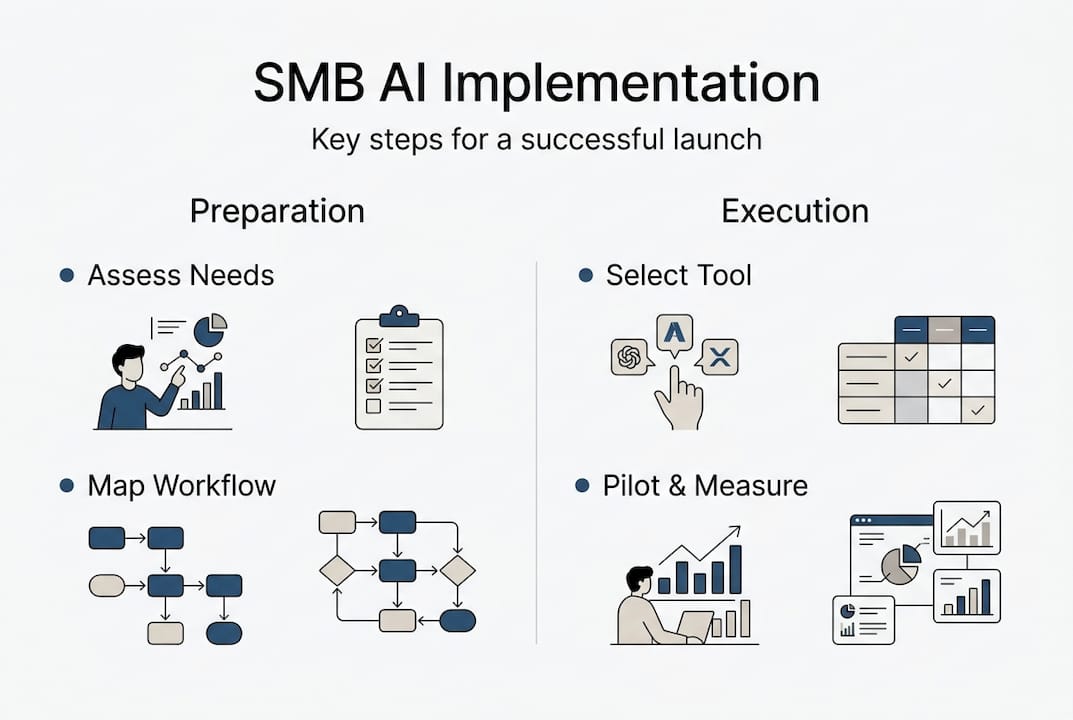
Once you've identified a target area, assess the quality of your data. AI systems learn from data, so if your customer records are incomplete, your inventory logs are inconsistent, or your CRM is a mess, any AI tool you layer on top will underperform. Clean, structured data is the foundation of effective automation. This step is less exciting than choosing a platform, but it determines whether your implementation succeeds or stalls.
Involving your team early is equally important. Employees who feel blindsided by new technology tend to resist it, even when the change benefits them. Share the "why" behind the initiative, invite feedback on which tasks feel most repetitive, and identify who on your team has the curiosity and capacity to become an internal AI champion. As implementation experts note, addressing employee resistance by showing concrete benefits and involving staff from the start dramatically improves adoption rates.
Here are the core readiness factors to evaluate before moving forward:
- Workflow clarity: Can you describe the process you want to automate in simple steps?
- Data quality: Is your relevant data organized, accessible, and reasonably accurate?
- Team readiness: Does your team understand the goal and have a point of contact for questions?
- Integration needs: Will the AI tool need to connect with existing software like your CRM or email platform?
- Budget and timeline: Do you have a realistic budget and a defined window for piloting?
Pro Tip: If you don't have in-house developers, start with no-code AI tools. Platforms like Zapier, Make, or purpose-built AI automation services let you automate workflows visually, without writing a single line of code. You can explore AI for small business options that require minimal technical setup and still deliver serious efficiency gains.
Choosing the right AI tools and platforms
With business priorities and readiness evaluated, it's time to navigate the crowded AI marketplace and equip your business with the right solutions.

Not all AI tools are built for SMBs. Some are enterprise-grade platforms with price tags to match. Others are lightweight apps that solve one narrow problem. The key is matching the tool's capabilities to your specific workflow challenge, your team's technical comfort level, and your available budget.
The four most relevant AI tool categories for SMBs are chatbots and virtual assistants (for customer service and lead capture), process automation platforms (for repetitive internal tasks), data analysis tools (for sales trends, inventory, and reporting), and AI content generation systems (for marketing and communications). Each category has distinct use cases, and the best choice depends on where your biggest pain point sits.
Here's a comparison of common AI tool types to help frame your decision:
| Tool type | Best for | Avg. monthly cost | Technical skill needed |
|---|---|---|---|
| AI chatbot | Customer support, lead gen | $30 to $300 | Low |
| Process automation | Repetitive data tasks | $20 to $500 | Low to medium |
| Data analytics AI | Reporting, forecasting | $50 to $400 | Medium |
| AI content tools | Marketing, email, social | $20 to $150 | Low |
Before committing to any platform, run through these key questions:
- Does this tool integrate with the software we already use?
- What does the vendor's support and onboarding look like?
- Is our data secure under this platform's privacy policy?
- Can we scale usage up or down as our needs change?
- Is there a free trial or pilot option before a full commitment?
One of the most important insights from SMB adoption research is that early movers gain a 12 to 18 month competitive lead over slower adopters. But that same research shows 60 to 67% of implementations fail when businesses skip clear metrics and structured pilots. Speed matters, but not more than strategy. You can review a detailed AI implementation checklist to make sure you're covering every critical step before signing up for a platform.
For SMBs exploring business strategies with AI, the most practical approach is to pick one tool, tie it to one workflow, and measure results before expanding. This keeps risk low and learning high.
Step-by-step: Implementing AI in your workflows
Once you've selected your ideal tools, here's how to put them into action for meaningful results, one workflow at a time.
A structured rollout prevents the chaos that derails most AI projects. Follow these six steps for a controlled, results-driven implementation:
- Define your objective. Write a one-sentence goal: "Reduce time spent on customer inquiry responses by 40% within 60 days."
- Select a single workflow. Choose the most repetitive, well-defined process in your target area.
- Configure and connect. Set up the AI tool, connect it to relevant data sources, and test it internally before going live.
- Run a pilot. Launch with a small subset of real-world scenarios. Limit scope intentionally.
- Gather feedback. Ask both your team and affected customers (if applicable) what's working and what isn't.
- Analyze results and decide. Compare outcomes against your baseline metric. Scale if results are positive. Iterate if they're mixed.
Human oversight during the pilot phase is non-negotiable. AI tools can misinterpret edge cases, especially in customer-facing workflows. Assign a team member to review AI outputs daily during the first two to four weeks. As implementation guidance confirms, maintaining human-in-the-loop oversight for judgment-heavy tasks protects both quality and customer trust.
Here's an example pilot tracking setup:
| Metric | Baseline (before AI) | Target | Week 2 result | Week 4 result |
|---|---|---|---|---|
| Response time (hrs) | 6.5 | 2.0 | 3.1 | 1.8 |
| Tickets resolved/day | 22 | 40 | 31 | 44 |
| Staff hours on task | 12 | 5 | 8 | 4.5 |
| Customer satisfaction | 3.6/5 | 4.2/5 | 3.9/5 | 4.3/5 |
Pro Tip: Track metrics that are easy to pull weekly without extra manual work. If measuring your results requires a separate project, you'll stop doing it. Tools that offer built-in dashboards make this effortless. When you're ready to go deeper, learning how to build custom AI solution workflows can help you extend automation beyond standard templates.
Common pitfalls and how to avoid them
Even with a strong plan, it's easy to stumble. Learn what traps to watch out for and how to dodge them for smoother AI adoption.
The failure rate for SMB AI implementations is not a rumor. Research consistently shows that 60 to 67% of small business AI projects fail when organizations skip structured pilots, ignore team buy-in, or launch without defined success metrics. Understanding why implementations fail is as valuable as knowing how to execute them well.
The most common pitfalls break down into four categories:
- Poor data quality: Garbage in, garbage out. AI tools trained on incomplete or inaccurate data produce unreliable outputs that erode trust fast.
- Legacy system friction: Older software platforms often lack APIs or integration points, making it difficult to connect AI tools without custom development work.
- Skills gaps: Teams unfamiliar with AI tools tend to underuse them or avoid them entirely. Training is not optional.
- Employee resistance: Staff who weren't consulted during planning often view AI as a threat to their roles rather than a support tool.
Beyond these four, there's a subtler trap that catches ambitious SMBs off guard: over-adoption. Trying to automate five workflows simultaneously, before any single one is proven, multiplies complexity and makes it nearly impossible to diagnose what's working.
"Over-adoption is riskier than slow, deliberate rollout. Start with one workflow, measure it thoroughly, and let results drive your next move."
The data on SMB adoption confirms that businesses with less bureaucracy can move faster than enterprises, but speed without structure is where the real risk lives. Building toward an AI-first organization takes discipline, not just enthusiasm. Review your automation tips regularly to stay grounded in what's actually proven to work.
What most AI guides get wrong and what actually works
With the fundamental steps and challenges clear, let's step back and look at what separates lasting AI success from costly detours.
Most AI guides treat implementation as a one-time project with a finish line. That framing is wrong, and it's why so many businesses feel disappointed six months after launch. AI tools evolve rapidly. Workflows that were optimized in January may need reconfiguration by July. The businesses that sustain real gains treat AI adoption as an ongoing operating discipline, not a deployment checkbox.
The other overlooked truth is that small wins matter more than big promises. A single automated workflow that saves your team four hours a week builds genuine momentum. It proves ROI, reduces skepticism, and creates internal advocates. That energy is what funds and justifies the next automation initiative.
Failed implementations, when studied honestly, are among the most valuable learning assets a business can have. They reveal data gaps, process weaknesses, and team dynamics that no consultant's audit would surface. The SMB AI adoption guide that actually works is the one your team builds through iteration, not the one you follow rigidly from a template.
Ready to automate smarter? Next steps with SimplyAI
If you're ready to put these practices into action and get expert support, here's how SimplyAI can help you go further, faster.
SimplyAI works with small and medium-sized businesses to design and implement AI automations that deliver measurable results without overwhelming your team. Whether you're starting from scratch or looking to scale an existing workflow, the process begins with your specific business needs, not a generic template.
Explore SimplyAI's AI automation services to see how workflow automation is applied across real business scenarios. If you're considering intelligent, autonomous systems, the AI agents for SMBs page outlines how AI agents handle complex, multi-step tasks with minimal human input. You can also browse the AI prompts gallery for ready-to-use starting points that accelerate your first automation project.
Frequently asked questions
What is the first step to implement AI tools in a small business?
Identify a single workflow or pain point that creates the most friction, then pilot a focused AI solution in that area before expanding. Starting narrow gives you clean data, clear results, and a manageable learning curve.
How do I choose the best AI tool for my business?
Compare tools based on your workflow needs, budget, integration compatibility, and vendor support quality. Always run a structured pilot before committing to full-scale deployment, since early movers who skip this step account for the majority of failed implementations.
What are the most common mistakes when implementing AI in SMBs?
Over-automating too quickly, skipping staff training, and launching without defined success metrics are the three most frequent causes of failure. Addressing these gaps before go-live dramatically improves your odds of a successful rollout.
Do I need coding skills to implement AI tools?
No. Many modern AI platforms are built for non-technical users, offering visual workflow builders and pre-built integrations. No-code tools make it possible to automate meaningful processes without writing a single line of code.
How fast can I expect results from AI tools?
Most businesses see measurable process improvements within the first two to four weeks of a targeted pilot, especially when tracking specific metrics from day one. SMBs move faster than enterprises precisely because they have fewer layers of approval slowing down iteration.