

TL;DR:
- AI-driven workflow automation helps SMB sales teams handle repetitive tasks, accelerate lead conversion, and build stronger customer relationships. Implementing AI requires careful preparation, including workflow mapping, data cleansing, and defining clear goals to ensure effective deployment. When properly used, AI amplifies sales capacity, improves metrics, and drives measurable growth without replacing the human element.
Sales teams at small and medium-sized businesses are caught in a relentless cycle: manually entering CRM data, chasing leads that go cold, and missing follow-ups because there simply aren't enough hours in the day. Meanwhile, customer expectations keep rising and competition grows sharper. The good news is that AI-driven workflow automation is no longer reserved for enterprise giants with massive budgets. Today, SMBs can deploy practical AI solutions that handle repetitive tasks autonomously, accelerate lead conversion, and free sales reps to focus on what they do best: building relationships and closing deals.
Table of Contents
- Understanding AI-driven sales workflows
- Preparing your business for AI-driven workflow automation
- Step-by-step guide: Implementing AI in your sales workflow
- Measuring and optimizing your AI-driven workflow
- The real impact and limits of AI in SMB sales workflows
- Unlock sales growth with AI-powered solutions
- Frequently asked questions
Key Takeaways
| Point | Details |
|---|---|
| AI automates key sales steps | AI-driven workflows automate prospecting, lead scoring, outreach, follow-ups, and CRM updates for SMBs. |
| Boost ROI without extra headcount | SMBs can expect 30-44% ROI and faster sales cycles by automating manual steps. |
| Best tools for SMBs | Platforms like HubSpot, Salesforce, and Pipedrive offer proven AI automation for small business sales. |
| Measure and optimize results | Tracking conversion rates and cycle times helps businesses fine-tune their AI workflows for maximum impact. |
| Human touch still matters | AI excels at scale and mundane tasks, but human reps are essential for relationship-building and nuanced decisions. |
Understanding AI-driven sales workflows
An AI-driven sales workflow is an end-to-end system that uses artificial intelligence to automate and optimize every stage of the sales process, from identifying new prospects to updating records after a deal closes. Rather than patching together manual spreadsheets and fragmented email threads, AI ties each stage into a continuous, data-informed loop.
At its core, an AI sales workflow automates lead generation, qualification, nurturing, outreach, follow-ups, and CRM updates using AI agents and tools like HubSpot Breeze, Salesforce Einstein, Pipedrive AI, and Outreach Omni. These platforms use large language models and machine learning to score leads, draft personalized messages, trigger follow-up sequences, and sync activity data in real time. For SMBs, this means a small sales team can operate with the throughput of a much larger organization.
The landscape of AI workflow solutions has matured significantly, giving business owners real choices across price points and complexity levels. To understand how the leading platforms compare, consider the table below.
| Platform | Core AI capability | Best suited for | Key benefit |
|---|---|---|---|
| HubSpot Breeze | Lead scoring, email gen, CRM sync | SMBs scaling outbound | All-in-one with low setup friction |
| Salesforce Einstein | Predictive scoring, forecasting | Mid-market and above | Deep analytics and pipeline insight |
| Pipedrive AI | Next-best-action, prospect research | Small teams, founder-led sales | Simplicity and fast time to value |
| Outreach Omni | Multi-channel sequence automation | SDR-heavy teams | High-volume outreach at scale |
Each platform addresses a specific stage of the funnel differently. HubSpot Breeze, for example, excels at automating inbound qualification and nurturing, while Outreach Omni is purpose-built for high-volume prospecting sequences. The right choice depends on your current workflow maturity, existing technology stack, and the size of your sales team. Reviewing real-world ROI data from similar-sized businesses can sharpen that decision considerably.
Preparing your business for AI-driven workflow automation
Deploying an AI-driven workflow without adequate preparation is one of the most common mistakes SMBs make. The technology is only as effective as the data and processes that feed it. Before selecting a platform or writing a single automation rule, you need to assess what you already have.

Start by auditing your current sales workflow stage by stage. Map out every manual touchpoint: where does a lead first enter your system, who qualifies it, how are follow-ups logged, and where do deals stall most often? This exercise reveals both the biggest time drains and the points of highest conversion leverage. For SMBs, tools like HubSpot Sales Hub enable smart lead routing, qualification logic, and multi-channel sequences without added headcount, while Pipedrive automates prospect research and next-best-actions. Knowing where those capabilities slot into your existing flow is essential before you flip any switches.
Data quality is the second critical prerequisite. AI models learn from your CRM data, so dirty, incomplete, or inconsistent records will degrade the quality of lead scores, forecasts, and recommendations. Spend time deduplicating contacts, standardizing field formats, and filling in missing data before connecting any AI tool.
The core prerequisites for a successful AI workflow rollout include:
Confirmed CRM access and administrator permissions for all integration work. A minimum of six months of historical contact and deal data for model training. Verified email platform integration, whether that is Gmail, Outlook, or a dedicated sales engagement tool. Defined lead qualification criteria so that AI scoring logic aligns with your actual sales motion. And a nominated internal owner who will manage the workflow post-launch and act on optimization signals.
Pro Tip: Before touching any AI tool, run a simple time-audit with your reps for one week. Track every task they perform and how long each takes. The results will almost always reveal two or three high-volume, low-judgment activities that are perfect automation candidates, often email follow-ups and CRM data entry.
Reviewing AI tools for SMBs alongside your audit findings helps match capabilities to your specific gaps rather than chasing the most popular platform. A thoughtful AI business strategy that begins with preparation consistently outperforms one that begins with tool selection.
Step-by-step guide: Implementing AI in your sales workflow
With your business primed for automation, here is a step-by-step walkthrough for building an efficient AI-powered sales workflow.
Step 1: Map your workflow stages and assign automation priorities. List every stage from lead capture to closed deal. Score each stage by two factors: how much time it currently consumes and how rule-based it is. Stages that are both time-consuming and rule-based, such as lead routing and initial outreach, are your highest-priority automation targets.
Step 2: Implement predictive lead scoring. Connect your CRM to an AI scoring engine. Feed it historical conversion data so it can identify the behavioral and demographic signals that predict purchase intent. Predictive lead scoring allows reps to focus on the top 20% of leads that drive the majority of revenue, rather than distributing effort evenly across all contacts.
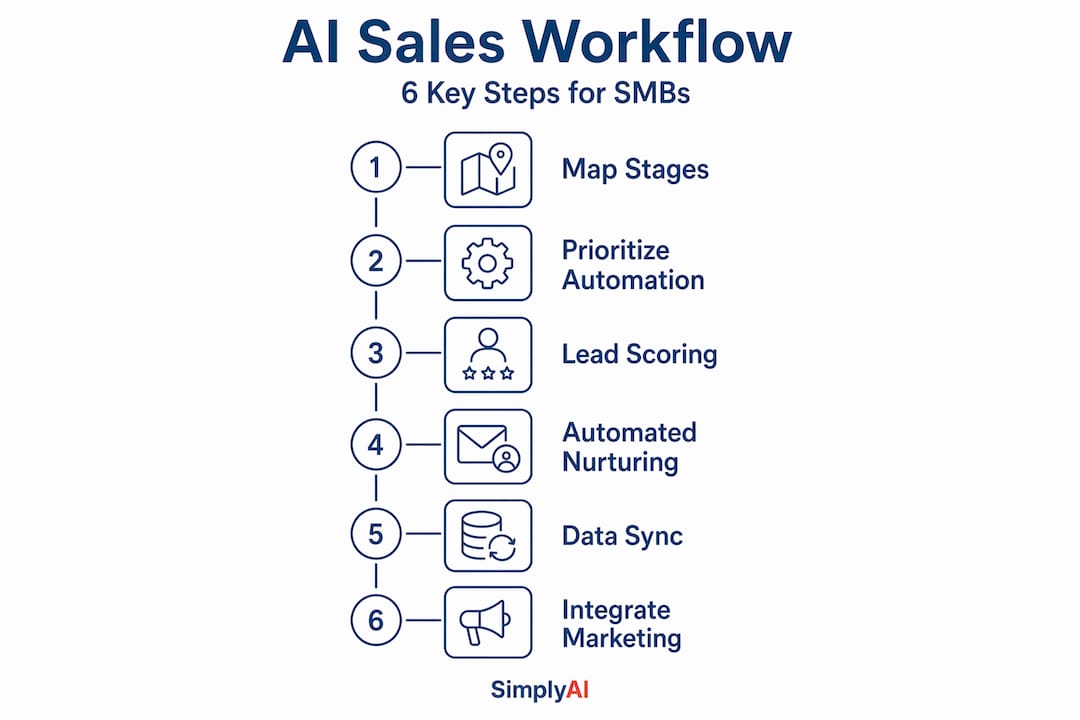
Step 3: Automate personalized email outreach. Use large language models to generate first drafts of outreach emails that incorporate prospect-specific context: their industry, recent company news, and their position in the funnel. Reps review and send, but the time investment drops from minutes to seconds per email. Salesforce Einstein benchmarks show that lead scoring improves conversion for high-score leads by 34%, while activity capture improves logging from 40% to 85%.
Step 4: Build trigger-based follow-up sequences. Configure workflow triggers based on buyer signals such as email opens, link clicks, page visits, or demo requests. When a prospect takes a high-intent action, the system automatically queues a follow-up task or sends a personalized message. Agentic AI systems like Microsoft's Sales Opportunity Agent go even further, monitoring open deals autonomously, flagging risks, and recommending next actions without waiting for a rep to notice a stalled opportunity.
Step 5: Automate CRM data sync and activity capture. Every email sent, call logged, and meeting booked should flow into the CRM automatically. Manual data entry is eliminated, records stay current, and managers gain accurate pipeline visibility without nagging reps for updates. A well-configured AI CRM integration can reduce administrative time by 30 to 50 percent for the average SMB sales team.
Step 6: Connect your marketing and sales automation layers. Ensure that your AI marketing automation workflows feed enriched contact data into the sales workflow seamlessly. When marketing nurtures a lead to a qualification threshold, the handoff to sales should be automatic and instantaneous, not dependent on a human to notice a score change.
Pro Tip: Focus on buyer signals at each stage rather than time-based triggers alone. A prospect who visits your pricing page twice in 48 hours is far more valuable to follow up with than one who simply received an email three days ago. Signal-based triggers consistently outperform calendar-based ones in conversion rate testing.
The efficiency gains from this approach are substantial and measurable. The table below summarizes typical performance improvements SMBs can expect after full implementation.
| Workflow area | Before AI automation | After AI automation | Improvement |
|---|---|---|---|
| Lead response time | 4 to 8 hours | Under 5 minutes | 95% reduction |
| CRM data entry accuracy | 60 to 70% | 90 to 95% | 25 to 35% gain |
| Email personalization at scale | 10 to 15 per rep per day | 50 to 100 per rep per day | 5x throughput |
| Sales cycle length | Baseline | 30 to 50% shorter | Varies by industry |
| Forecast accuracy | 50 to 60% | 75 to 85% | 20 to 25% gain |
Measuring and optimizing your AI-driven workflow
After implementation, measuring outcomes and identifying bottlenecks is vital for ongoing success. Deploying AI tools and walking away is not a strategy. The workflows need continuous monitoring, and the data they generate should inform regular optimization cycles.
The primary metrics to track include lead-to-opportunity conversion rate, average sales cycle length, revenue per rep, email response rates by sequence, and CRM data completeness scores. Each of these metrics maps directly to a specific part of the automated workflow, making it straightforward to trace performance changes back to specific automation rules.
The performance case for AI-driven sales workflows is compelling. AI-augmented reps achieve 41% higher revenue per rep, generating $1.75M versus $1.24M for non-augmented reps, while actually completing 18% fewer activities. This counterintuitive finding reflects the quality-over-quantity shift that AI enables: reps engage fewer, better-qualified prospects with more relevant messages at more opportune moments. For SMBs specifically, AI automations yield 30 to 44% ROI across key activities, with lead scoring returning approximately 38% and email agents returning approximately 44%.
The troubleshooting checklist for underperforming AI workflows focuses on four areas. First, verify that lead scoring models are being retrained regularly as your customer profile evolves. Second, check that trigger logic reflects current buyer behavior rather than assumptions made during initial setup. Third, audit email templates for relevance, since AI-generated content can drift toward generic over time without human review. Fourth, confirm that CRM data pipelines are still clean and that new contact fields are being populated correctly.
Data-driven automation works best when it is treated as a living system rather than a one-time implementation. Set a monthly review cadence for key metrics and a quarterly deep dive for model retraining and workflow redesign. Personalization strategies should also be revisited quarterly, as market conditions and buyer preferences shift faster than most static workflow configurations can accommodate.
Pro Tip: Create a simple dashboard that surfaces your three most important workflow metrics in real time. When a metric moves outside its normal range, investigate the specific automation stage responsible rather than making broad changes. Surgical adjustments preserve what is working while fixing what is not.
The real impact and limits of AI in SMB sales workflows
Beyond stats and setup, here is a candid view on what AI-driven sales workflows mean for SMBs in practice. The efficiency gains are real. The ROI figures cited above are not outliers. But the implementation reality is more nuanced than a technology vendor's pitch deck suggests.
AI genuinely excels at the tasks that drain sales reps without delivering proportional returns: data entry, sequence management, initial qualification logic, and pipeline reporting. These are high-volume, low-judgment activities where machine consistency beats human effort every time. Where AI falls short is equally clear: it cannot read the room on a difficult discovery call, navigate a complex stakeholder dynamic, or build the trust that turns a skeptical buyer into a long-term client. AI excels at scale and grunt work but consistently fails at relationship-building and nuanced judgment, and 59% of sales reps still express fear about job displacement from automation.
The adoption pattern we observe is telling: when AI recommendations are surfaced within a rep's existing workflow, action rates reach 38%, compared to just 8% when the same insights are delivered through a separate AI tool or dashboard. The technology must fit the human, not the other way around. Forcing reps to learn new interfaces or change their behavioral patterns dramatically undermines adoption, regardless of how sophisticated the underlying AI is.
Our perspective is direct: AI should amplify the sales team's capacity, not attempt to replace its judgment. The businesses that extract the most value from AI business strategies treat their reps as pilots, not passengers. They use AI to handle the altitude controls so the human can focus on navigation and communication. This philosophy is not just philosophically sound; the data supports it. Augmented reps outperform both fully manual reps and teams that over-automate at the expense of authentic engagement.
Unlock sales growth with AI-powered solutions
If the step-by-step guide above resonates with challenges your sales team faces today, the next step is connecting it to solutions that are purpose-built for SMBs rather than retrofitted from enterprise platforms.
At SimplyAI, we design and implement AI-driven workflow automations tailored to your specific sales motion, from lead scoring logic to CRM sync and multi-channel outreach sequences. Our AI agents for sales operate autonomously within your existing tools, surfacing buyer signals and triggering actions without adding complexity for your team. And for businesses that want their teams to grow alongside the technology, our AI corporate education programs ensure adoption rates stay high and ROI compounds over time. The transformation starts with a single conversation about where your workflow stands today.
Frequently asked questions
What sales tasks can AI automate for small businesses?
AI-driven workflows automate lead generation, qualification, nurturing, outreach, follow-ups, and CRM updates using tools like HubSpot Breeze, Salesforce Einstein, Pipedrive AI, and Outreach Omni. This covers the majority of repetitive sales tasks without requiring additional headcount.
How much ROI can SMBs expect from AI-driven sales workflows?
SMBs typically see 30 to 44% ROI from AI automations, with lead scoring returning around 38% and email agents around 44%. AI-augmented reps also generate 41% higher revenue per rep on average.
Which AI tools are best for automating SMB sales workflows?
Popular choices include HubSpot Sales Hub, Salesforce Einstein, and Pipedrive AI, each offering different strengths depending on team size, budget, and workflow complexity. HubSpot suits all-in-one needs, while Pipedrive is ideal for smaller, founder-led sales teams.
Can AI replace sales reps completely?
AI cannot replace the relationship-building and nuanced judgment that define high-value sales interactions. It handles scale and repetition exceptionally well, but human reps remain essential for complex deal navigation and trust development.
How can I make sure AI-powered workflows actually deliver results?
Track conversion rates, sales cycle length, and revenue per rep consistently after implementation, then run monthly optimization reviews and quarterly model retraining cycles to ensure the workflow adapts as your customer profile evolves.