

TL;DR:
- SMBs are successfully using machine learning to automate tasks and improve decision-making.
- Supervised learning is the most practical starting point for small businesses to gain immediate value.
- Practical ML focuses on clean data, clear business problems, and gradual implementation to avoid common pitfalls.
Machine learning is no longer the exclusive domain of Silicon Valley giants or teams of data scientists with PhD-level credentials. Small and medium-sized businesses are already using it to automate repetitive tasks, predict customer behavior, and make smarter operational decisions every day. Yet many SMB owners still believe this technology sits out of reach, buried under layers of complexity and cost. That assumption is wrong, and holding onto it is expensive. This guide breaks down what machine learning actually means for a business like yours, explains the main types in plain terms, and shows you exactly where to start.
Table of Contents
- Machine learning explained: What every business owner needs to know
- Types of machine learning: From prediction to process optimization
- Machine learning in action: Real-world uses for SMBs
- Common pitfalls and practical tips for SMBs integrating ML
- Our perspective: Why practical machine learning beats theory for SMBs
- Ready to integrate machine learning? Take the next step
- Frequently asked questions
Key Takeaways
| Point | Details |
|---|---|
| ML is accessible for SMBs | Small and medium businesses can successfully use machine learning to automate tasks and improve decisions. |
| Supervised learning is SMB-friendly | Start with supervised learning for prediction tasks like sales forecasting before exploring more advanced approaches. |
| Practical integration matters | No-code platforms and CRM add-ons enable business owners to use ML without technical expertise. |
| Data quality drives results | High-quality, well-labeled data helps ML models deliver reliable business value and avoids costly mistakes. |
Machine learning explained: What every business owner needs to know
Now that we've challenged common misconceptions, let's explore what machine learning really means for business owners. At its core, machine learning (ML) is a category of artificial intelligence where computer systems improve their performance by learning from data and experience rather than following rigid, pre-written rules. Think of it this way: instead of telling software precisely what to do in every scenario, you feed it examples, and it figures out the patterns on its own.
For an SMB owner, that distinction matters enormously. Traditional software automates tasks you already know how to define step by step. Machine learning handles tasks where the rules are too complex, too numerous, or constantly shifting, like predicting which customers are likely to churn or which inventory items will spike in demand next month.
The three major types of machine learning that every business owner should know are:
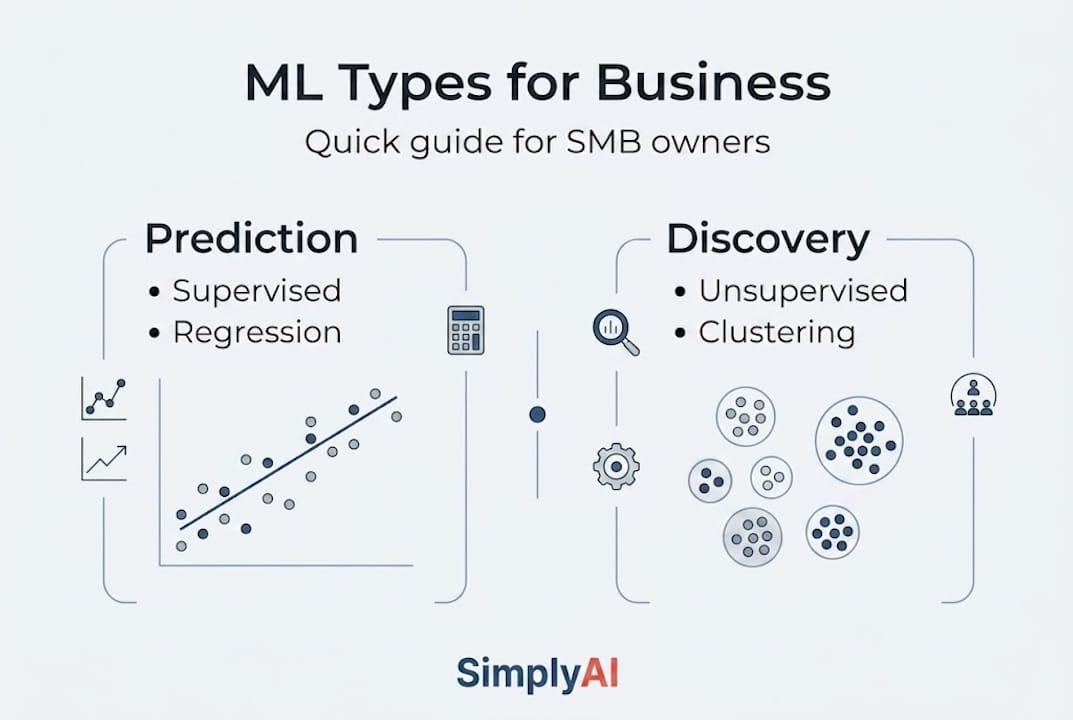
- Supervised learning: The model trains on labeled data, meaning each example comes with the correct answer. You show it thousands of invoices and whether each was paid on time or late, and it learns to predict payment risk for future invoices.
- Unsupervised learning: The model finds hidden patterns in data without any pre-set labels. You give it your customer database and it clusters customers into segments you didn't know existed.
- Reinforcement learning: An agent learns by trial and error, receiving rewards for good decisions and penalties for bad ones, gradually developing strategies for complex, sequential tasks.
Supervised learning is the most immediately practical for SMBs. According to machine learning fundamentals, supervised models train on input-output pairs and minimize a loss function (such as mean squared error for regression or cross-entropy for classification) through optimization techniques like gradient descent. Common algorithms include random forests and support vector machines (SVMs), tools that are now embedded in many no-code platforms and CRM systems.
"Machine learning shifts the competitive advantage from who has the most employees to who has the smartest systems."
The business value crystallizes quickly when you consider demand forecasting. An SMB retailer can feed its historical sales data, seasonal trends, and even local weather patterns into a supervised learning model and get inventory predictions that reduce both overstock and stockouts. That is a direct, measurable impact on cash flow. Exploring predictive analytics for SMBs reveals that businesses adopting this approach consistently see efficiency gains across procurement and operations. The barrier to entry, once daunting, has dropped significantly thanks to cloud-based platforms that handle the heavy mathematical lifting behind the scenes.
Pro Tip: If you're new to ML, the best starting point is identifying one business decision you make repeatedly using imperfect information. That is almost certainly a problem a supervised learning model can improve within months.
Types of machine learning: From prediction to process optimization
With the basics covered, let's dive deeper into the main machine learning types and their uses for small businesses. Each type solves a different category of problem, and choosing the right one saves time, money, and frustration.
Supervised learning in practice shines brightest when you have historical records tied to outcomes. A small e-commerce business predicting which of its website visitors will convert to buyers is using supervised learning. So is a service firm forecasting next quarter's revenue based on pipeline data. The model learns from past wins and losses, then applies that knowledge forward. The output is a concrete, actionable prediction: this lead has a 72% probability of converting, or that shipment has a high risk of delay.

Unsupervised learning is less about prediction and more about discovery. Feed it your raw customer transaction data and it will surface natural groupings you never explicitly defined, perhaps identifying a segment of high-frequency, low-spend buyers who respond well to loyalty programs, versus infrequent but high-value purchasers who respond to premium offers. That kind of insight directly powers personalized marketing without requiring a marketing PhD to design the segments manually.
Reinforcement learning operates differently. As noted by machine learning fundamentals, an RL agent interacts with its environment and maximizes cumulative reward using policies like Q-learning or Proximal Policy Optimization (PPO), making it well suited for sequential decision-making tasks like inventory optimization. For SMBs, this translates to systems that continuously adjust reorder points based on real-time demand signals rather than static rules someone set up three years ago.
Here is a direct comparison to help clarify which type fits your situation:
| Type | Learns from | Strength | Common SMB use case |
|---|---|---|---|
| Supervised | Labeled data (inputs + correct answers) | Accurate predictions on known tasks | Sales forecasting, churn prediction |
| Unsupervised | Unlabeled data | Finding hidden patterns and groupings | Customer segmentation, anomaly detection |
| Reinforcement | Trial and error with rewards | Optimizing sequential decisions | Inventory management, dynamic pricing |
To get started effectively, consider this progression:
- Identify a forecasting or classification task (supervised learning territory).
- Collect at least six months of historical data with clear outcome labels.
- Choose a no-code platform or CRM with built-in ML capabilities.
- Run a pilot, validate the outputs against known results, and then scale.
Understanding types of automation for SMBs shows how these ML types plug directly into automation workflows, turning predictions into triggered actions without human intervention at every step.
Pro Tip: Start with supervised learning for predicting business outcomes. It has the clearest success criteria and the most accessible tooling for businesses without dedicated data science teams.
Machine learning in action: Real-world uses for SMBs
Understanding ML types leads naturally to how businesses put them to practical use. The gap between theory and application is narrower than most SMB owners realize, particularly when no-code and low-code platforms now serve as the bridge.
Automating invoicing and accounts receivable is one of the fastest wins available. Supervised learning models trained on payment histories can flag which outstanding invoices carry the highest collection risk, allowing your team to prioritize follow-ups rather than treating every unpaid invoice the same. This kind of targeted approach can meaningfully reduce days sales outstanding (DSO) without adding headcount.
Predicting marketing response represents another high-value use case. Rather than sending promotional emails to your entire list and hoping for the best, a trained model can score each contact by predicted response probability. You reach the right people, reduce list fatigue, and improve return on ad spend. This is not speculative technology. MDPI machine learning research shows that gradient boosting models achieve 75.4% balanced accuracy and a ROC AUC of 0.815 in predicting SME investment readiness, and deep learning outperforms traditional ML on small tabular datasets with high kurtosis, demonstrating the empirical power these approaches bring to business prediction problems.
Customer segmentation through unsupervised learning enables you to tailor your product catalog, pricing tiers, and service levels to how customers actually behave rather than how you assume they behave. A hospitality business using this approach might discover that a previously invisible segment of midweek business travelers responds 40% better to loyalty perks than weekend leisure guests, a finding that reshapes its entire upsell strategy.
Here is a snapshot of how ML use cases map to measurable business outcomes:
| Use case | ML type | Business outcome |
|---|---|---|
| Invoice risk scoring | Supervised | Reduced DSO, improved cash flow |
| Marketing response prediction | Supervised | Higher conversion, lower ad cost |
| Customer segmentation | Unsupervised | Personalized offers, increased LTV |
| Inventory optimization | Reinforcement | Fewer stockouts, lower holding costs |
| Anomaly detection (fraud) | Unsupervised | Reduced financial losses |
"The businesses gaining the most from machine learning are not the largest ones; they are the most organized ones."
Reviewing ML integration case studies confirms that SMBs who begin with clearly scoped, data-rich problems consistently achieve faster returns than those attempting broad, enterprise-scale rollouts from the start. The lesson is precision over ambition in the early stages.
Common pitfalls and practical tips for SMBs integrating ML
Even with the benefits, business owners need to watch out for common traps and optimize their ML adoption. Machine learning delivers results only when the underlying conditions support it, and several hidden costs can erode the value if ignored.
Data labeling costs are the most frequently underestimated expense. Supervised learning requires labeled data, and labeling takes time, expertise, and sometimes money. A retailer wanting to predict customer return rates needs historical records where the outcomes are clearly tagged. If your data is unstructured, incomplete, or siloed across systems, the cost of cleaning and labeling it can exceed the initial budget estimates by a significant margin.
Bias from poor labels and distribution shifts present a subtler risk. As machine learning fundamentals notes, supervised models suffer from data labeling costs, bias from poor labels, and poor generalization to distribution shifts; unsupervised models face ambiguous validation and irrelevant patterns; and reinforcement learning systems encounter exploration-exploitation tradeoffs, sample inefficiency, and reward hacking. In business terms, this means a model trained on pre-pandemic customer data may perform poorly in post-pandemic conditions because the underlying patterns shifted dramatically. Periodic retraining is not optional; it is maintenance.
Ambiguous validation is a trap that unsupervised learning users fall into frequently. Clustering algorithms will always produce clusters. The harder question is whether those clusters reflect meaningful business reality or mathematical artifacts. Without tying unsupervised outputs back to clear business metrics (like revenue per segment or campaign response rate), it is easy to optimize for patterns that do not actually matter.
Reward hacking in reinforcement learning occurs when an RL agent finds unexpected ways to maximize its reward signal that do not align with the intended business goal. An inventory optimization agent rewarded purely for minimizing stockouts might solve the problem by always ordering maximum quantities, driving up storage costs dramatically.
The process automation benefits are real, but they require disciplined implementation. Organizations using automation strategies for SMBs that combine ML with structured process design consistently outperform those that treat ML as a plug-and-play solution.
Key risks to monitor during any ML integration:
- Data quality gates: Establish minimum data completeness thresholds before training any model.
- Business validation checkpoints: Every model output should be reviewed against actual business outcomes during the first 90 days.
- Scope control: Resist the temptation to expand ML use cases before validating the first one thoroughly.
- Retraining schedules: Build periodic model updates into your operational calendar, not as an afterthought.
Pro Tip: Start with low-stakes automation, like categorizing support tickets or scoring leads, before applying ML to critical processes like financial forecasting or supply chain decisions. Proving value at the margins builds the organizational trust needed for larger deployments.
Our perspective: Why practical machine learning beats theory for SMBs
With pitfalls in mind, here's our candid take on practical machine learning for SMBs. The technology industry has a habit of overhyping the newest, most complex algorithms, and machine learning is no exception. Many SMB owners feel pressure to explore deep learning and neural networks because that is where the headlines point. In most cases, that instinct leads to unnecessary complexity and disappointing results.
The evidence supports a more pragmatic position. Arxiv ML research demonstrates that traditional ML models, particularly tree-based ensembles, often match or exceed deep learning performance on the tabular data that characterizes most SMB datasets. Hybrid approaches that combine paradigms are recommended for robustness. In plain terms: a well-tuned random forest model working on clean sales data will outperform an elaborate neural network trained on the same imperfect dataset almost every time.
The real competitive edge for SMBs does not come from chasing algorithmic sophistication. It comes from having clean, well-organized data and connecting it to a clear business question. No-code and low-code ML platforms have made this achievable for teams without data science backgrounds. The businesses building sustainable advantages are those focused on results and process integration, not buzzword compliance. Building a data-driven workflow for SMBs grounded in practical ML is the path that consistently delivers measurable returns.
Ready to integrate machine learning? Take the next step
For SMBs ready to move from research to action, here's how SimplyAI can help.
Machine learning becomes powerful when it is embedded directly into the operations that drive your business. SimplyAI designs and implements AI automations for business that translate ML insights into automated workflows, reducing manual work and improving decision speed across your organization.
Whether you need intelligent AI agent solutions that handle customer interactions autonomously, or you want to build internal capability through structured AI education for SMB teams, SimplyAI delivers solutions calibrated to your business size, data maturity, and growth targets. The goal is measurable results, not theoretical elegance. Reach out to explore which ML application fits your operations today.
Frequently asked questions
What is the difference between supervised, unsupervised, and reinforcement learning?
Supervised learning trains on labeled data pairs, unsupervised finds patterns without predefined labels, and reinforcement learning develops strategies through trial and error to maximize cumulative rewards. Each type suits a different category of business problem.
How can SMB owners start using machine learning?
Begin with supervised learning for forecasting tasks and unsupervised learning for customer segmentation, leveraging no-code AI platforms or CRM integrations that remove the need for deep technical expertise. A focused pilot on one business problem is always the most effective starting point.
Are deep learning algorithms always better than traditional ML for SMBs?
No. Tree-based ensembles frequently match or exceed deep learning performance on the tabular datasets most SMBs work with, and hybrid approaches combining multiple paradigms deliver greater robustness at lower operational cost.
What are the most common mistakes SMBs make with machine learning?
The most frequent errors are underestimating data labeling costs, working with poor quality or biased data, and skipping proper business validation of model outputs before deploying them in live operations.