

TL;DR:
- Predictive analytics uses historical data to forecast future business outcomes and improve decisions.
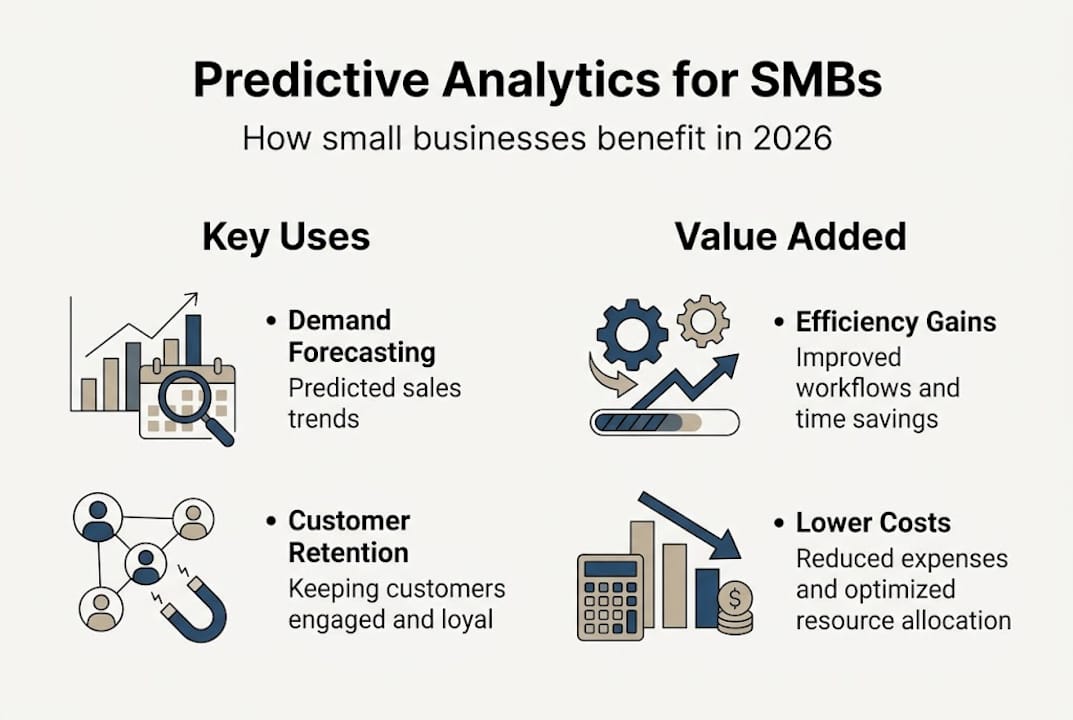
- SMBs can benefit from demand forecasting, customer retention, and operational efficiency gains.
- Starting simple with clear goals, clean data, and integrated workflows enables effective adoption without high costs.
Most small and medium-sized business owners assume predictive analytics belongs to the world of enterprise giants with armies of data scientists and seven-figure technology budgets. That assumption is costing them. Predictive analytics, at its core, is about using patterns in your existing data to make smarter decisions about what happens next. Whether you're trying to reduce customer churn, optimize inventory, or forecast demand more accurately, these tools are now accessible, practical, and increasingly affordable. This article walks you through what predictive analytics actually is, how it works in a real business context, the benefits it delivers, the pitfalls to avoid, and the concrete steps you can take to start today.
Table of Contents
- What is predictive analytics and how does it work?
- Key business benefits of predictive analytics for SMBs
- Common pitfalls and limitations in predictive analytics
- Getting started: Practical steps for SMBs
- Our view: Why SMBs shouldn't fear predictive analytics
- How SimplyAI helps you seize predictive analytics opportunities
- Frequently asked questions
Key Takeaways
| Point | Details |
|---|---|
| Predictive analytics defined | It uses data and algorithms to predict business outcomes for improved decisions. |
| Business benefits for SMBs | SMBs leverage predictive analytics to increase sales, retain customers, and operate more efficiently. |
| Know the limitations | Expect data bias, rare event blind spots, and the need for ongoing monitoring when using predictive analytics. |
| Human judgment matters | Predictive models work best when paired with real-world business experience and regular review. |
| Start small, scale impact | Begin with clear goals and available tools, then expand predictive analytics as you see value. |
What is predictive analytics and how does it work?
Predictive analytics is the practice of using historical data, statistical algorithms, and machine learning models to estimate the likelihood of future outcomes. It doesn't tell you exactly what will happen. It gives you a well-informed probability based on patterns your business has already generated. Think of it as turning your past performance into a forward-looking decision engine.
To understand its unique value, it helps to place it alongside its siblings. Descriptive analytics answers what happened, using reports, dashboards, and summaries. Diagnostic analytics answers why it happened, identifying root causes and correlations. Predictive analytics answers what will happen, and as Coursera notes, it is inherently limited in novel scenarios where historical patterns don't apply. Prescriptive analytics goes one step further and recommends what to do about it. Most SMBs are already doing descriptive analytics without calling it that. Predictive analytics is the natural, powerful next step.
The workflow follows a repeatable process. First, you collect relevant data, such as sales transactions, customer interactions, or inventory records. Second, you clean and prepare that data, removing errors and filling gaps. Third, you select a predictive model suited to your question, whether that's a regression model for forecasting numbers or a classification model for predicting customer behavior. Fourth, you train and test the model on your data to validate its accuracy. Fifth, you deploy it as a decision-support tool embedded in your daily operations. You can learn more about structuring this process through AI data analysis for SMBs.
For SMBs, the most common and immediately valuable use cases include:
- Sales forecasting: Predict next month's revenue based on seasonality, promotions, and pipeline data.
- Inventory optimization: Avoid overstocking or stockouts by anticipating demand shifts.
- Customer churn prediction: Identify clients showing early warning signs of disengagement before they leave.
- Lead scoring: Prioritize prospects most likely to convert, saving your sales team time.
Building data-driven workflows around these outputs is what transforms a predictive model from an interesting experiment into a genuine business asset. The key insight is that predictive analytics works best when your environment is relatively stable. The more consistent your historical patterns, the more reliable your forecasts will be.
Key business benefits of predictive analytics for SMBs
Now that we know what predictive analytics is, let's look at the actual business advantages SMBs can realize.
The most immediate benefit is more precise demand forecasting. Instead of ordering inventory or staffing based on gut instinct or last year's spreadsheet, you're working from a model that accounts for dozens of variables simultaneously. This directly reduces waste, improves cash flow, and ensures you can actually meet demand when it spikes.
Customer retention is another area where predictive analytics delivers outsized returns. Acquiring a new customer costs significantly more than retaining an existing one. When your model flags a long-term client as showing churn signals, such as declining purchase frequency or reduced engagement, your team can intervene with a targeted offer or personal outreach before that client walks out the door. Pairing this with data-driven marketing strategies creates a powerful retention engine.
Operational efficiency gains are equally significant. Predictive models applied to supply chain management can anticipate bottlenecks, flag supplier delays before they cascade, and help you allocate labor resources more effectively during high-demand periods. This is where automation efficiency and predictive analytics begin to overlap, creating compound operational advantages.

The critical nuance, however, is that ROI comes through action loops, not from models alone. A prediction sitting in a dashboard that nobody acts on generates zero value. The businesses that realize genuine returns are those that embed predictive outputs directly into their decision-making routines.
Pro Tip: Use predictive insights to inform, not replace, human judgment. A model might flag a customer as high-churn risk, but your account manager knows that client just went through a leadership change. Human context closes the gap that data alone cannot.
The compounding effect of these benefits is what makes predictive analytics so strategically important. Each improvement feeds the next. Better forecasting reduces costs, freeing capital for smarter marketing, which generates richer customer data, which improves your next round of predictions.
Common pitfalls and limitations in predictive analytics
While the benefits are compelling, there are critical limitations and pitfalls SMBs must anticipate.
Predictive models are only as reliable as the conditions they were trained on. As research on AI failure modes makes clear, these systems can break down on rare events, distribution shifts, adversarial inputs, and can systematically amplify historical bias. Understanding these failure modes before deployment is not optional. It's essential.
Here are the five most common pitfalls SMBs encounter:
- Overfitting: The model learns your training data too precisely and performs poorly on new, real-world data.
- Data shift: Business conditions change, making historical patterns unreliable as predictors.
- Feedback loops: Acting on predictions changes behavior, which then distorts future predictions.
- Bias amplification: If your historical data reflects past biases, your model will reproduce and scale them.
- Lack of interpretability: Complex models, often called "black boxes," produce outputs that are difficult to explain or justify to stakeholders.
Comparing realistic expectations against common myths helps clarify the path forward:
| Common myth | Realistic expectation |
|---|---|
| Predictions are always accurate | Models produce probabilities, not certainties |
| More data always means better results | Clean, relevant data outperforms raw volume |
| One model fits all scenarios | Different questions require different model types |
| Models work indefinitely once deployed | Regular retraining is essential as context shifts |
| AI replaces the need for human review | Human oversight remains critical throughout |
The AI-assisted analytics guide offers deeper context on how to structure oversight for these tools. Building toward an AI-first organization means creating processes where humans remain actively engaged in reviewing and validating model outputs.
Pro Tip: Continually retrain and monitor models as business context changes. Set a calendar reminder to review model performance quarterly, or whenever a major market shift occurs.
Getting started: Practical steps for SMBs
To turn insights into action, here's how SMBs can launch their first predictive analytics project.
Before choosing any tool or hiring any consultant, your team needs to answer four foundational questions:
- What is the specific business decision we want to improve?
- What data do we already have that relates to this decision?
- How will we act on the predictions once we have them?
- How will we measure whether the model is actually helping?
These questions prevent the most common failure mode in analytics projects: building something technically impressive that nobody uses.
Once you have clear answers, follow this practical sequence:
- Identify your highest-impact use case. Start with a single, focused problem, such as predicting which customers are likely to churn in the next 90 days. Narrow scope produces faster results and clearer learning.
- Gather and clean your historical data. This step is unglamorous but decisive. Inconsistent formats, missing values, and duplicate records will corrupt your model's output before it even runs.
- Choose your approach. Off-the-shelf tools like built-in CRM analytics, Google's Looker, or Microsoft's Power BI offer accessible starting points. More complex or customized needs may warrant expert implementation support.
- Integrate predictions into your daily workflows. A churn score only matters if your account team sees it and acts on it. Embed outputs into the tools your staff already use.
- Measure, iterate, and improve. As experts note, models excel in stable patterns but require continuous retraining paired with human judgment to remain effective over time.
Exploring AI automation benefits can help you identify where predictive outputs slot most naturally into your existing operations. Building a centralized intelligence layer across your business systems amplifies the value of every prediction you generate by making insights available across departments in real time.
The starting point doesn't need to be ambitious. A single well-deployed model, acting on reliable data, integrated into one key workflow, can generate measurable ROI within months.
Our view: Why SMBs shouldn't fear predictive analytics
Having explored both benefits and pitfalls, here's our perspective on what most SMBs consistently miss about predictive analytics.
The dominant fear is complexity. Business owners imagine that predictive analytics requires specialized infrastructure, large data science teams, and months of technical setup before anything useful emerges. That picture is outdated. The real barrier in 2026 isn't technology. It's organizational mindset and the willingness to act on data rather than instinct.
What we observe is that the SMBs making the most progress aren't starting with the most sophisticated models. They're starting with clear business questions, clean data, and a genuine commitment to using predictions in their decision loops. The technology follows naturally from that foundation.
Predictive analytics doesn't require perfection. A model that's right 70% of the time is still dramatically better than guesswork. When you pair AI-driven insights with experienced human judgment, you close the remaining gap effectively. Most SMBs are far closer to capturing this competitive advantage than they realize. The decision to start is the hardest one.
How SimplyAI helps you seize predictive analytics opportunities
Ready to put predictive analytics into action? Here's how SimplyAI empowers your journey.
At SimplyAI, we work with small and medium-sized businesses to design and implement practical AI solutions that generate measurable results, not theoretical models that collect dust. Whether you're exploring your first data-driven project or ready to scale existing automation, our team brings the technical expertise and business context to make it work.
Our AI automation solutions are tailored to your specific workflows, and our AI agents for SMBs can integrate predictive outputs directly into your customer-facing and operational processes. For teams building internal capability, our AI corporate education programs equip your staff to understand, evaluate, and act on predictive insights with confidence. The opportunity is real and the tools are ready. Let's put them to work.
Frequently asked questions
How is predictive analytics different from descriptive and prescriptive analytics?
Predictive analytics forecasts what will happen, while descriptive analytics explains what already happened and prescriptive analytics recommends specific actions to take next.
What is an example of predictive analytics in a small business?
A retailer using last year's sales data to estimate which products will sell fastest next quarter is a straightforward and common real-world example.
What are the main limitations of predictive analytics?
Predictive analytics can fail on rare events, amplify historical bias, and lose accuracy over time without regular monitoring and retraining.
Do I need expensive software to start with predictive analytics?
No. Many affordable and user-friendly tools, including cloud-based CRM platforms and business intelligence software, let SMBs begin with modest budgets and scale as results justify further investment.