
TL;DR:
- Modern semantic analysis AI understands meaning, intent, and context beyond simple keyword matching.
- It processes language through layered stages: lexical, grammatical, syntactical, and semantic analysis.
- Challenges include handling ambiguity, sarcasm, metaphors, and evolving language, requiring human oversight.
Most business owners assume AI reads text the way a search engine does — scanning for matching words and returning relevant results. That assumption is increasingly outdated. Modern AI systems powered by semantic analysis understand meaning, intent, and context behind human language, not just the keywords themselves. For small and medium-sized businesses, this distinction is far more than academic. It determines whether your chatbot frustrates customers or actually helps them, whether your analytics surface real insights or just noise. This guide breaks down what semantic analysis AI is, how it works, and why it represents a genuine opportunity for SMBs ready to compete smarter.
Table of Contents
- What is semantic analysis in AI?
- How does semantic analysis AI work?
- Key techniques and technologies powering semantic analysis
- Challenges and limitations in real-world use
- Semantic analysis AI vs. other AI approaches: What business owners need to know
- A practitioner's perspective: What most guides overlook about semantic AI
- Unlock semantic analysis AI for your business
- Frequently asked questions
Key Takeaways
| Point | Details |
|---|---|
| Goes beyond keywords | Semantic analysis AI interprets meaning, intent, and context—not just keyword matches. |
| Layered AI process | Understanding text involves multiple analytical stages before extracting true meaning. |
| Technique variety | Methods like NER, word embeddings, and knowledge graphs power advanced semantic AI. |
| Has clear limitations | Ambiguity, idioms, and cultural context can lead to failures in real-world applications. |
| Drives business value | When implemented thoughtfully, semantic analysis AI improves customer engagement and operations. |
What is semantic analysis in AI?
Semantic analysis in AI refers to the ability of a system to interpret the meaning of language, not just its surface-level structure. Where traditional keyword-based tools match words to patterns, semantic AI identifies relationships, resolves ambiguity, and extracts intent from context. It is a foundational component of natural language processing (NLP), the field that enables machines to work with human language in a meaningful way.
Consider a simple example. A customer sends a message: "I'm done with my plan." A keyword system might flag "plan" and route the message to a billing team. A semantic analysis system recognizes the phrase signals dissatisfaction or cancellation intent, triggering an entirely different response. That gap in understanding has real consequences for customer retention.
Semantic analysis interprets context by combining lexical, grammatical, and syntactical analysis — moving well beyond word-matching to capture what language actually communicates.
The core value for SMBs is straightforward. Customers rarely express themselves with perfectly structured sentences. They use slang, abbreviations, and implied meaning. Semantic AI bridges that gap, making your automated systems genuinely useful rather than technically functional but practically frustrating.
Semantic analysis also powers AI data analysis for better business decisions, enabling you to extract themes, patterns, and sentiment from unstructured text at scale. Whether it's reviewing customer emails, analyzing survey responses, or monitoring social media mentions, the technology translates raw language into actionable intelligence.
Key capabilities that semantic analysis adds over basic keyword tools:
- Identifying intent behind ambiguous phrasing
- Recognizing relationships between entities in text
- Understanding negation ("I do not want an upgrade")
- Connecting context across multiple sentences
- Resolving word meaning based on surrounding language
For businesses pursuing data-driven decision making, semantic analysis is the layer that makes unstructured data usable. It transforms conversations, reviews, and support tickets into structured intelligence you can act on.
How does semantic analysis AI work?
The process of semantic analysis is layered, moving from raw text to extracted meaning through a series of structured stages. Understanding these stages helps you see where AI systems succeed and where they struggle.
The four primary stages are:
- Lexical analysis — The text is broken into individual units called tokens (words, punctuation, symbols). Each token is assigned a basic grammatical role.
- Grammatical analysis — The system identifies parts of speech: nouns, verbs, adjectives. This step determines how words function in a sentence.
- Syntactical analysis — Sentence structure is mapped. The system builds a parse tree showing how words relate to each other grammatically.
- Semantic analysis — Meaning is extracted. The system interprets what the sentence actually communicates, considering context, relationships, and intent.
These four stages of processing work in sequence, with each layer informing the next. A failure at any earlier stage cascades into errors downstream.
| Stage | What it does | Business relevance |
|---|---|---|
| Lexical | Tokenizes and tags words | Foundational text preprocessing |
| Grammatical | Identifies parts of speech | Accurate sentence interpretation |
| Syntactical | Maps sentence structure | Enables relationship extraction |
| Semantic | Extracts meaning and intent | Powers chatbots, analytics, search |
Practically speaking, this pipeline is what allows intent recognition in AI systems to distinguish between a customer asking a billing question versus raising a complaint — even when the phrasing looks similar on the surface.
Pro Tip: When a chatbot or AI tool misunderstands customers repeatedly, trace the failure back to these stages. Is it misidentifying words (lexical), misreading sentence structure (syntactical), or failing to capture intent (semantic)? Each requires a different fix.
For SMBs deploying customer support automation, survey analysis, or AI-assisted workflows, understanding this pipeline gives you a sharper lens for evaluating vendor claims and diagnosing performance gaps before they cost you customers.
Key techniques and technologies powering semantic analysis
Several specialized techniques sit beneath the surface of any robust semantic AI system. Knowing them helps you evaluate tools intelligently and ask better questions when assessing vendors.
The primary methodologies include NER, Word Sense Disambiguation, Semantic Role Labeling, Distributional Semantics, and Knowledge Graphs, each addressing a distinct challenge in language understanding.
| Technique | What it does | Business application |
|---|---|---|
| Named Entity Recognition (NER) | Identifies names, dates, locations, organizations | CRM enrichment, contract analysis |
| Word Sense Disambiguation | Resolves multiple meanings of a word | Accurate search and chatbot responses |
| Semantic Role Labeling | Maps relationships between actions and actors | Workflow automation, process extraction |
| Distributional Semantics (BERT, Word2Vec) | Understands words by their context patterns | Recommendation engines, content analysis |
| Knowledge Graphs | Maps structured relationships between concepts | Enterprise search, intelligent Q&A |
Large language models (LLMs) like GPT-4 have dramatically expanded what semantic analysis can achieve, processing nuanced language at scale. However, LLMs are not a complete solution. They can hallucinate facts, struggle with highly specialized domain knowledge, and fail on uncommon terminology without proper grounding.
This is where semantic methodologies in AI get particularly interesting for practical deployment. The most capable business AI systems today combine LLMs with structured knowledge graphs, ensuring the model's reasoning is anchored to verified, domain-specific information.
Key considerations when evaluating semantic AI tools:
- Does the system support domain-specific fine-tuning?
- Can it handle industry terminology accurately?
- Is there transparency into how it reaches conclusions?
- Does it integrate with your existing data infrastructure?
Pro Tip: Pairing an LLM with a knowledge graph dramatically increases robustness for niche industries. A law firm's AI assistant, for example, performs far better when the language model is grounded in a legal ontology rather than relying solely on general training data. The same principle applies to healthcare, finance, and manufacturing. Explore semantic vs syntactic AI to better understand which approach fits your specific use case.
Challenges and limitations in real-world use
The technology is genuinely impressive. But responsible deployment means understanding exactly where it breaks down.
Semantic analysis AI faces persistent challenges with language that humans handle intuitively but that requires significant cultural and contextual knowledge to interpret correctly. The most common failure points include:
- Ambiguity — Words with multiple meanings that depend entirely on context
- Sarcasm and irony — Statements where the literal meaning is the opposite of the intended meaning
- Metaphors and idioms — Figurative language that doesn't map to literal definitions
- Ellipsis — Sentences where key information is implied rather than stated
- Cultural references — Context-dependent expressions that require shared background knowledge
The performance gap at the edges is significant. Research shows accuracy drops 73 to 100% in edge cases involving entity swaps, temporal reversals, and ambiguous pronoun references — scenarios that appear routinely in real customer communications.
Even the most advanced semantic AI systems encounter failure points that appear trivial to human readers. The practical implication is clear: AI should augment human judgment, not replace it entirely.
Consider a practical scenario. A customer emails: "My last order was fine, but this one is a disaster." A well-calibrated semantic system correctly identifies a negative sentiment about the current order. A poorly tuned one might average the sentiment and classify the email as neutral, burying a complaint that warrants immediate attention.

The solution is not to abandon semantic AI. It is to supplement it intelligently. Combining AI with human review workflows, especially for high-stakes interactions, remains the most reliable approach. Understanding AI edge cases before deployment prevents costly surprises. LLM limitations are well-documented, and informed businesses plan around them rather than discovering them in production.
Pro Tip: Always pilot semantic AI tools with a sample of real customer data from your own business before full deployment. Generic benchmarks rarely reflect the specific language patterns, abbreviations, and domain terminology your customers actually use.
Semantic analysis AI vs. other AI approaches: What business owners need to know
Not every business challenge calls for semantic analysis. Understanding how it compares to other AI strategies helps you invest wisely and match the right tool to the right problem.
The major approaches you'll encounter are semantic, syntactic, sentiment, and generative AI, each with distinct strengths and limitations.
| AI approach | Core focus | Best use case | Key limitation |
|---|---|---|---|
| Semantic analysis | Meaning and intent | Customer support, search, analytics | Struggles with ambiguity and metaphor |
| Syntactic analysis | Grammar and structure | Document formatting, grammar checking | Misses meaning entirely |
| Sentiment analysis | Emotional tone | Review monitoring, NPS analysis | Oversimplifies complex responses |
| Generative AI | Content creation | Drafting emails, reports, marketing copy | Can hallucinate facts |
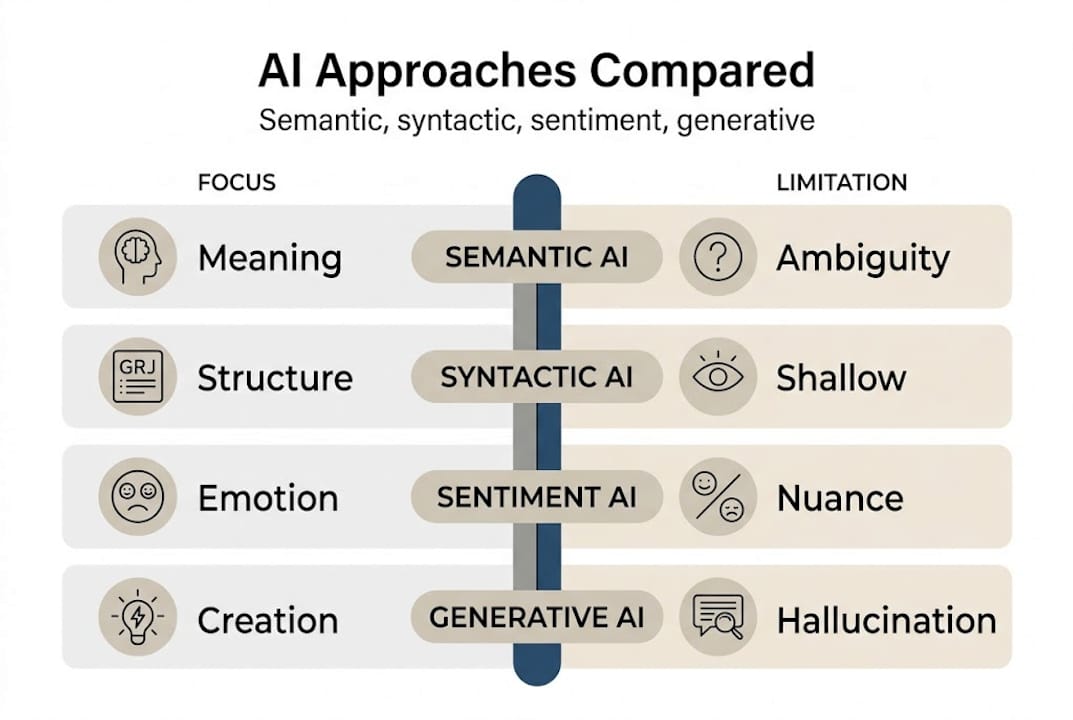
For SMBs, the practical question is which outcome you are trying to achieve. If you need to understand why customers are contacting you at scale, semantic analysis is the right foundation. If you want to track brand perception across reviews, sentiment analysis may suffice. If you need to automate content production, generative AI is your tool.
Common SMB applications that benefit from semantic analysis specifically:
- Routing support tickets by customer intent rather than keyword triggers
- Analyzing open-ended survey responses for recurring themes
- Building chatbots that handle nuanced, multi-step customer inquiries
- Extracting competitive intelligence from unstructured market data
Explore semantic vs syntactic differences in more depth to sharpen your vendor evaluation process. For businesses assessing conversational AI use cases, semantic analysis is nearly always the enabling technology behind any chatbot that handles something more complex than simple FAQs.
A practitioner's perspective: What most guides overlook about semantic AI
Most articles on semantic analysis AI present the technology as closer to "solved" than it actually is in production environments. The reality, observed across real SMB deployments, is more nuanced and demands a different strategic mindset.
The dominant misconception is that deploying a semantic AI tool is a one-time implementation. In practice, language is dynamic. Customer terminology evolves, new product names emerge, and industry slang shifts. A system calibrated today needs ongoing refinement to remain accurate six months from now.
Combining semantic AI with subject matter expertise consistently produces stronger outcomes than purely automated approaches. The businesses that see the best results are those that treat semantic AI as a collaborative tool rather than a replacement for human judgment.
Building toward AI-first organizations does not mean removing humans from the loop. It means designing systems where AI handles volume and humans handle edge cases and continuous improvement. Pilot aggressively, measure accurately, and iterate before scaling. That discipline separates businesses that extract real value from semantic AI and those that simply buy a tool and wonder why it underperforms.
Unlock semantic analysis AI for your business
Understanding semantic analysis AI is the first step. Putting it to work in your business is where the real advantage is built.
SimplyAI designs and implements AI solutions that embed advanced semantic analysis directly into your customer engagement and business automation workflows. From AI-powered automations that intelligently route and respond to customer inquiries, to intelligent AI agents that understand nuanced requests and take action autonomously, our implementations are built for SMBs that want measurable results, not theory. If you are ready to move from keyword-level tools to systems that genuinely understand your customers, the practical path forward starts with a conversation about your specific workflows and goals.
Frequently asked questions
How is semantic analysis different from keyword analysis?
Semantic analysis interprets context and meaning by combining lexical, grammatical, and syntactical analysis, while keyword analysis only scans for specific word matches without understanding intent or nuance.
What problems can semantic analysis AI help solve for small businesses?
Semantic AI enables better customer service, more accurate analytics, and improved automated workflows by understanding meaning, intent, and context rather than just surface-level word patterns.
What is an example of semantic analysis in business?
A chatbot that correctly distinguishes between a customer wanting to cancel versus pause a subscription is using semantic analysis, because it interprets meaning and intent rather than responding to a trigger word like "stop."
What are the main challenges with semantic analysis AI?
Ambiguity, metaphors, sarcasm, and complex context are the leading failure points, with research showing accuracy drops dramatically in edge cases — making human oversight and iterative testing essential components of any reliable deployment.