
TL;DR:
- SMBs can boost marketing efficiency by adopting AI tools tailored to their specific goals.
- Personalization through AI increases customer engagement and loyalty via relevant content and recommendations.
- Starting with small, measurable AI experiments helps SMBs avoid overwhelming complexity and achieve tangible results.
Top AI marketing tips to boost SMB engagement in 2026
Running marketing for a small or medium-sized business has never been more demanding. Between managing social media, nurturing leads, crafting email campaigns, and analyzing results, the workload can feel relentless. Yet the businesses pulling ahead are not necessarily the ones with the biggest budgets. They are the ones adopting AI to work smarter, automate the routine, and engage customers at a level of precision that was once reserved for enterprise giants. This article delivers actionable, practical AI marketing tips tailored specifically for SMB owners who want measurable results without the technical overwhelm.
Table of Contents
- How to choose the right AI tools for your marketing
- Personalization: Using AI to tailor marketing for better results
- AI automation: Streamline repetitive marketing tasks
- Predictive analytics and data-driven decision making
- Why most AI marketing advice gets it wrong for SMBs
- Take your SMB's marketing further with AI solutions
- Frequently asked questions
Key Takeaways
| Point | Details |
|---|---|
| Start with clear goals | Choose AI marketing tools based on your specific business objectives, not hype. |
| Leverage personalization | AI-driven personalization makes marketing more relevant and effective for your customers. |
| Automate for efficiency | Use AI to handle repetitive marketing tasks and free up your time for high-impact work. |
| Embrace predictive analytics | Let AI help you forecast results and make better marketing decisions with less guesswork. |
| Focus on what works | Prioritize simple, maintainable AI strategies over chasing every new trend. |
How to choose the right AI tools for your marketing
Selecting the right AI tools is the foundation of any effective AI marketing strategy. Without a clear selection process, it is easy to get distracted by flashy platforms that do not actually solve your core business problems. The key is to start with your marketing goals and work backward to the technology, not the other way around.
Begin by mapping your most pressing marketing needs. Are you struggling to generate leads consistently? Is customer retention your weak point? Do you want to increase engagement on email campaigns? Each challenge points toward a different category of AI tool. Lead generation needs differ significantly from retention automation, and understanding this distinction saves you both time and money. Top software and platforms are now using AI to enhance marketing for tech businesses, and the variety of solutions on the market reflects just how broad the opportunity has become.
Once you have clarity on your goals, evaluate tools against three practical criteria:
- Compatibility: Does the tool integrate with your existing CRM, email platform, or e-commerce system? A powerful AI tool that cannot connect to your current stack will create more problems than it solves.
- Ease of use: Can your team adopt the tool without a steep learning curve? Look for platforms that offer intuitive dashboards, pre-built templates, and solid onboarding support.
- Proven results: Seek platforms with documented case studies, preferably from businesses in your industry or of a similar size. Vendor promises mean little without evidence.
- Scalability: The tool should grow with your business. What works for fifty customers today should still work at five thousand, without requiring a complete platform change.
- Support quality: Responsive customer support is critical, especially in the early stages of adoption when issues are more likely to arise.
When evaluating options, pay attention to whether the platform offers AI-based predictive analytics, which can help you forecast campaign performance before you spend a cent. Platforms that also support data-driven marketing strategies give you the added advantage of turning your existing customer data into actionable insights.
"The best AI tool is not the most sophisticated one. It is the one your team will actually use consistently and that directly addresses your specific marketing bottleneck."
Pro Tip: Do not try to automate everything at once. Start with one high-impact area, such as automating your email follow-up sequence or deploying a chat widget on your website, then expand once you see results. This focused approach reduces risk and builds organizational confidence in AI adoption.
Personalization: Using AI to tailor marketing for better results
Once you have chosen a suitable AI tool, the next step is leveraging it for real marketing impact through personalization. Generic broadcast marketing is losing its effectiveness. Customers now expect communications that feel relevant to their specific situation, and AI makes that level of personalization achievable even for businesses without a dedicated data science team.
Personalization powered by AI works by analyzing behavioral signals, purchase history, browsing patterns, and demographic data to serve each customer content that matches their interests and stage in the buying journey. The results are significant. AI personalization strategies have demonstrated a measurable lift in conversion rates, repeat purchases, and customer lifetime value across industries. The core principle is simple: relevant communication builds trust, and trust drives loyalty.
Here are the most impactful forms of AI-driven personalization SMBs should prioritize:
- Dynamic email content: AI tools can automatically adjust the subject line, imagery, and product recommendations within each email based on what individual recipients have previously engaged with.
- Product recommendations: E-commerce businesses can deploy AI recommendation engines that surface the right products at the right moment, similar to the approach used by major retail platforms but accessible at a fraction of the cost.
- Segmented campaigns: Instead of sending one message to your entire list, AI segments your audience by behavior, geography, or purchase frequency and triggers tailored campaigns for each group automatically.
- Behavioral retargeting: AI tracks how visitors interact with your website and serves follow-up ads or emails that reference the specific pages or products they viewed.
Collecting and using customer data responsibly is essential. Be transparent about what data you collect, comply with applicable privacy regulations, and give customers meaningful control over their preferences. Responsible data practices build the trust that makes personalization effective in the first place.
AI can tailor marketing messages and experiences for tech sector audiences with remarkable precision, and the same capability extends to retail, services, hospitality, and virtually every SMB vertical.
Pro Tip: Choose AI tools that handle audience segmentation automatically. You should not need a data scientist to benefit from personalization. Modern platforms do the heavy lifting, so you focus on crafting the message rather than sorting the list.
AI automation: Streamline repetitive marketing tasks
Personalization is one major benefit of AI, but AI also excels at eliminating the repetitive, time-consuming work that consumes hours every week without generating proportional value. For SMB owners who wear multiple hats, this is where AI delivers some of its most immediate and tangible returns.
The marketing tasks most suited to AI automation include:
- Social media scheduling and posting: AI tools can generate captions, select optimal posting times based on audience activity data, and publish content across multiple platforms without manual intervention.
- Email campaign management: From welcome sequences to re-engagement campaigns, AI can trigger the right email at the right moment based on customer behavior, without you having to manage each send manually.
- Performance reporting: Instead of manually pulling data from multiple platforms each week, AI-powered dashboards aggregate results and surface the metrics that matter most, saving hours of analysis time.
- Ad optimization: AI can automatically adjust bids, rotate creative assets, and reallocate budget toward the best-performing segments within paid advertising campaigns.
AI-driven chatbots enhance marketing and customer support by handling common inquiries autonomously, which dramatically reduces the volume of repetitive support tickets your team receives. Businesses that deploy chatbots report significant reductions in average response time, often cutting it from hours to seconds.
The comparison between manual and AI-automated workflows illustrates the scale of the efficiency gain:
| Task | Manual workflow | AI-automated workflow |
|---|---|---|
| Email follow-up | Sent in batches, often delayed | Triggered instantly by behavior |
| Social media posts | Drafted and posted daily | Scheduled weeks in advance |
| Customer query response | Handled by staff, hours to respond | Chatbot responds in seconds |
| Campaign reporting | Pulled manually from multiple tools | Aggregated automatically in real time |
| Audience segmentation | Sorted periodically by spreadsheet | Updated continuously by AI |
If you are exploring how to get started with automated customer interaction, resources on building AI chatbots and conversational AI for customer service provide a practical foundation. The transition from manual to automated does not have to be abrupt. Automating even two or three recurring tasks creates measurable time savings that free your team to focus on strategy and relationship building.
Predictive analytics and data-driven decision making
With automation covered, the next step is letting AI show you what will work best before you invest time and budget. Predictive analytics is the practice of using historical data and machine learning models to forecast future outcomes, and it represents one of the most powerful shifts available to SMB marketers today.
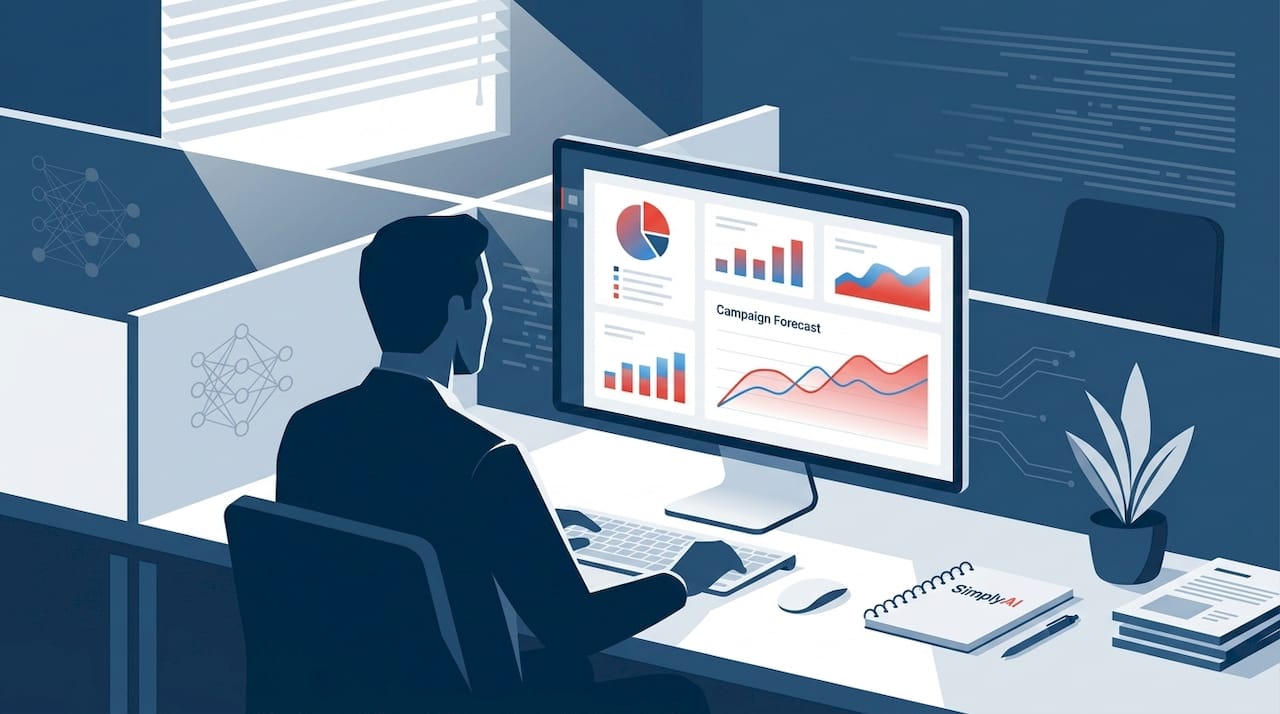
Traditionally, small businesses made marketing decisions based on intuition or limited historical reporting. Predictive analytics changes that equation. AI analyzes patterns across past campaigns, customer interactions, and market signals to generate forecasts that guide decisions with a level of confidence that gut instinct simply cannot match. Using AI-based predictive analytics optimizes marketing for new tech ventures, but the application extends to any SMB seeking to reduce wasted spend and improve campaign returns.
Here are key predictive metrics SMBs should begin tracking:
| Predictive metric | What it reveals |
|---|---|
| Customer lifetime value forecast | Which customers are worth the most over time |
| Churn probability score | Which customers are at risk of leaving |
| Lead conversion likelihood | Which leads are most likely to become buyers |
| Campaign response prediction | Which audience segments will engage with a given message |
| Optimal send time analysis | When individual customers are most likely to open emails |
Implementing predictive analytics in your marketing follows a logical sequence:
- Audit your data sources: Identify where your customer and campaign data currently lives. CRM records, email platform metrics, website analytics, and sales data are all valuable inputs.
- Centralize your data: Connect your tools so data flows into a single system. Many modern AI platforms offer native integrations that make this straightforward.
- Define the outcomes you want to predict: Start with one or two specific questions, such as which leads are most likely to convert this month, rather than trying to predict everything at once.
- Deploy an AI analytics tool: Platforms designed for predictive analytics for SMBs handle the modeling automatically. You review the outputs and act on them.
- Test and refine: Treat each prediction as a hypothesis. Run campaigns based on AI recommendations, measure the results, and feed the learnings back into the system.
"Predictive analytics does not eliminate uncertainty. It narrows it. And for a small business working with limited marketing budget, narrowing uncertainty is one of the highest-value things you can do."
Pairing predictive analytics with AI-powered business strategies creates a feedback loop where each campaign makes the next one smarter. Over time, your marketing system becomes increasingly precise, spending less to achieve more.
Why most AI marketing advice gets it wrong for SMBs
Here is the uncomfortable reality: most AI marketing advice circulating in blog posts and webinars is written with enterprise budgets and dedicated tech teams in mind. When SMB owners try to apply it directly, they encounter tools that are too complex, implementation timelines that stretch for months, and ROI that is impossible to measure clearly. The advice is not wrong in theory. It is wrong in context.
The most common failure pattern is adopting too much AI technology too quickly, then struggling to maintain it. Businesses end up with half-implemented platforms, disconnected data, and teams that revert to manual processes because the new system is too confusing. Analysis paralysis is equally damaging. Spending weeks evaluating every available AI tool delays action and creates the illusion of progress without any actual marketing improvement.
What actually works for busy SMB owners is a philosophy of small, measurable experiments. Pick one marketing problem, apply one AI solution, measure the result over thirty to sixty days, and decide whether to scale or adjust. This approach delivers real learning without betting the entire marketing operation on a single platform decision. Realistic AI strategies for SMBs consistently outperform grand transformation plans that never fully launch.
Pro Tip: Delegate to AI the tasks where it genuinely outperforms humans: pattern recognition, timing optimization, and data processing. Keep the human touch for relationship building, brand voice, and strategic decisions. That combination is where SMBs generate their strongest competitive advantage.
Take your SMB's marketing further with AI solutions
The tips in this article give you a clear roadmap, but implementation is where the real work begins. SimplyAI is built specifically to help SMBs like yours move from strategy to execution without the friction that typically slows AI adoption.
Whether you need AI automation services to eliminate repetitive marketing tasks, AI agents for marketing that engage your customers around the clock, or corporate AI education to bring your team up to speed, SimplyAI provides tailored solutions designed for practical, measurable results. Our approach prioritizes simplicity, fast deployment, and clear ROI so that AI becomes an asset rather than a burden. Reach out to SimplyAI today and take the first concrete step toward smarter, more efficient marketing.
Frequently asked questions
What is the easiest way for SMBs to start with AI marketing?
The simplest starting point is implementing AI-powered tools for email and social media automation, which require minimal technical expertise and deliver measurable results quickly. Top platforms are now purpose-built for non-technical business owners.
Is AI marketing expensive for small businesses?
Many AI marketing platforms offer affordable, scalable pricing, allowing SMBs to start with a modest investment and expand as results justify higher spend. Entry-level tools often cost less per month than a single traditional advertising placement.
How does AI personalization improve customer engagement?
AI-driven personalization delivers relevant content and recommendations to each customer, which increases the likelihood of engagement and builds the kind of loyalty that drives repeat business.
Can AI really automate customer support for SMBs?
Yes. AI-powered chatbots handle common queries autonomously, reducing response time from hours to seconds and improving satisfaction for both customers and your internal team.