

TL;DR:
- AI consulting is a strategic advisory focused on defining problems, assessing readiness, and building governance structures, not just technical model development. It involves multiple phases, including strategy development, data readiness, solution integration, and ongoing governance to ensure AI delivers measurable business value. Successful engagement depends on organizational alignment, clear objectives, and patience through foundational work to achieve durable AI advantages.
Most business leaders assume AI business consulting is primarily about data scientists building machine learning models. That assumption is costing companies real money. What AI consulting actually delivers is a strategic advisory function that helps organizations identify the right problems, assess their readiness, and build governance structures that make AI investments stick. Technology is only the last mile. The distance before it, covered with strategy, data architecture, and change management, is where the real value lives. This article cuts through the noise and gives you a clear, practical view of what AI consulting is, what it delivers, and how to use it well.
Table of Contents
- Key Takeaways
- What AI business consulting actually is
- Core components of AI consulting services
- How AI consulting creates operational business value
- Emerging trends shaping AI consulting in 2026
- Choosing the right AI consulting partner
- My take: the foundation always beats the shortcut
- Ready to put AI consulting into practice?
- FAQ
Key Takeaways
| Point | Details |
|---|---|
| AI consulting is strategic, not just technical | It covers business problem definition, governance, and organizational readiness, not just model building. |
| Engagements follow a phased lifecycle | Advisory work comes first to align strategy, then delivery phases cover architecture through deployment. |
| Operational integration drives real ROI | AI must be embedded in workflows and linked to financial outcomes to produce measurable, lasting results. |
| Emerging capabilities are expanding the field | Hybrid-AI platforms and agent-ready workflows are reshaping what AI consulting can deliver in 2026. |
| Partner selection requires clear internal readiness | Executive sponsorship and data maturity must be in place before a consulting engagement can succeed. |
What AI business consulting actually is
AI business consulting is professional advisory and, in many cases, delivery work that helps enterprises design, build, and operationalize AI solutions. The starting point is never a model. It is a business problem, a data readiness assessment, and a governance conversation. That is the fundamental distinction separating AI consulting from data science or software development.
A data scientist's job is to build and refine models. A software developer's job is to ship code. An AI consultant's job is to ask whether the organization is ready to benefit from AI in the first place, which problems are worth solving with it, and what governance structures will prevent failure once deployment happens. These are leadership-level questions, not engineering questions.
Enterprise AI consulting concentrates on strategy, governance, operating models, and change management. The consulting firm is not deciding which algorithm to use. It is deciding which investment is worth pursuing and what organizational design will support it. That distinction matters enormously when you are allocating budget.
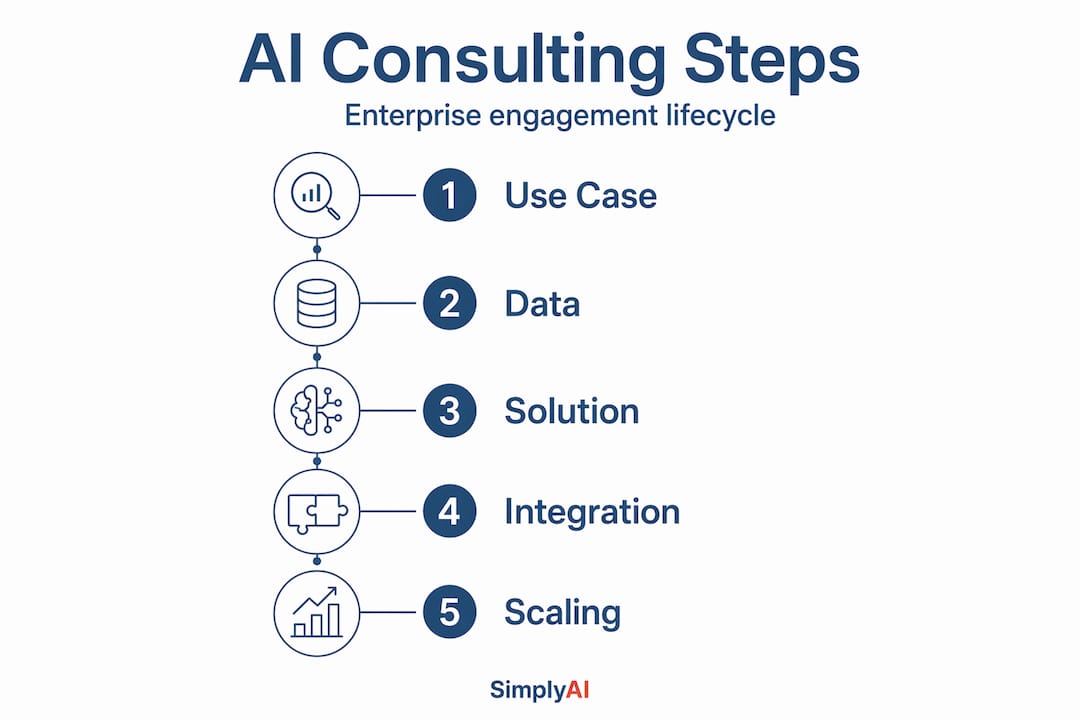
A typical AI consulting engagement moves through several lifecycle phases: use case identification, data and infrastructure readiness assessment, model or solution development, system integration, deployment, and ongoing governance. Some consultants cover the full arc. Others focus exclusively on the strategic front-end.
Core components of AI consulting services
Understanding what you are actually buying when you engage AI consulting services helps you set realistic expectations and evaluate proposals intelligently. These engagements typically include the following phases:
-
Strategy and roadmap development. The consultant works with leadership to identify which business problems are candidates for AI, prioritize them by potential impact, and build a phased roadmap tied to measurable outcomes rather than technology capabilities.
-
Data architecture and readiness assessment. Before any model is built, consultants audit the quality, accessibility, and governance of the data the organization holds. Poor data architecture is the single most common reason AI projects fail before they begin.
-
Solution development and integration. This phase involves building or configuring AI solutions, whether large language models, computer vision systems, or automation workflows, and integrating them into existing enterprise systems.
-
Deployment, monitoring, and governance. Releasing an AI solution into production is not the end of the engagement. Effective consultants establish monitoring frameworks, performance benchmarks, and risk governance structures to protect the organization after go-live.
Pro Tip: Ask any prospective consulting partner to show you their governance framework template before the engagement begins. If they do not have one, that tells you everything you need to know about how they handle AI in production.
The model of engagement also matters. Some organizations benefit from advisory-only to delivery phased approaches, where strategy and readiness work are completed before any technical build begins. This prevents the costly mistake of investing in AI infrastructure before the business is ready to absorb it.
| Engagement model | What it covers | Best for |
|---|---|---|
| Advisory only | Strategy, roadmap, governance design | Organizations early in AI maturity |
| Advisory plus delivery | Full lifecycle from problem to production | Mid-market companies scaling AI |
| Delivery only | Build, integrate, and deploy | Organizations with existing AI strategy |
The right choice depends on your current maturity level and the clarity of your internal AI vision.
How AI consulting creates operational business value
The gap between a successful AI pilot and a production system that moves the P&L is where most enterprises stall. AI consulting exists precisely to close that gap. Moving from experimentation to operational implementation requires aligning stakeholders, selecting the right use cases, and embedding AI in workflows rather than running it as a parallel experiment alongside normal operations.

Use case selection is more important than most executives realize. Not every process that could be automated should be automated first. Consultants prioritize use cases based on three factors: the availability and quality of data to support the use case, the operational impact if the AI performs well, and the organizational willingness to change the workflow around the AI output. Getting that sequence right dramatically increases the probability of a genuine return.
Stakeholder alignment is the other critical variable. Technical teams and business units often have fundamentally different definitions of success. An AI consultant operating at the leadership level acts as a translator between those two worlds, making sure that what gets built actually solves the problem that leadership cares about.
Linking AI efficiency gains to P&L line items is what separates organizations that build durable AI-first cost advantages from those that generate impressive demos but modest results. This is a discipline that good AI consulting firms enforce from day one. Every use case should have a defined financial metric attached to it before development begins.
Pro Tip: Before your first consulting session, prepare a one-page brief that names the top three business problems you want to solve, the metrics you currently use to measure them, and the data you believe you have available. This single document will cut weeks off the discovery phase. Learn how AI integration shapes workflows in practice to ground that brief in realistic expectations.
Change management is often the last thing executives think about and the first thing that derails an AI deployment. Employees whose workflows change around an AI system need training, communication, and clear explanations of how their roles evolve. Consultants who skip this step leave organizations with capable AI systems that no one uses.
Emerging trends shaping AI consulting in 2026
The scope of what AI consulting services can deliver is expanding rapidly. IBM Consulting's 2026 capabilities illustrate the direction the entire field is moving: hybrid-AI platforms that embed enterprise AI with existing data and processes, agent-ready workflows that automate complex multi-step operations, and multi-agent interoperability that allows different AI systems to collaborate within a single enterprise architecture.
Hybrid-AI platforms are particularly significant for executives concerned about data sovereignty. These architectures allow organizations to run AI workloads on-premise or in private cloud environments while still accessing the power of large language models. For industries with strict regulatory requirements, this is not optional. It is the only viable path to enterprise-scale AI.
| Trend | What it enables | Business impact |
|---|---|---|
| Hybrid-AI platforms | On-premise AI with LLM-scale capabilities | Data sovereignty and compliance at scale |
| Agent-ready workflows | Automated multi-step enterprise processes | Significant labor cost reduction |
| Multi-agent interoperability | Multiple AI systems collaborating autonomously | Cross-functional process automation |
| AI platform enablement | Consulting builds and manages AI infrastructure | Faster deployment with lower internal overhead |
The consulting role itself is evolving. Firms are increasingly expected to not just advise on AI strategy but to build and maintain the platforms that make AI execution possible. This shift means the line between consulting and managed services is blurring, and the most capable partners are those who can operate across both.
For small and mid-sized businesses, AI automation growth drivers in 2026 are no longer reserved for enterprise budgets. The accessibility of AI agent frameworks and pre-built automation platforms has opened the field considerably, which is precisely where focused consulting can accelerate time-to-value for organizations that lack internal AI talent.
Choosing the right AI consulting partner
Most enterprises lack internal capabilities to move from AI strategy to production on their own. The skills required, including ML engineering, data architecture, and AI governance, are scarce, expensive to hire, and difficult to retain. That gap is precisely why external consulting partnerships are worth evaluating seriously.
Before you engage any partner, make sure your organization has these foundations in place:
- Executive sponsorship. An AI initiative without a named executive owner who has budget authority and decision-making power will stall at the first organizational obstacle.
- A clearly defined business problem. "We want to use AI" is not a brief. "We want to reduce customer service ticket resolution time by 30% within six months" is a brief.
- A basic data inventory. You do not need perfect data. You need to know what data you have, where it lives, and who owns it.
- Organizational willingness to change. If the business units affected by the AI deployment are not aligned, no consultant can force adoption from the outside.
When evaluating potential partners, ask them to walk you through a specific past engagement: what problem they were hired to solve, what they discovered during readiness assessment, what they built, and what the measured outcome was. Vague answers about transformation and impact are red flags. Specific numbers and timelines are what you want to hear.
Ignoring governance and strategy is how many firms end up with costly failed AI investments. The advisory layer of consulting, the work that happens before any code is written, is often where the highest-value work occurs.
Pro Tip: Avoid partners who begin the sales conversation with technology. The best AI consulting firms start every engagement by asking what business outcomes you are trying to achieve, and they push back hard when those outcomes are not specific enough.
My take: the foundation always beats the shortcut
I have watched organizations spend six-figure budgets on AI development and end up with nothing they could actually use in production. Not because the models were poor. Because the organizations had not done the foundational work. They had not defined what success looked like, they had not assessed whether their data could support the use case, and they had not built the internal alignment needed to absorb change.
The most effective AI consulting engagements I have seen share a common structure. They start with a focused advisory phase that is almost uncomfortably slow. Leadership gets aligned. Data gets inventoried. Governance gets designed. And only then does the build phase begin. That patience in the beginning pays back dramatically in the delivery phase because there are no surprises, no scope debates, and no stakeholder conflicts to manage mid-project.
The organizations that try to skip straight to the build because they are in a hurry almost always circle back to this foundational work eventually, but at a higher cost and with less goodwill from the teams involved. AI-assisted analytics adoption follows the same pattern. The most successful implementations are the ones that started with clear measurement frameworks before they selected any technology.
My honest advice: resist the pressure to show AI results quickly. A properly scoped AI consulting engagement takes time to set up correctly. The organizations that allow that process to unfold are the ones that build durable AI advantages rather than expensive proofs of concept that never reach scale.
— Theodor
Ready to put AI consulting into practice?
Understanding what AI business consulting delivers is the first step. The next step is finding a partner who can execute it without overcomplicating the process. Simplyai works with small and mid-sized businesses to design and deploy practical AI solutions that produce measurable results. From AI workflow automations that reduce manual work across your operations to intelligent AI agents that handle complex, multi-step processes autonomously, Simplyai covers the full arc from strategy through production. Every engagement starts with your business problem, not a technology pitch. If you are ready to move from curiosity to concrete results, Simplyai is built for exactly that conversation.
FAQ
What is AI business consulting?
AI business consulting is professional advisory and delivery work that helps organizations identify the right AI use cases, assess data and infrastructure readiness, and deploy AI solutions with proper governance. It focuses on business outcomes rather than model building.
How is AI consulting different from hiring a data scientist?
A data scientist focuses on building and refining models. An AI consultant addresses the broader question of which business problems are worth solving with AI, how the organization needs to prepare, and what governance is required to sustain AI in production.
What does a typical AI consulting engagement include?
A typical engagement covers use case identification, data readiness assessment, solution development, system integration, deployment, and governance. Some engagements are advisory only, while others extend to full end-to-end delivery.
Why do many AI initiatives fail without consulting support?
Many AI investments fail when organizations focus on technology build before addressing strategy, governance, and organizational readiness. Consulting at the strategic layer prevents costly investments in solutions the business is not prepared to use.
How do I know if my business is ready for an AI consulting engagement?
Readiness requires executive sponsorship, a clearly defined business problem, an inventory of relevant data, and organizational willingness to change affected workflows. These four elements are more predictive of success than any technical factor.