

TL;DR:
- AI has transformed customer journey mapping by enabling rapid, continuous data analysis from multiple sources, eliminating manual labor.
- Autonomous agentic AI systems can manage complex customer flows, making detailed mapping more crucial to ensure accuracy and appropriate decision-making.
AI is no longer a background utility in customer experience. US traffic to retail sites driven by generative AI tools increased nearly 700% in 2026 compared to the previous year, which means the path customers take to your brand has fundamentally changed. Understanding what is customer journey mapping AI, and how it differs from traditional manual approaches, is now a competitive necessity for marketing professionals and business leaders. This guide covers the core capabilities, practical tools, agentic AI implications, and the strategic decisions your team needs to make now.
Table of Contents
- Key takeaways
- What is customer journey mapping AI?
- Agentic AI and autonomous journey orchestration
- Designing for the dual customer journey
- AI tools for journey mapping and optimization
- Journey mapping best practices and common pitfalls
- My take on AI and human-centric journey design
- How Simplyai helps you map and optimize customer journeys with AI
- FAQ
Key takeaways
| Point | Details |
|---|---|
| AI accelerates map creation | AI tools reduce journey map creation from days or weeks to minutes, freeing teams for strategic work. |
| Agentic AI raises the stakes | Autonomous AI agents manage end-to-end journeys, making detailed mapping more critical, not less. |
| Dual journey design matters | Brands must simultaneously design for AI evaluation logic and human emotional decision-making. |
| Data completeness drives ROI | Capturing offline touchpoints like call center data is essential for accurate revenue attribution. |
| Human oversight remains essential | AI augments journey insight but cannot replace strategic human judgment about brand and ethics. |
What is customer journey mapping AI
Customer journey mapping is the practice of documenting every stage a customer moves through before, during, and after a purchase. It covers touchpoints, pain points, emotional states, and the decisions that determine whether a customer converts or churns. Traditional journey mapping is valuable but labor-intensive. Teams spend days synthesizing interview transcripts, CRM data, web analytics, and support tickets into a coherent visual map that is often outdated before it reaches the boardroom.
Customer experience mapping AI changes that equation at the source. AI systems gather and correlate data from CRM platforms, behavioral analytics, social signals, support interactions, and third-party sources simultaneously. The result is not just a faster map. It is a living, continuously updated model of how customers actually behave rather than how your team assumes they behave.
The benefits of journey mapping with AI are most visible in scale and speed. Tools like Cemantica's Alex AI reduce journey creation time from days or weeks to minutes. That speed allows teams to test multiple journey hypotheses, segment by persona, and refine maps based on real behavioral signals rather than periodic research sprints.
- Automated data aggregation across CRM, analytics, and support platforms eliminates manual consolidation
- Natural language processing extracts sentiment and intent from unstructured sources like reviews and chat logs
- Pattern recognition surfaces non-obvious correlations between touchpoints and conversion outcomes
- Continuous refinement keeps maps current as customer behavior shifts, rather than freezing a snapshot in time
Pro Tip: Don't treat your AI-generated journey map as a finished deliverable. The real value comes from treating it as a live signal feed that your team interrogates weekly, not a static document reviewed quarterly.
Agentic AI and autonomous journey orchestration
Understanding how to map customer journeys with AI is only part of the picture. The more disruptive development is agentic AI, which moves beyond analysis into action. Agentic AI systems operate autonomously within defined parameters, making real-time decisions about what content to serve, when to escalate to a human agent, and which next-best action will keep a customer moving forward.
Here is how the implementation of agentic AI in customer journeys typically unfolds:
- Journey mapping and instrumentation. Before any autonomous action is possible, a detailed map of all customer pathways must exist. Agentic AI needs this map as its operating playbook.
- Signal monitoring. The AI continuously monitors behavioral signals such as dwell time, scroll depth, cart abandonment triggers, and prior interaction history to assess intent in real time.
- Autonomous decision execution. When signals match a defined scenario, the AI acts without human approval. This might mean triggering a discount offer, reassigning a support ticket, or surfacing a comparison tool.
- Edge case detection. When a customer's behavior falls outside trained parameters, the system flags the interaction and routes it to a human agent, preserving experience quality at the boundaries.
- Outcome learning. Every interaction feeds back into the model, refining future decisions across the entire customer base.
Agentic AI manages these complex flows autonomously, addressing edge cases and enabling next-best actions. However, deployment timelines are significant. Managed platform rollouts typically require 4 to 8 weeks, while custom setups can extend to 3 to 6 months. Planning for that timeline is a prerequisite for realistic expectations.
Journey mapping becomes more important with greater AI autonomy, not less. As journey mapping researchers note, identifying friction points, emotional states, and human handoff thresholds requires a more precise map when AI systems are acting on it autonomously. An incomplete map translates directly into autonomous errors at scale.
Pro Tip: When implementing agentic AI, start by mapping your highest-volume, most predictable journeys first. Save edge-heavy, emotionally complex journeys for after your team has calibrated the system's decision quality.
Designing for the dual customer journey
One of the most underappreciated challenges in AI in customer journey strategy is that brands now face two parallel decision paths. One is the human customer path, driven by emotion, trust, social proof, and price sensitivity. The other is the AI evaluation path, driven by signal strength, confidence scores, and recommendation relevance. Both must be designed for intentionally.
"As AI commoditizes, real differentiation comes from intentional orchestration of human and AI interactions for seamless customer experience." — CMSWire
The table below contrasts the two paths to clarify where design conflicts arise:
| Dimension | Human customer path | AI evaluation path |
|---|---|---|
| Primary driver | Emotion and trust | Signal strength and confidence |
| Decision speed | Variable, often slow | Milliseconds |
| Information type | Narrative, social proof | Structured data, behavioral signals |
| Failure mode | Emotional disconnect | Algorithmic exclusion |
| Recovery mechanism | Human empathy | Retraining and reweighting |
Brands must design journeys for these two parallel paths simultaneously. Optimizing exclusively for AI evaluation logic, for example by structuring all content for machine readability, risks creating an experience that feels cold and transactional to human customers. Optimizing exclusively for emotional resonance risks your brand being deprioritized by AI recommendation engines.

The answer is a persistent conversational thread across both paths. Consumer expectations now demand continuous guidance and personalized experiences across online, physical, and AI agent touchpoints. That continuity is not accidental. It requires deliberate architectural decisions about data sharing, content structure, and escalation logic that connect the human and AI experiences without creating jarring transitions.
AI tools for journey mapping and optimization
The market for customer journey mapping tools has expanded significantly as AI capabilities have matured. The most capable platforms share a set of core features that separate them from traditional visualization tools.
- Automatic map generation from existing data sources, reducing the time investment required to create a baseline journey view
- Continuous refinement triggered by real behavioral data rather than manual updates driven by periodic research cycles
- Integration with internal and external data including CRM records, marketing automation platforms, and third-party intent signals
- Real-time decisioning layers that allow marketers to act on journey insights within the same session they are identified
- Persona segmentation at scale, allowing teams to maintain dozens of distinct journey variants without proportional increases in team workload
Unified decisioning engines represent the most sophisticated tier. Tools like Adobe Journey Optimizer coordinate real-time personalization across channels and reduce personalization latency to milliseconds. That latency reduction is not a marginal improvement. It is the difference between a recommendation that arrives during a decision window and one that arrives after the window has closed.
| Tool capability | Traditional tools | AI-powered tools |
|---|---|---|
| Map creation speed | Days to weeks | Minutes |
| Data sources | Manual input | Automated multi-source |
| Update frequency | Periodic | Continuous |
| Personalization depth | Segment-level | Individual-level |
| Decisioning | Manual | Real-time autonomous |
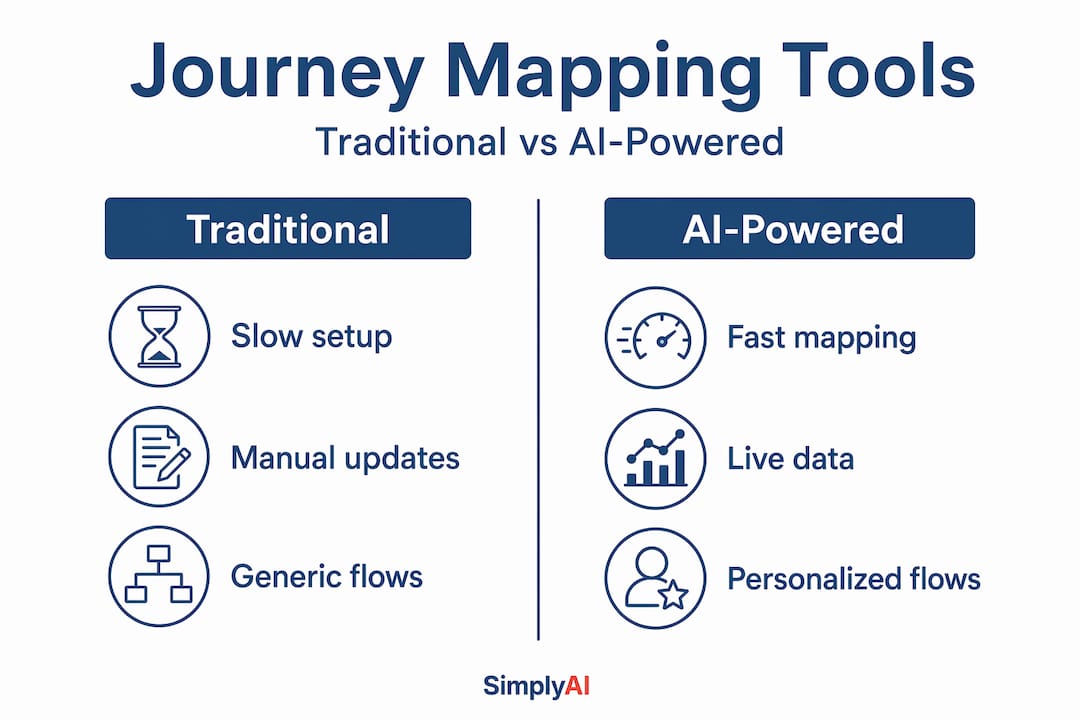
83% of teams see AI as critical for personalization, and 71% use generative AI weekly for journey optimization. The most effective tools operate natively on existing marketing data systems to reduce time to value and allow phased scaling, which makes adoption far more practical for mid-sized organizations without large data engineering teams.
You can explore how AI agents drive results across different business functions to understand how journey orchestration fits into a broader automation strategy.
Pro Tip: Before evaluating any AI journey mapping platform, audit your current data infrastructure first. The most sophisticated AI tool will underperform if it cannot access clean, unified customer data from your CRM, support platform, and analytics system.
Journey mapping best practices and common pitfalls
Adopting AI-driven journey mapping requires more than selecting the right software. The organizational and strategic conditions around the tool determine whether it delivers measurable results or becomes another underused platform.
Journey mapping best practices for AI-driven implementations include several non-negotiable conditions. Clear goals and KPIs must exist before any tool is deployed. Without defined success metrics, AI-generated insights have no organizational home and rarely drive decisions. Cross-functional alignment between marketing, sales, customer success, and data teams is equally critical, because AI journey maps expose gaps that no single team can address alone.
Data quality and governance are foundational concerns that many teams underestimate. An AI system trained on incomplete or biased data will produce confident but incorrect journey models. Establishing data ownership, refresh cadences, and quality checkpoints before launch prevents compounding errors downstream.
One of the most common and costly mistakes is ignoring offline touchpoints entirely. Ignoring offline interactions like call center calls leads to incomplete revenue attribution. Closed-loop attribution systems are critical for connecting AI-driven online personalization to revenue outcomes that often close offline. Without that connection, your AI journey map is measuring a fraction of the actual customer experience.
Phased rollouts reduce risk meaningfully. Starting with one high-volume journey, instrumenting it fully, measuring outcomes, and then expanding allows teams to build internal confidence and organizational capability in parallel with technology adoption. Brands that attempt full-scale deployment without this foundation frequently stall during implementation. You can review practical AI integration examples that demonstrate this phased approach across different workflow contexts.
Pro Tip: Assign a "journey owner" for each AI-mapped flow. This person is responsible for reviewing AI recommendations, flagging anomalies, and ensuring the map reflects current business reality. AI handles the analysis; the journey owner handles judgment.
My take on AI and human-centric journey design
I've spent considerable time working with organizations adopting AI journey mapping, and the most persistent mistake I've observed is treating AI output as a conclusion rather than a starting point. The speed and confidence that AI tools project can create a false sense of completeness. A map generated in minutes still reflects the quality of the underlying data and the clarity of the questions your team asked.
What I've learned is that the organizations getting the most from customer experience mapping AI are not the ones with the most sophisticated tools. They are the ones with the clearest human judgment about what the tool's output means for their specific brand, customers, and competitive context. AI surfaces the pattern. It cannot tell you whether the pattern reflects your brand's values or contradicts them.
The dual journey challenge described earlier is one I find genuinely underappreciated in leadership conversations. Executives focus on the human customer experience, as they should. But the AI evaluation path, the signals your brand sends to recommendation engines, content aggregators, and large language models, is shaping who encounters your brand before any human decision is made. Designing only for the human path increasingly means designing for a smaller and smaller audience.
I also carry a consistent concern about data privacy and ethical considerations. AI journey mapping works by collecting and correlating behavioral data at scale. The more granular the data, the more accurate the model, and the greater the privacy obligation. Brands that treat data governance as a compliance formality rather than a trust-building strategy will face erosion of the customer confidence that makes journey mapping worthwhile in the first place.
— Theodor
How Simplyai helps you map and optimize customer journeys with AI
Simplyai designs and implements AI automations and AI agent solutions that help marketing and operations teams move from manual journey tracking to intelligent, continuous customer experience optimization.
Simplyai's AI automation services cover the full spectrum of journey mapping needs, from automated data aggregation and CRM integration to real-time personalization triggers and closed-loop attribution. For businesses ready to explore agentic AI capabilities, Simplyai's AI agent solutions provide end-to-end journey orchestration designed for small and medium-sized companies that need measurable results without enterprise-scale infrastructure. If your team is navigating the shift from static journey maps to AI-driven, continuously updated customer experience models, Simplyai delivers the practical implementation support to make that transition effective and sustainable. Contact Simplyai to discuss a tailored solution for your customer journey goals.
FAQ
What is customer journey mapping AI?
Customer journey mapping AI is the use of artificial intelligence to automatically gather, analyze, and visualize how customers interact with a brand across all touchpoints. Unlike manual mapping, AI tools continuously update journey models based on real behavioral data.
How does AI improve customer journey mapping?
AI reduces map creation time from days to minutes, enables continuous refinement based on live data, and surfaces patterns in customer behavior that manual analysis would miss. Tools like Cemantica's Alex AI demonstrate this speed advantage directly.
What is agentic AI in customer journeys?
Agentic AI refers to autonomous systems that manage customer journey flows without constant human input, executing next-best actions, handling edge cases, and routing complex interactions to human agents when needed.
What are the main benefits of journey mapping with AI?
The primary benefits include faster map creation, real-time personalization at individual scale, continuous data-driven refinement, and the ability to connect online and offline touchpoints for complete revenue attribution.
What is the biggest risk of AI customer journey mapping?
The biggest operational risk is incomplete data. Ignoring offline interactions like call center conversations leads to gaps in revenue attribution and produces journey models that do not reflect the full customer experience.