
TL;DR:
- Marketing automation transforms manual tasks into proactive, 24/7 systems that support SMB growth.
- Effective automation enhances time savings, consistency, personalization, and scalability without significant staff increases.
- Starting small with low-risk tasks and continuously optimizing is key to sustainable, personalized automation.
Most small and medium-sized businesses spend far more staff hours on repetitive marketing work than they ever account for — sending follow-up emails one by one, manually scheduling social posts, and copying customer data between tools. That hidden labor cost quietly limits growth. Marketing automation turns those reactive, time-heavy processes into proactive, 24/7 systems that work even when your team does not. For SMBs that want to compete with larger players without expanding headcount, AI-powered automation is not a luxury. It is the lever that makes scaled, consistent marketing possible.
Table of Contents
- What does marketing automation really mean?
- Top benefits of automating marketing tasks for SMBs
- What should you automate first? Expert tips and risk zones
- How to avoid the robotic trap: Maintaining personalization in automated marketing
- Bringing it together: Practical steps to start automating your marketing
- Why most SMBs underestimate the real value of marketing automation
- Ready to unlock 24/7 marketing with AI-powered automation?
- Frequently asked questions
Key Takeaways
| Point | Details |
|---|---|
| Automation scales marketing | Using AI, SMBs can engage customers around the clock without hiring extra staff. |
| Start with low-risk tasks | Prioritize automating routine, high-volume actions for the fastest ROI. |
| Personalization matters | Modern automation tools can keep campaigns human and relevant. |
| Measure and iterate | Small experiments and data tracking ensure sustainable automation growth. |
| AI unlocks agility | Beyond time savings, automation frees up your team for creative marketing work. |
What does marketing automation really mean?
Marketing automation is the use of software and AI to execute marketing tasks automatically, based on triggers, schedules, or customer behavior. At its core, it covers tools like email drip campaigns, social media scheduling platforms, AI-powered chatbots, and customer segmentation engines. These systems handle the repetitive, rules-based work so your team can focus on strategy and creativity.
A common misconception is that automation replaces marketers. It does not. Think of it more like giving your marketing team a highly capable assistant who never sleeps and never forgets a follow-up. Skilled marketers still make the strategic calls — they decide what message to send, to whom, and why. Automation simply executes those decisions at a speed and consistency no human team can match.
Another persistent myth is that marketing automation is only accessible to enterprise companies with large technology budgets. That was true a decade ago. Today, platforms like Mailchimp, HubSpot, ActiveCampaign, and dozens of AI-native tools offer SMB-friendly pricing tiers that make entry straightforward. As research on AI marketing efficiency for small businesses confirms, the technology has matured to the point where implementation is realistic for teams of even five to ten people.
"For SMBs, automation scales marketing without proportional staff increases, turning reactive manual processes into proactive, 24/7 systems."
The "set and forget" myth is equally dangerous. Automated campaigns still need regular review, testing, and optimization. Automation handles execution — not strategy, not creative judgment, and not the analysis that tells you what to change next quarter.
Top benefits of automating marketing tasks for SMBs
With a clear understanding of marketing automation, let's look at what it can actually deliver for your business.
The benefits of automating marketing tasks extend well beyond saving a few hours per week. Research shows that AI in SME marketing enhances business sustainability by mediating marketing strategies to measurable outcomes through better data and operational efficiency. That means the payoff is not just tactical — it is structural.
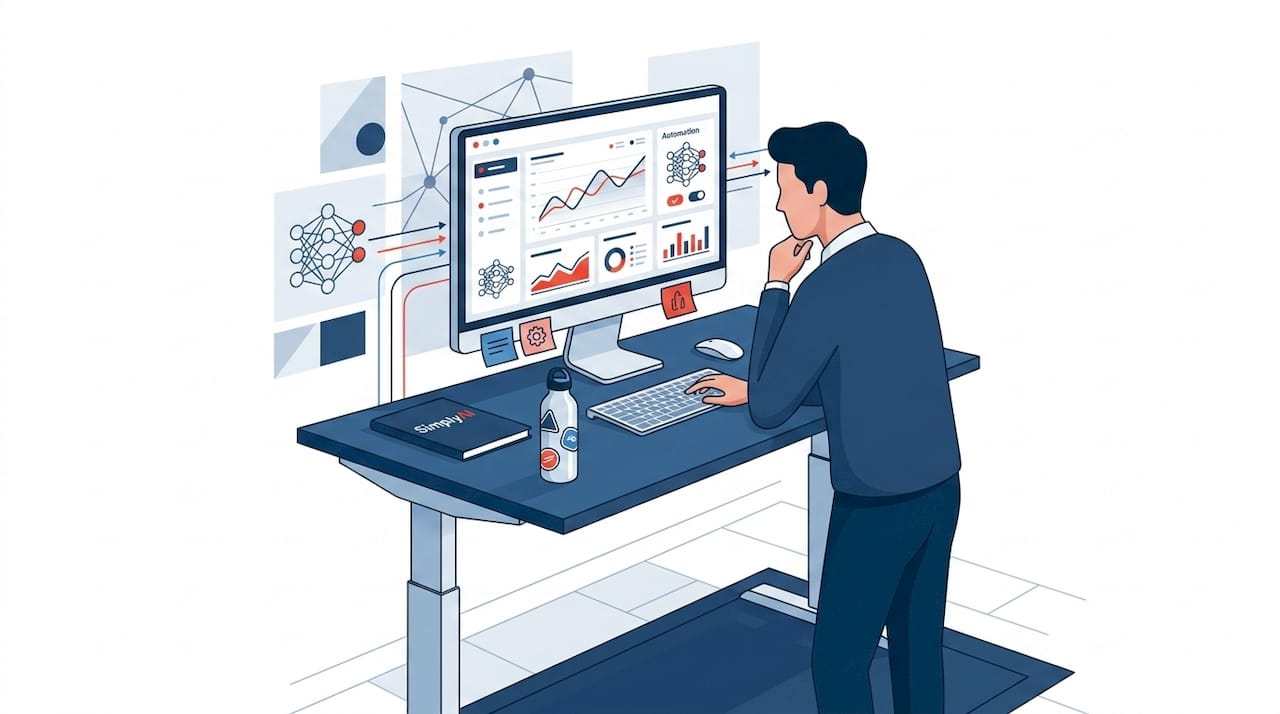
Consider the contrast between manual and automated marketing outcomes:
| Marketing task | Manual approach | Automated approach |
|---|---|---|
| Email follow-ups | Sent individually, often delayed | Triggered instantly based on behavior |
| Social media posting | Scheduled one at a time, easily forgotten | Queued weeks in advance, consistent |
| Lead scoring | Assessed subjectively by sales staff | Scored automatically using behavioral data |
| Customer segmentation | Done periodically, often outdated | Updated in real time as behavior changes |
| Campaign reporting | Compiled manually from multiple sources | Aggregated automatically in dashboards |
The pattern is clear. Manual processes introduce delays, inconsistencies, and gaps. Automation closes those gaps and creates a more reliable customer experience across every touchpoint.
Here are the top benefits SMBs consistently report after implementing marketing automation:
- Time savings at scale. Tasks that once consumed hours each week, like sending newsletters, tagging contacts, or updating CRM records, happen automatically.
- Always-on campaigns. Automated systems engage leads and customers outside business hours, capturing opportunities that manual processes would miss entirely.
- Data-driven targeting. When you build data-driven marketing strategies, automation ensures those strategies are executed consistently based on real behavioral signals rather than assumptions.
- Scalability without added headcount. As your contact list grows from 500 to 50,000, automated workflows handle the increased volume without requiring proportionally more staff.
- Improved consistency. Every lead gets the same quality of follow-up, regardless of how busy your team is on any given day.
Pro Tip: Start where the ROI is most obvious. Identify the three most time-consuming, repeatable marketing tasks your team handles manually each week. Those are your best candidates for automation, and they are where you will see the fastest return. Effective marketing automation workflows begin with a single, well-defined process rather than an attempt to automate everything simultaneously.
What should you automate first? Expert tips and risk zones
Knowing the benefits, the next step is learning where to begin and what to avoid when automating marketing.
Not all marketing tasks carry equal automation risk. The guiding principle from experienced practitioners is straightforward: automate low-risk tasks first, protect high-risk human judgment tasks, and start small to measure ROI before scaling. That approach protects your brand while building confidence and operational muscle.
Here is how to think about the risk spectrum:
| Task type | Risk level | Automation suitability |
|---|---|---|
| Welcome email sequences | Low | Excellent starting point |
| Social media scheduling | Low | Easy win with immediate time savings |
| Abandoned cart reminders | Low | High ROI, minimal brand risk |
| Lead nurturing drip campaigns | Medium | Suitable with careful message design |
| Personalized product recommendations | Medium | Suitable with good data infrastructure |
| Crisis communications | High | Never automate — requires human judgment |
| Complaint resolution messaging | High | Automate initial acknowledgment only |
| Influencer outreach | High | Requires authentic human relationships |
When you plan to implement AI tools in your marketing stack, starting at the low-risk end of this spectrum is not timidity — it is sound strategy. It lets you learn how automation behaves in your specific business context before expanding into more complex territory.
The five tasks most SMBs should automate first are:
- Welcome and onboarding email sequences for new subscribers or customers
- Social media post scheduling using tools like Buffer or Hootsuite
- Lead capture form follow-up emails triggered immediately after form submission
- Birthday or anniversary messages to existing customers with a personalized offer
- Re-engagement campaigns targeting contacts who have not opened emails in 90 or more days
Understanding which automation types drive SMB efficiency helps you move methodically rather than reactively, selecting the tools and workflows that fit your business model rather than chasing the latest platform trend.
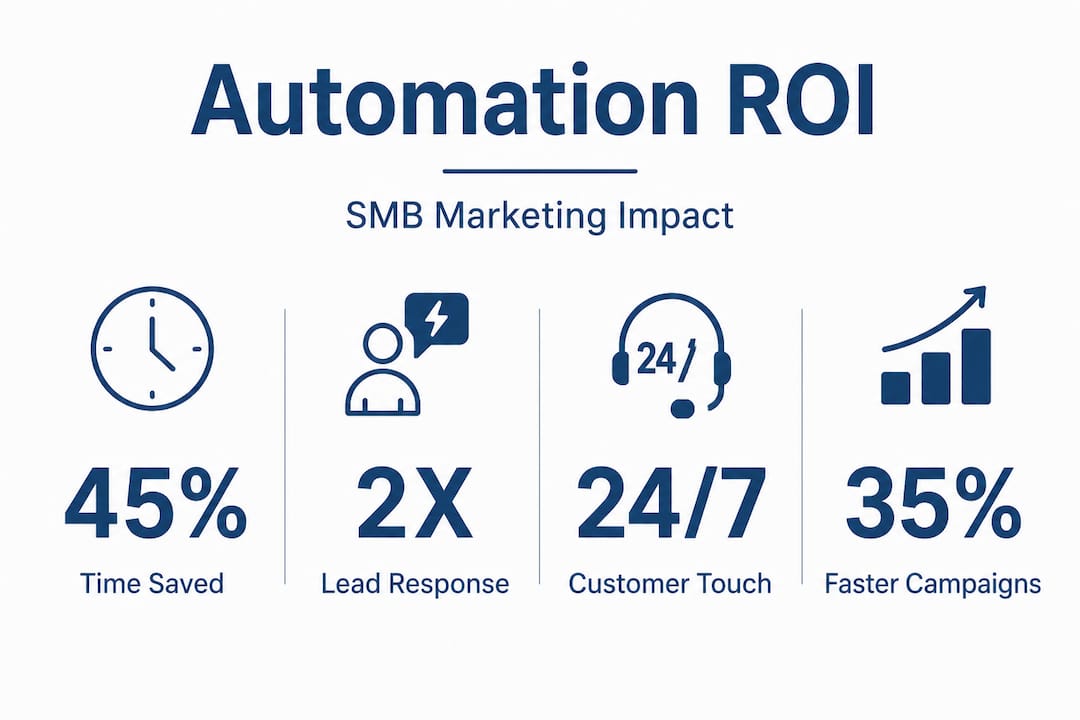
Pro Tip: Before declaring any automation a success, define what success looks like. Set specific benchmarks — open rates, click-through rates, conversion rates, or time saved per week — and measure against them after 30 and 90 days. You cannot optimize what you do not measure.
How to avoid the robotic trap: Maintaining personalization in automated marketing
While automation is powerful, many business owners fear it might cost them a personal relationship with their customers. Here's how to keep that human touch.
The concern is legitimate. Poorly executed automation produces generic, tone-deaf messaging that erodes customer trust faster than silence would. Many businesses have experienced the awkward automated email that arrives completely out of context, addressing a customer by the wrong name or promoting a product they already purchased. Those failures are not inevitable — they are the result of implementation without enough attention to personalization logic.
"Concerns include initial costs, complexity, and risk of impersonal 'robotic' feel; mitigated by user-friendly AI tools and personalization focus."
Modern AI-powered automation tools are specifically designed to counteract this problem. Large language models (LLMs) can generate message variations tailored to different customer segments, behavioral signals, and purchase histories. Computer vision tools can customize visual content based on audience demographics. These are not theoretical capabilities — they are features available today in platforms accessible to SMBs.
The key is designing automation workflows with personalization as a first principle, not an afterthought. Specific practices that preserve the human element include:
- Using dynamic content fields that pull in the customer's name, location, past purchase data, or browsing history rather than sending the same message to everyone.
- Segmenting your audience into tightly defined groups based on behavior — not just demographics — so messages feel relevant and timely.
- Writing automated messages in a conversational tone that sounds like your brand voice, not a legal notice.
- Building in human review checkpoints for high-stakes communications, such as win-back campaigns or post-complaint follow-ups.
- Testing messages with small audience segments before deploying to your full list, catching tone or relevance issues before they scale.
Investing in AI personalization for SMB marketing is not about adding complexity. It is about using data you already have to make every automated touchpoint feel intentional. When customers receive a message that acknowledges where they are in their journey with your brand, automation stops feeling robotic and starts feeling attentive.
Bringing it together: Practical steps to start automating your marketing
With the risks addressed, it's time to put automation into play — here's how to get started confidently.
Starting a marketing automation initiative does not require a six-month technology project or a dedicated IT team. It requires clarity about your current processes, a disciplined approach to tool selection, and a commitment to measuring what changes. Research confirms that AI-driven efficiency gains for SMEs are most pronounced when businesses align their automation strategy with specific, measurable business outcomes rather than automating for automation's sake.
Follow this roadmap to get started:
- Document your current manual processes. Before you automate anything, write down exactly what your team does today — step by step — for your top five most repetitive marketing tasks. This documentation becomes the blueprint for your automation workflows.
- Identify your highest-leverage automation targets. Look for tasks that are high frequency, rule-based, and time-consuming. Welcome emails, lead follow-ups, and social scheduling typically top this list.
- Choose a platform that fits your current scale. Start with one tool rather than five. Most SMBs find success beginning with their email marketing platform's built-in automation features before adding dedicated automation software.
- Build and test one workflow at a time. Design your first automated workflow, test it with a small segment of contacts, and verify that every trigger, delay, and message works as intended before expanding the audience.
- Set clear benchmarks before launching. Define the specific metrics you will track — open rate, conversion rate, time saved per week — and record baseline figures from your manual process for comparison.
- Review and optimize monthly. Automation is not passive. Schedule a monthly review to assess performance against benchmarks and refine messages, timing, or segmentation logic accordingly.
Building effective marketing automation workflows is an iterative process. The businesses that see the most sustained improvement are those that treat automation as a living system, not a one-time setup. Each optimization cycle compounds the efficiency gains and tightens the alignment between your marketing activity and actual business results.
Pro Tip: Document your manual process before you replace it. The act of writing out each step reveals assumptions, inefficiencies, and decision points you may not have been consciously aware of. That documentation makes the automation design phase dramatically faster and reduces the risk of replicating inefficient processes inside your new automated system.
Why most SMBs underestimate the real value of marketing automation
When business owners first consider marketing automation, they almost universally frame the value in terms of time savings. That framing is understandable — it is the most tangible and immediate benefit. But it is also incomplete, and that incompleteness leads many SMBs to under-invest in automation or to abandon it prematurely when results are slower than expected.
The more significant value of automation is what it makes possible rather than what it eliminates. When your team stops manually sending follow-up emails and building weekly social posts from scratch, they do not simply gain free time. They gain the cognitive space to think strategically, experiment with new campaign ideas, and analyze customer behavior in ways that manual execution never allows. That shift from execution to strategy is a seismic shift for growing businesses.
Marketing automation also creates an always-on presence that manual processes structurally cannot. A customer who fills out your contact form at 11 PM on a Friday receives an immediate, relevant response from an automated system. Without automation, that same customer waits until Monday morning at best — and in competitive markets, that delay costs real opportunities.
From observing businesses across different sectors adopt automation, one pattern stands out clearly. The companies that grow fastest are not the ones that automate the most processes from the start. They are the ones that start small, learn quickly, and keep human judgment firmly in place for the decisions that genuinely require it. Agility, not scale, is the primary output of a well-designed automation strategy. Businesses that understand this — and explore AI-powered business strategies with that mindset — consistently outperform those chasing full automation for its own sake.
The real opportunity is not just efficiency. It is transformation: a marketing function that operates with consistency, generates richer data, and frees your best people to do the work only humans can do.
Ready to unlock 24/7 marketing with AI-powered automation?
The path from manual, reactive marketing to an intelligent, always-on system is more accessible than most SMB owners realize. Whether you are starting with a single email workflow or building a fully integrated AI-driven marketing engine, the key is taking that first deliberate step with a clear strategy and the right implementation partner.
SimplyAI helps small and medium-sized businesses design and implement marketing automation systems that deliver measurable results — from AI automations that handle lead nurturing and CRM updates, to sophisticated AI agents that engage customers autonomously across channels. For teams that want to build internal capability alongside their automation infrastructure, the AI corporate education program equips your staff to work confidently with AI tools from day one. Every solution is tailored to your specific business model, your existing tools, and your growth goals — because generic automation rarely produces dramatic results.
Frequently asked questions
What are examples of marketing tasks that can be automated?
Common tasks include email campaigns, social media posting, lead nurturing, and customer segmentation — particularly low-risk, high-frequency tasks like welcome sequences and abandoned cart reminders that follow predictable rules.
How do I decide what not to automate in my marketing?
Avoid automating tasks that require complex human judgment or emotional nuance, since you should always protect high-risk tasks like crisis messaging, sensitive complaint handling, or relationship-driven outreach that requires authentic human engagement.
Will marketing automation make my brand feel less personal?
Modern AI tools use dynamic personalization to tailor messages by behavior and purchase history, directly addressing the robotic feel risk through user-friendly features designed specifically to maintain a human, relevant tone at scale.
Does automation require a big upfront investment for SMBs?
Not necessarily — concerns about initial costs and complexity are increasingly addressed by affordable, scalable AI tools built specifically for small businesses, many of which offer free tiers or low-cost entry points.
How quickly can I see results after automating marketing tasks?
Many SMBs notice improved efficiency and clearer data insights within the first few weeks, as AI-driven marketing efficiency translates manual guesswork into measurable, data-backed outcomes that improve steadily with each optimization cycle.