

TL;DR:
- Decision automation using AI enables small and medium businesses to handle complex, variable decisions at scale with greater consistency. It complements traditional RPA by managing exceptions and unstructured data, creating hybrid workflows that enhance efficiency and customer experience. Implementing decision automation involves starting small, mapping decision points, and continuously refining models, unlocking substantial strategic advantages across operations.
Most business owners assume automation means setting up a few rules to handle the same task over and over. That mental picture, while understandable, dramatically undersells what modern AI technology can do. Decision automation goes far beyond routine repetition. It gives businesses the ability to act on complex, variable situations autonomously, at scale, and with far greater consistency than manual processes allow. For small and medium-sized businesses (SMBs), this represents a genuine strategic opportunity, one that can reshape both internal workflows and the customer experience in measurable, lasting ways.
Table of Contents
- What is decision automation? Defining the concept
- RPA vs AI-driven decision automation: Key differences
- How SMBs benefit from decision automation
- Implementing decision automation in your business
- The uncomfortable truth most business owners miss about decision automation
- Empower your business with AI-driven decision automation
- Frequently asked questions
Key Takeaways
| Point | Details |
|---|---|
| AI handles complexity | Decision automation lets businesses address variable tasks and exceptions using AI, not just simple routines. |
| Hybrid approach works best | Combining RPA and AI-driven automation covers both structured and unstructured business processes effectively. |
| Human judgment essential | Even the best AI automation requires human oversight for ambiguous or complex cases. |
| SMBs gain workflow benefits | Small businesses can boost efficiency and customer satisfaction by automating decisions in key processes. |
What is decision automation? Defining the concept
Now that we've challenged common views on automation, let's unpack what decision automation actually means for small and medium businesses.
Decision automation refers to the use of AI-driven systems to evaluate incoming data, apply logic or learned patterns, and execute a business decision without requiring a human to step in each time. It is not simply a programmed rule. It is a responsive system capable of handling variability, making judgment calls on categorized inputs, and routing or resolving situations that would otherwise pile up in an employee's inbox.
Traditional robotic process automation (RPA) is excellent at executing the same defined steps reliably and quickly. But RPA struggles the moment a situation falls outside the script. Decision automation, by contrast, is built for variation. It handles exceptions, adapts to unstructured inputs, and applies weighted logic to reach outcomes that serve the business goal. According to industry analysis comparing approaches, RPA suits stable, structured tasks, while AI-driven decision automation handles variable, exception-rich workflows, with hybrid deployments offering the strongest overall results.
Consider a few concrete SMB scenarios. A small lending firm can use decision automation to evaluate creditworthiness across dozens of data points and return a preliminary decision within seconds. An e-commerce business can automatically segment and route customer service inquiries, resolving simple cases without agent involvement and escalating complex ones with context already attached. A retail operation can trigger restocking orders based on dynamic demand signals rather than fixed inventory thresholds. These are the kinds of automation types for SMB efficiency that produce visible, measurable gains.
Pro Tip: Start mapping your existing decisions by asking, "Would the answer change depending on the specific details of this situation?" If yes, that decision likely involves variability and is a strong candidate for AI-driven automation rather than simple RPA.
It is also important to recognize where human judgment remains irreplaceable. Genuinely ambiguous situations, those involving ethical trade-offs, unique customer relationships, or data outside normal parameters, still require human oversight. Decision automation is not a replacement for human thinking. It is a force multiplier, handling the volume so your team can focus where their judgment truly matters. Understanding decision-making workflows in your own operation is the first step toward knowing where automation delivers real value.
RPA vs AI-driven decision automation: Key differences
Understanding the basics makes it easier to compare decision automation with traditional automation tools like RPA.
Robotic process automation is the workhorse of digital operations for many businesses. It follows predetermined rules to execute structured, repetitive tasks at high speed and low cost. Data entry, invoice processing, report generation, and system syncing are all natural fits. RPA does not think. It executes. That reliability is its greatest strength in the right context.
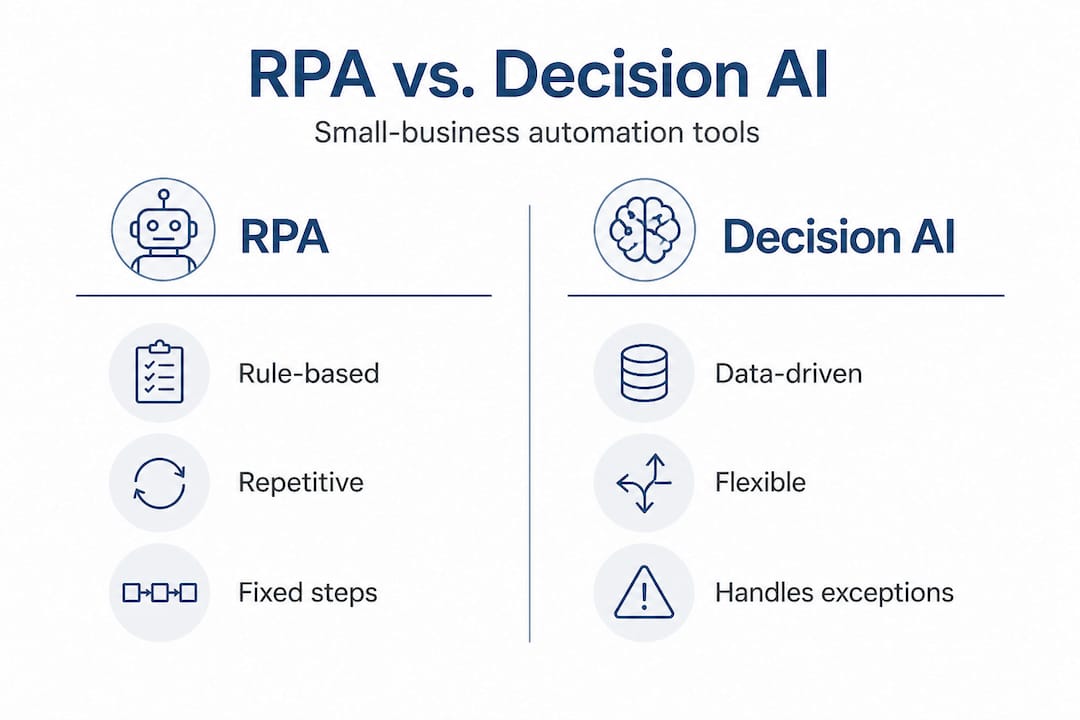
AI-driven decision automation operates differently. It applies machine learning models, natural language processing, or rule engines layered with probability logic to evaluate inputs that may differ significantly from one case to the next. Rather than following a fixed path, it chooses a path based on what the data indicates.
| Dimension | RPA | AI decision automation |
|---|---|---|
| Task type | Repetitive, rule-based | Variable, exception-driven |
| Input structure | Structured, predictable | Structured or unstructured |
| Speed | Very high | High |
| Flexibility | Low | High |
| Error handling | Fails on exceptions | Adapts to exceptions |
| Cost to implement | Lower | Moderate to higher |
| Best use case | Data entry, file transfer | Routing, approvals, triage |
The most forward-looking SMBs are not choosing between these two approaches. They are combining them. A hybrid model uses RPA to handle the mechanical steps of a process and AI decision automation to manage the variable judgments embedded within it. For example, an insurance business might use RPA to extract claim data from emails and forms, and then use AI to assess that data and decide whether the claim qualifies for automatic approval or requires manual review.
Gartner predicts that 50% of all business decisions will be automated by AI by 2027. That figure signals a seismic shift already underway in how organizations of all sizes operate. For SMBs that understand the difference between automation vs manual work and where each type of automation fits, this shift represents an enormous competitive opportunity rather than a disruption to fear.
The key insight is this: if a task involves fixed steps, use RPA. If a task involves weighing information and making a call, use AI decision automation. When a workflow contains both elements, a hybrid deployment is almost always the right answer.
How SMBs benefit from decision automation
With the differences clear, SMBs can now focus on the advantages decision automation brings to their workflows and customer interactions.

The practical benefits of decision automation show up quickly and across multiple dimensions of a business. Speed is often the first gain business owners notice. Decisions that once required a staff member to gather information, review it, and take action now happen in milliseconds. Customers get faster responses. Orders are fulfilled without delays. Escalations reach the right person with full context already attached.
Here is a structured view of the benefit areas most relevant to SMBs, along with example use cases:
| Benefit area | Example use case | Measurable outcome |
|---|---|---|
| Customer experience | Automated inquiry routing | Faster resolution, fewer handoffs |
| Inventory management | Demand-triggered restocking | Reduced stockouts, lower overstock |
| Financial operations | Credit and approval decisions | Faster cycles, fewer manual reviews |
| Marketing | Segment-based campaign triggers | Higher relevance, improved conversion |
| HR operations | Leave request processing | Reduced admin burden |
Beyond speed, accuracy improves significantly when decisions follow consistent, data-driven logic. Human reviewers, even skilled and experienced ones, introduce variability based on fatigue, bias, or incomplete information. A well-configured decision automation system applies the same logic every single time, which reduces errors and produces more equitable outcomes across customer segments.
The following steps represent a practical sequence for realizing these benefits:
- Identify the decisions your team makes most frequently in customer-facing processes.
- Map out what data points inform each decision and how consistent the logic is across cases.
- Determine which decisions follow clear patterns versus which require significant contextual judgment.
- Prioritize the high-volume, pattern-driven decisions for automation first.
- Build feedback loops so the system learns from outcomes and improves over time.
Using AI data analysis for business decisions is particularly powerful in this context, because it allows decision models to improve continuously as more data flows through them. The system gets smarter with use.
Pro Tip: Do not automate a broken process. Before deploying decision automation, map the existing workflow thoroughly and fix obvious logic gaps. Automation accelerates what is already there, including the flaws.
It is worth acknowledging the real complexity that comes with unstructured inputs. When customers write free-text messages, submit non-standard forms, or communicate through voice channels, the AI must interpret meaning before it can apply decision logic. Natural language processing and large language models have made this dramatically more feasible than it was just a few years ago. Still, the more unstructured the input environment, the more important human oversight becomes at the edges of the system. Exploring business growth automation solutions that combine intelligent interpretation with robust escalation paths is the approach that produces sustainable results.
Implementing decision automation in your business
With clear benefits established, let's outline how small business owners can start implementing decision automation today.
Implementation does not have to be a large-scale, all-at-once project. The most successful SMB deployments start small, prove value quickly, and scale from there. The following sequence is practical, low-risk, and adaptable to businesses across industries.
- Audit your current decision landscape. List every recurring decision your team makes in the course of a normal week. Flag which ones are rule-based and which ones require variable judgment. This audit is the foundation of your automation strategy.
- Select a high-impact, bounded process to pilot. Look for a process where volume is high, the decision logic is reasonably clear, and errors are costly in terms of time or customer satisfaction. Customer inquiry triage, order approval, or pricing tier assignment are common starting points.
- Choose tools that integrate with your existing stack. Avoid solutions that require you to rebuild your entire workflow. Look for platforms with pre-built connectors to your CRM, helpdesk, or e-commerce system. Integration friction is one of the most common reasons automation pilots fail.
- Configure, test, and run in parallel. Before going live, run the automated system alongside your existing manual process for a set period. Compare outcomes, catch edge cases, and refine the logic before full deployment.
- Monitor outcomes and maintain human oversight. Establish clear metrics: decision accuracy, processing time, escalation rate, and customer satisfaction scores. Assign a team member to review flagged cases and provide feedback that improves the model over time.
"The goal is not to remove human beings from the process. The goal is to remove human beings from the decisions that do not require them, so they can focus entirely on the decisions that do."
Understanding adaptive AI for SMB automation is particularly relevant here, because the best modern platforms are designed to learn from correction. When a human reviewer overrides an automated decision and logs the reason, that information becomes training data for the next iteration of the model. This continuous feedback loop is what separates a static rule engine from a genuinely intelligent decision system.
As noted in comparisons of automation deployment models, hybrid approaches consistently outperform purely automated or purely manual systems. Preparation for scaling should include defining the governance structure around who reviews escalations, what triggers a model retrain, and how new decision types get added to the automation scope over time.
The uncomfortable truth most business owners miss about decision automation
As you prepare to automate more decisions, consider what most business owners overlook, and how to get ahead.
Here is the pattern we observe consistently. An SMB invests in automation, sees genuine gains in the first few months, and then plateaus. The owner concludes that they have extracted most of the available value. What has actually happened is that they automated the easy part and stopped before reaching the high-value layer.
Simple automation, the kind that handles the same five-step process the same way every time, is relatively straightforward to implement. It produces visible results quickly. But it captures only a fraction of the total opportunity. The larger gains come from automating decisions that involve variability, exceptions, and trade-offs. Those are harder to configure. They require better data, more careful logic design, and stronger governance. Most SMBs stop before they get there, not because it is impossible, but because it feels risky and unfamiliar.
The businesses that are building genuine competitive advantages right now are the ones willing to get comfortable with that complexity. They are learning to design decision models for variable inputs, to trust AI-generated outcomes in high-volume contexts, and to focus their human talent on the cases where judgment is irreplaceable in ambiguity rather than on the hundreds of cases where the logic is already clear.
There is also a subtler point worth making. Treating AI as a tool rather than a replacement is not just philosophically correct. It is operationally superior. Teams that use automation to amplify their judgment outperform teams that abdicate judgment to automation entirely. The goal is a working relationship between human expertise and AI capability, one where each handles what it does best. Businesses that understand this dynamic are the ones positioned to benefit most from the AI automation reshaping enterprise operations across every sector in the years ahead.
The uncomfortable truth is that most SMBs are leaving substantial efficiency gains and customer experience improvements untouched because they stopped automating at the point where it got interesting.
Empower your business with AI-driven decision automation
If this article has made one thing clear, it is that decision automation is not a distant technology for large enterprises. It is a practical, scalable capability available to SMBs right now, and it has the potential to transform how your business operates from the ground up.
SimplyAI is built specifically to help businesses like yours move from understanding to action. Whether you are ready to deploy AI automations for business that streamline your workflows, explore AI agents solutions that handle complex decision chains autonomously, or invest in AI corporate education to build internal capability, SimplyAI provides tailored solutions with measurable outcomes. The opportunity to automate smarter, not just faster, is here. The businesses moving now are the ones that will define what competitive advantage looks like in the years ahead.
Frequently asked questions
How does decision automation differ from regular automation?
Decision automation uses AI to handle complex, variable decisions and exceptions across workflows, while regular automation focuses on repetitive, rule-based tasks that follow a fixed, predictable path every time.
What types of business processes are best suited for decision automation?
Processes with variable inputs and frequent exceptions, like customer service routing and approvals, inventory management, and loan assessments, benefit most because they involve judgment rather than simple step execution.
Is human judgment still needed after implementing decision automation?
Yes, human judgment remains essential for ambiguous or highly complex cases where AI faces genuine uncertainty and where the stakes of an incorrect automated decision are significant.
How can small businesses start using decision automation?
Begin by identifying rule-based versus variable decision types in your current workflows, pilot automation in one bounded process, and monitor outcomes carefully before expanding the scope.