

TL;DR:
- Streamlining ecommerce operations involves automating manual tasks and integrating data to boost efficiency and accuracy. An operations audit is essential to identify high-impact, repeatable processes before phased automation deployment begins. Unifying inventory data and implementing multi-node fulfillment systems improve delivery speed and reduce costs, enhancing overall operational performance.
Streamlining ecommerce operations is the process of reducing manual effort and improving efficiency by combining automation, data-driven inventory management, and optimized fulfillment methods into a single, coordinated system. For ecommerce managers and business owners, this is not a luxury. It is the operational foundation that separates brands growing at scale from those drowning in repetitive tasks. Platforms like Shopify, tools like Klaviyo, and AI automation frameworks have made it possible to automate ecommerce tasks that once required entire teams. This guide walks you through exactly how to do it, from auditing your current processes to deploying phased automation and building a lean fulfillment network.
How to streamline ecommerce operations: start with an audit
Before any automation project delivers results, you need a precise map of every operational task your business runs. This is called an operations audit, and it is the single most important step most ecommerce teams skip. Without it, you automate chaos instead of eliminating it.
The audit process requires you to build a complete inventory of tasks across every function: order management, inventory replenishment, customer support, marketing, and fulfillment. For each task, record six data points:
- Task name and owner: Who is responsible, and is that consistent?
- Frequency and trigger: Does it run daily, per order, or on a schedule?
- Systems involved: Which platforms touch this task (Shopify, your 3PL, your CRM)?
- Time spent per execution: Measure in minutes, not estimates.
- Decision complexity: Is the outcome always the same, or does it require judgment?
- Error rate: How often does this task produce mistakes that require rework?
Once you have this data, score each task on two dimensions: automation potential (how rule-based and repeatable it is) and business impact (what happens to revenue, cost, or customer experience if it runs better). Tasks that score high on both dimensions are your automation quick wins. Tasks that score high on impact but require significant integration work are your strategic projects. Tasks that score low on both can often be eliminated entirely.
The scoring matrix produces four quadrants. Quick wins belong in Phase 1 of your rollout. Strategic projects belong in Phase 2. Low-impact, low-effort tasks should be documented but deprioritized. High-effort, low-impact tasks should be questioned before any resources are allocated.
Pro Tip: Standardize the process before you automate it. If your team handles order exceptions differently depending on who is working, automating that process will simply produce inconsistent outcomes faster. Document the correct procedure first, then build the automation around it.
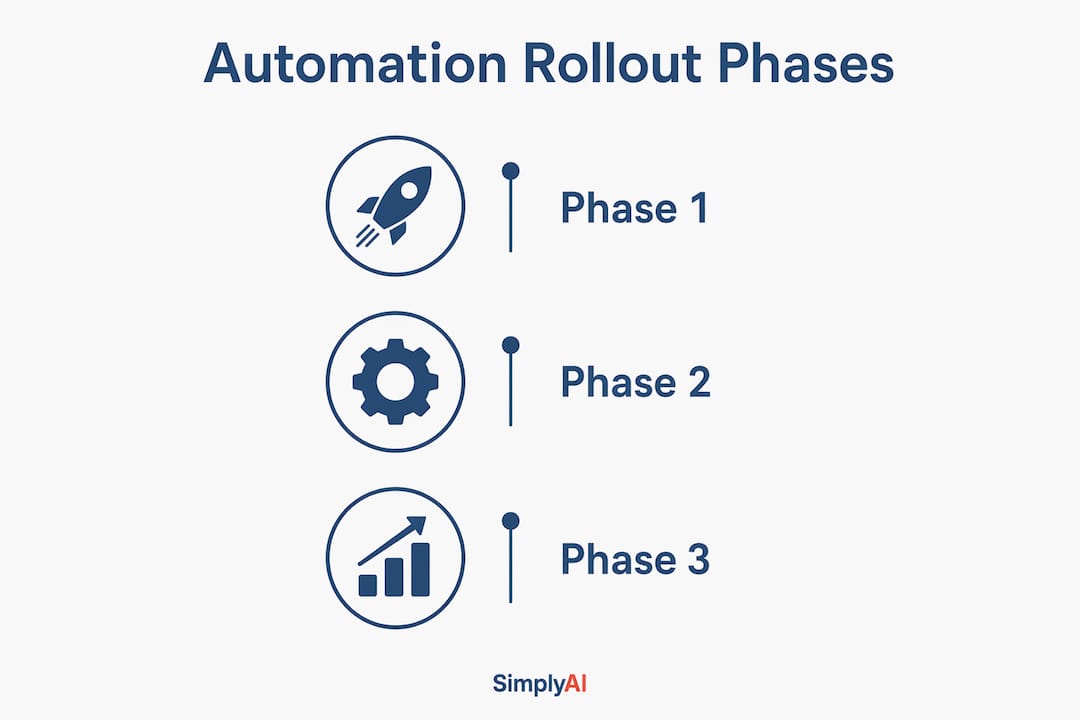
What does a phased automation rollout look like?
A phased rollout is the most reliable method for deploying ecommerce automation without disrupting live operations. It sequences projects by complexity and dependency, so each phase builds on the last rather than competing with it.
Phase 1 (Weeks 1 to 4): Quick wins. These are high-impact, low-effort automations that free team capacity immediately. The most common examples include:
- WISMO (Where Is My Order) auto-responses triggered by order status changes in your OMS
- Automated order confirmation and shipping notification emails via Klaviyo
- Accounting sync between Shopify and QuickBooks or Xero to eliminate manual reconciliation
- Low-stock alert triggers sent to your purchasing team when inventory drops below a threshold
- Return label generation triggered automatically upon return request approval
Each of these projects typically takes two to five days to configure and test. The combined effect is measurable within the first month: fewer support tickets, fewer manual data entries, and a team that has time to focus on higher-value work.
Phase 2 (Months 2 to 3): Strategic projects. These require deeper integration and carry more complexity. Manual purchase order generation is a strong Phase 2 candidate. Inventory management systems can auto-generate and route POs via email or EDI, updating demand forecasts in real time. Other Phase 2 projects include real-time inventory sync across multiple sales channels, multi-channel order routing logic, and automated fraud flagging. Each of these takes two to six weeks to build and test properly.
Phase 3 (Month 4 and beyond): Monitoring and optimization. Automation is not a set-and-forget system. You need dashboards that surface exception rates, automation failure logs, and KPI trends. For teams scaling into more complex territory, event-driven architecture using tools like Google Pub/Sub or AWS EventBridge allows decoupled AI agents to coordinate across systems without tight point-to-point integrations. This approach produces resilient, scalable automation that does not break when one system changes.
Pro Tip: Start with automations that free your team's time rather than those that eliminate headcount. The teams that get the most from automation are the ones that redeploy that capacity toward merchandising, conversion rate work, and customer strategy.
How to build a lean inventory and multi-node fulfillment system
Lean inventory management is defined as maintaining the minimum stock required to meet demand without stockouts, using a single reconciled data source across all sales channels. The operative phrase is "single reconciled source." When Shopify, Amazon, and wholesale channels each maintain separate inventory counts, demand forecasting becomes unreliable and reorder automation fails. Integrated data sources with dynamic reorder points that adjust to sales velocity and supplier lead times are the technical foundation of a lean system.

Dynamic reorder points replace static par levels. Instead of reordering when stock hits 100 units regardless of context, a dynamic system calculates the reorder point based on current daily sales velocity, supplier lead time, and a safety stock buffer that accounts for your returns rate. Incorporating returns as a buffer in demand planning prevents the overstocking that erodes margins for high-return categories like apparel and electronics.
The multi-node fulfillment strategy takes lean inventory a step further by distributing stock across geographically optimized warehouse locations. The data here is compelling. A multi-node strategy reduces average shipping zones from 4.2 to 2.7 and cuts transit times from three to five days down to one to two days. That means lower carrier costs per shipment and faster delivery, which directly improves repeat purchase rates.
| Strategy | Single-node | Multi-node |
|---|---|---|
| Average shipping zones | 4.2 | 2.7 |
| Average transit time | 3 to 5 days | 1 to 2 days |
| Reorder logic | Centralized, static | Per-node, dynamic |
| Returns buffer | Often ignored | Built into demand plan |
Configuring a multi-node system requires per-node reorder points rather than mirroring your central warehouse logic. A fulfillment center in Atlanta serving the Southeast has different lead times and sales velocity than one in Los Angeles serving the West Coast. Treating them identically produces stockouts in one location and overstock in another.
Does your online store performance affect operational efficiency?
Site performance is an operational variable, not just a marketing concern. A one-second delay in page load time costs approximately 7% in conversions, and mobile users are disproportionately affected given that over 70% of Shopify traffic comes from mobile devices. That conversion loss translates directly into higher cost per acquisition and lower revenue per visitor, both of which increase operational pressure on every downstream system.
Checkout optimization is where site performance and operational efficiency intersect most directly. A checkout flow that requires account creation, multiple address confirmation steps, or slow payment processing creates abandonment that no amount of fulfillment speed can recover. Shopify's accelerated checkout options, combined with address validation APIs, reduce friction and lower the rate of orders with incorrect shipping data, which in turn reduces fulfillment exceptions.
Customer support integration with your backend systems produces a second category of operational gains. Unifying customer support with IMS and OMS data eliminates the information silos that force support agents to ask customers for order numbers they already have. When a support agent can see real-time inventory status, order location, and return history in a single interface, average handle time drops and first-contact resolution rates rise. Proactive automated communication, such as delay notifications triggered by carrier scan events, reduces inbound ticket volume before it starts.
Klaviyo's event-based segmentation allows you to trigger post-purchase flows, reorder reminders, and proactive delay communications based on OMS data rather than time-based rules. This approach to ecommerce workflow enhancement produces measurably better customer retention than generic broadcast email campaigns.
Pro Tip: Audit your support ticket categories before building automation. If 40% of your tickets are WISMO inquiries, that is a fulfillment communication problem, not a support staffing problem. Fix the communication trigger, and the ticket volume drops without adding headcount.
Key takeaways
Effective ecommerce operations improvement requires a sequenced approach: audit first, automate second, and optimize continuously using unified data across inventory, fulfillment, and customer systems.
| Point | Details |
|---|---|
| Audit before automating | Map every task with owner, frequency, systems, and decision complexity before building any automation. |
| Phase your rollout | Start with quick wins in weeks one to four, then tackle complex integrations in months two and three. |
| Unify inventory data | A single reconciled data source across all channels is the prerequisite for accurate demand forecasting and reorder automation. |
| Distribute fulfillment nodes | Multi-node strategies reduce shipping zones and transit times, lowering costs and improving retention. |
| Integrate support with backend | Connecting IMS and OMS to your support platform reduces ticket volume and improves first-contact resolution. |
Why most ecommerce teams get automation backwards
Most ecommerce teams I work with make the same mistake: they buy the software before they understand the problem. A new inventory management platform does not fix a demand forecasting process that relies on gut feel and spreadsheets. A marketing automation tool does not improve retention if the underlying customer data is fragmented across three systems that never talk to each other.
The teams that see the most dramatic results from AI-driven automation are the ones that treat it as a capacity multiplier rather than a headcount reduction tool. When you automate WISMO responses, your support team does not shrink. They shift their attention to complex escalations, product feedback loops, and proactive outreach to high-value customers. That shift compounds over time in ways that are genuinely hard to replicate through hiring alone.
The other pattern I see consistently is teams underestimating the importance of data discipline. The best automation stack in the world produces garbage outputs if the underlying data is inaccurate. Consistent SKU naming conventions, reconciled channel inventory, and clean customer records are not glamorous work. They are, however, the actual foundation that makes everything else function. Before you invest in a new platform, spend two weeks cleaning the data in the systems you already have. The ROI on that work almost always exceeds the ROI on new software.
— Theodor
How Simplyai can accelerate your operations transformation
Simplyai designs and implements AI automations and workflow integrations built specifically for ecommerce businesses that need measurable efficiency gains without the overhead of a large internal tech team. From automated order routing and inventory sync to AI-powered customer communication workflows, Simplyai builds systems that reduce manual work and improve operational accuracy across every channel. For ecommerce managers ready to move from manual processes to a fully integrated automation architecture, Simplyai's AI automation services provide the technical expertise and implementation support to get there faster. Explore how Simplyai's solutions map to your specific operational challenges and start building the infrastructure your growth requires.
FAQ
What does it mean to streamline ecommerce operations?
Streamlining ecommerce operations means reducing manual effort and improving process efficiency through automation, integrated data systems, and optimized fulfillment workflows. The goal is to lower costs, reduce errors, and free team capacity for higher-value work.
Where should I start when trying to improve ecommerce efficiency?
Start with an operations audit that maps every task by owner, frequency, systems involved, and time spent. This identifies which processes are strong candidates for automation and which need to be standardized before any technology is applied.
How long does a phased ecommerce automation rollout take?
Phase 1 quick wins, such as WISMO auto-responses and accounting syncs, are typically achievable within four weeks. Phase 2 strategic projects like automated purchase order generation and multi-channel order routing take two to six weeks each.
What is a multi-node inventory strategy?
A multi-node inventory strategy distributes stock across multiple geographically optimized warehouse locations. This approach reduces average shipping zones from 4.2 to 2.7 and cuts transit times from three to five days down to one to two days, lowering carrier costs and improving delivery speed.
How does site speed affect ecommerce operations?
A one-second delay in page load time reduces conversions by approximately 7%, which increases cost per acquisition and puts pressure on every downstream operational system. Optimizing checkout performance and mobile load times directly reduces fulfillment exceptions caused by abandoned or incomplete orders.