

TL;DR:
- Hyperautomation combines multiple advanced technologies to automate entire workflows, not just isolated tasks. It enhances efficiency, reduces errors, and enables SMBs to scale operations without proportional staffing increases. Success depends on organizational alignment, integration, and continuous improvement, not technology alone.
Most businesses have automated something. Maybe invoices get processed automatically, or a CRM sends follow-up emails without anyone lifting a finger. That kind of task-level automation delivers real value, but it represents only the beginning of what is now possible. The gap between "we have some automation" and "our operations run intelligently" is widening fast, and businesses that do not bridge it risk falling behind competitors who move faster, serve customers better, and operate at lower cost. Hyperautomation is what closes that gap, and understanding it is no longer optional for growth-focused organizations.
Table of Contents
- Defining hyperautomation: Beyond basic automation
- The core tools and technologies powering hyperautomation
- Benefits of hyperautomation for SMBs: Efficiency and growth
- How to spot and overcome hyperautomation pitfalls
- Why hyperautomation success isn't about technology alone
- Unlock the potential of hyperautomation for your business
- Frequently asked questions
Key Takeaways
| Point | Details |
|---|---|
| Hyperautomation redefined | It moves beyond single-task automation by connecting multiple advanced technologies to transform workflows. |
| SMB advantages | Hyperautomation offers SMBs efficiency, reduced costs, and better customer service without increasing headcount. |
| Start with strategy | Choose automation targets carefully and align technology with business goals for sustainable success. |
| Avoid common mistakes | Focus on integration, staff buy-in, and ongoing measurement to ensure value. |
| People matter most | The real key to hyperautomation is organizational culture, not just cutting-edge technology. |
Defining hyperautomation: Beyond basic automation
After establishing the need for more than basic automation, it is critical to clarify what hyperautomation truly means and how it is different from what most businesses already know.
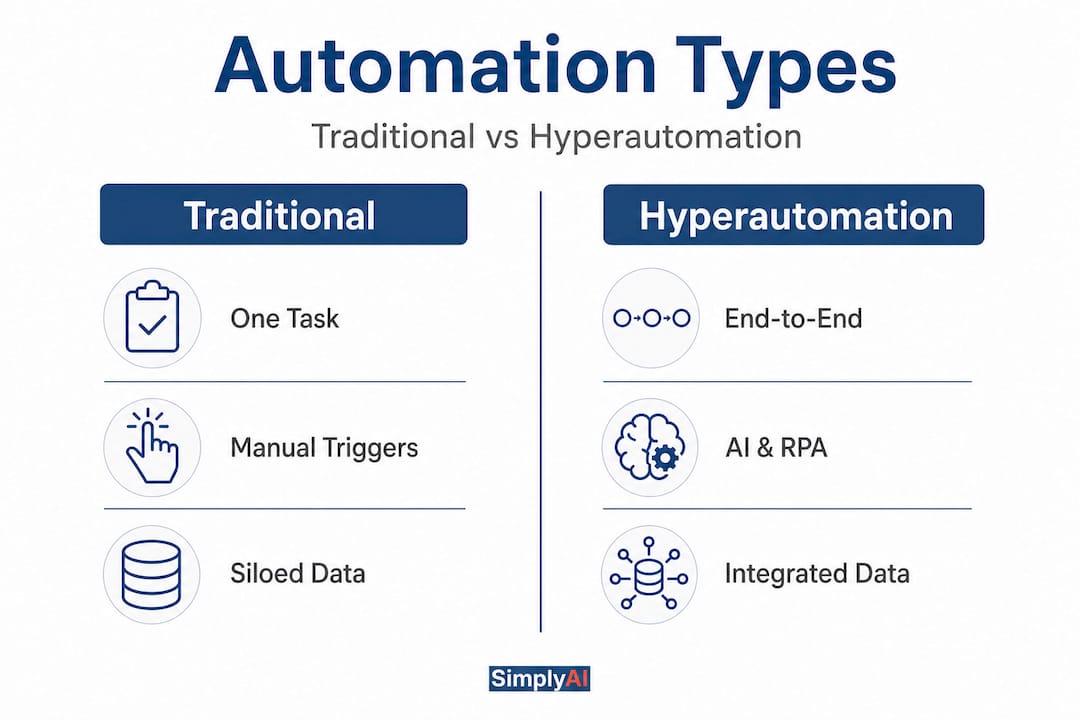
Traditional automation focuses on a single, repetitive task. A script runs, a form gets filled, an email gets sent. It is linear, predictable, and relatively narrow in scope. Hyperautomation is something fundamentally different. It combines multiple technologies, including Robotic Process Automation (RPA), Artificial Intelligence (AI), Machine Learning (ML), natural language processing, and process mining, to automate entire end-to-end workflows rather than isolated steps. According to Gartner's research on hyperautomation, it is one of the top strategic technology trends reshaping how organizations operate.
Think of traditional automation as automating a single station on a factory floor. Hyperautomation, by contrast, connects every station, monitors the entire production line in real time, and uses intelligent systems to adapt when something changes. The result is an operation that can sense, decide, and act with minimal human intervention across complex, multi-step processes.
| Feature | Traditional automation | Hyperautomation |
|---|---|---|
| Scope | Single task or process | End-to-end workflows |
| Decision-making | Rule-based only | AI-driven and adaptive |
| Technology used | One tool | Multiple integrated tools |
| Human involvement | High for exceptions | Significantly reduced |
| Learning capability | None | Continuous improvement via ML |
The business case for this shift is compelling. Fragmented processes create data silos, slow response times, and costly errors. Hyperautomation breaks down those silos by connecting systems that previously operated independently. An order management system, a customer support platform, and a logistics tracker can all communicate through a hyperautomation layer, enabling a smoother, faster customer experience. For practical AI integration examples that illustrate this in action, the possibilities span industries from retail to professional services.
Small and medium-sized businesses especially benefit from thinking in terms of connected workflows rather than isolated automation wins. The intelligent automation guide for SMBs outlines how businesses with lean teams can achieve outsized operational gains when automation layers work together rather than in isolation.
The core tools and technologies powering hyperautomation
Now that hyperautomation is clearly defined, let us explore the practical tools and technologies that make it function in real business settings.
Hyperautomation is best understood as a toolbox approach, where the right combination of technologies is layered to address the complexity of a given process. No single tool delivers hyperautomation on its own. The power comes from integration and orchestration.

Robotic Process Automation (RPA) sits at the foundation. RPA software bots mimic human actions on digital systems, logging into applications, copying data, filling forms, and triggering workflows. RPA handles the repetitive, rules-based tasks that eat hours of productive time. But RPA alone cannot make judgment calls or adapt when the data does not fit the expected pattern.
That is where Artificial Intelligence and Machine Learning enter. AI brings natural language understanding, computer vision, and decision-making capabilities. ML allows systems to learn from historical data and continuously improve accuracy over time. When an AI layer is added to an RPA workflow, the system can handle unstructured inputs like free-text emails or scanned documents, not just clean, structured data.
Process mining is a less discussed but critically important technology. It analyzes event logs from existing systems to map how processes actually run, as opposed to how they are supposed to run. This reveals bottlenecks, redundancies, and deviation patterns that human analysts might never spot. For businesses exploring adaptive AI for SMBs, process mining provides the diagnostic foundation that makes subsequent automation genuinely effective.
Advanced analytics and business intelligence complete the picture. These tools give decision-makers real-time visibility into process performance, enabling faster course corrections and more confident strategic planning.
| Technology | Primary function | Example use case |
|---|---|---|
| RPA | Task execution | Automating data entry across systems |
| AI and ML | Decision-making and learning | Classifying customer inquiries automatically |
| Process mining | Workflow discovery and diagnosis | Identifying invoice approval bottlenecks |
| NLP | Understanding language | Parsing unstructured customer feedback |
| Analytics | Performance monitoring | Tracking end-to-end process efficiency |
The critical caveat here is that interoperability matters more than any single tool. Businesses sometimes purchase multiple automation platforms without ensuring they can communicate with each other. That approach produces an expensive patchwork rather than a cohesive hyperautomation system. Investing in connected, compatible technologies from the start prevents significant rework down the line. For AI solutions for business growth that demonstrate how layered technologies drive measurable results, the pattern consistently shows that integration quality predicts outcome quality.
Pro Tip: Before evaluating any new automation technology, audit your current system landscape. Map which tools need to exchange data and verify API compatibility. A connected architecture makes every additional tool dramatically more powerful.
Benefits of hyperautomation for SMBs: Efficiency and growth
With a clear understanding of the technologies involved, it is essential to see the real-world returns that hyperautomation can deliver, especially for SMBs navigating competitive environments.
The advantages are not theoretical. Businesses implementing hyperautomation report meaningful, measurable improvements across multiple dimensions of operations and customer experience. Here are the most significant benefits SMBs consistently realize.
1. Dramatic cost reduction. When intelligent automation handles routine work, the labor cost per transaction falls significantly. A hyperautomated accounts payable process, for example, can process invoices at a fraction of the cost of manual handling, with higher accuracy and zero fatigue.
2. Faster end-to-end cycle times. Human-driven processes are constrained by working hours, handoff delays, and cognitive bandwidth. Automated workflows run continuously, dramatically accelerating time-to-resolution for customer requests, order fulfillment, compliance reporting, and more.
3. Significant error reduction. Manual data handling introduces mistakes that cascade into costly corrections. Hyperautomation eliminates most data-entry errors, reducing rework, customer complaints, and compliance risk simultaneously.
4. Scalable operations without proportional headcount increases. This is one of the most strategically valuable aspects for SMBs. As volume grows, hyperautomation absorbs the load. A business can triple its order volume without tripling its operations team, as detailed in resources on optimizing business processes for sustainable growth.
5. Improved customer experience. Faster response times, consistent service quality, and proactive communication are all outcomes of well-executed hyperautomation. Customers do not see the technology, but they feel its effect in every interaction.
6. Better data-driven decision-making. When processes run through connected automated systems, they generate structured data automatically. Leaders gain real-time visibility into performance metrics that were previously buried in spreadsheets or unavailable entirely.
"The businesses that will lead their markets in the next decade are those that treat automation not as a cost-cutting tool but as a growth engine that enables them to serve customers at a level their competitors simply cannot match."
The opportunity for agility is worth emphasizing specifically. Traditional businesses operate with rigid processes that are slow to change. A hyperautomated organization can reconfigure workflows in response to a market shift, a new regulation, or a customer demand pattern in a matter of days rather than months. For a deeper look at how data-driven automation types contribute to this agility, the evidence points clearly toward connected, intelligent systems as a competitive differentiator.
Pro Tip: Start measuring the cost per transaction in your most manual processes right now. That baseline number will make the ROI case for hyperautomation undeniable once you run your first pilot.
How to spot and overcome hyperautomation pitfalls
Even with all these advantages, hyperautomation comes with real challenges and risks. Here is what you need to know to succeed.
The first and most common mistake is automating everything without prioritizing. Not every business process benefits equally from automation. Pursuing automation across the board dilutes focus, exhausts budget, and produces mediocre results everywhere instead of dramatic results in the places that matter most. Focus intensely on high-volume, high-impact workflows where errors are costly and speed is competitively meaningful.
Lack of system integration is the second major pitfall. Businesses sometimes invest in best-in-class automation tools that cannot communicate with each other or with existing core systems. The result is automation islands rather than a cohesive intelligent layer. Compatibility assessment must precede vendor selection, not follow it. Resources on process automation for scaling consistently highlight integration architecture as the deciding factor between automation projects that deliver lasting value and those that stall.
Insufficient team buy-in is frequently underestimated as a risk. Hyperautomation changes how people work. If staff view it as a threat rather than a tool that frees them from tedious work, adoption will be slow, workarounds will proliferate, and the system will underperform. Leadership must communicate the "why" clearly and involve team members in identifying processes to automate.
Failure to monitor and iterate is another common error. Hyperautomation is not a set-and-forget investment. Processes evolve, data patterns shift, and business conditions change. Building in regular performance reviews and creating a feedback loop for continuous improvement is essential to sustaining value over time. The AI automation trends of 2026 point clearly toward iterative, adaptive systems as the standard for high-performing organizations.
Change management and training must be treated as core components of any hyperautomation initiative. Staff who understand how to work alongside automated systems, how to interpret their outputs, and how to flag exceptions intelligently become multipliers of the technology's value. Without that investment, even well-designed systems underperform because the human layer is unprepared.
Pro Tip: Before launching any automation initiative, form a small cross-functional team that includes operations, IT, and at least one frontline employee from the affected process. Their combined insight will reveal integration gaps and adoption risks that a purely technical team will miss.
Why hyperautomation success isn't about technology alone
Moving from potential pitfalls to a broader perspective, here is what most guides overlook when discussing hyperautomation.
The technology conversation dominates discussions about hyperautomation, and understandably so. The tools are impressive and the capabilities are genuinely transformative. But after working closely with businesses across multiple industries, a consistent pattern emerges: the companies that achieve lasting, scalable results from hyperautomation are not necessarily the ones with the most sophisticated technology stacks. They are the ones with the clearest organizational alignment.
Technology is the enabler. Culture is the engine. When leadership actively drives the vision for automation, communicates it transparently, and creates space for experimentation and occasional failure, teams respond with exactly the creative problem-solving that makes hyperautomation initiatives successful. When leadership delegates the entire initiative to an IT department without strategic ownership, the project tends to solve technical problems rather than business problems.
The biggest structural mistake we observe is letting the technology drive the agenda. A business that says "we bought an RPA platform, now let us find things to automate" will consistently underperform compared to a business that says "our customer onboarding takes twelve days and we want it to take two, so let us find the right technology to make that happen." Goal clarity precedes tool selection, always.
Continuous learning is not just a feature of ML systems. It needs to be a feature of the organization itself. The businesses that extract the most value from hyperautomation treat every deployment as a learning opportunity, review outcomes honestly, and iterate without ego. They empower employees to suggest improvements, celebrate small wins, and gradually build institutional knowledge about what works. This is the compounding advantage that separates leaders from followers in the automation era.
For a concrete picture of how this plays out in practice, the AI integration examples from businesses that have made this cultural shift are illuminating. The technology was rarely the hard part.
Unlock the potential of hyperautomation for your business
If you are inspired to take the next step, here is how our team can support your hyperautomation journey.
Hyperautomation represents one of the most significant opportunities available to SMBs today, but knowing where to start is genuinely difficult without experienced guidance.
At SimplyAI, we specialize in helping small and medium-sized businesses assess their automation readiness, identify high-impact workflows, and implement connected AI solutions that deliver measurable results. Whether you are exploring AI automation services for the first time or ready to deploy sophisticated AI agents for business that operate autonomously across your workflows, we design solutions scaled precisely to your business context. We also provide corporate AI education to ensure your team is equipped to work confidently alongside the technology you deploy. Reach out for an assessment, a pilot project, or a structured training program. The next step is simpler than you think.
Frequently asked questions
How is hyperautomation different from regular automation?
Hyperautomation integrates multiple automation technologies and AI to optimize entire workflows end-to-end, whereas regular automation typically addresses a single repetitive task using rule-based tools without learning or adaptive capabilities.
Do I need a large IT team to get started with hyperautomation?
No. Many hyperautomation platforms are designed with usability in mind, and partnering with a specialist provider means you can achieve significant results even with limited internal technical resources.
What are the first steps to adopting hyperautomation?
Start by identifying the two or three processes in your business that are high-volume, error-prone, or slow, then engage an automation specialist or platform provider for a structured assessment of what is feasible and where the return will be strongest.
Can hyperautomation help improve customer experience?
Absolutely. By reducing processing times, eliminating manual errors, and enabling consistent service delivery around the clock, hyperautomation directly improves the speed, accuracy, and reliability of every customer-facing interaction.
Will hyperautomation replace jobs in my company?
Hyperautomation is far more likely to transform roles than eliminate them entirely, freeing your team from repetitive, low-value tasks so they can focus on judgment-intensive work that genuinely requires human skill and creativity.