

TL;DR:
- Responsible AI guidelines establish ethical principles and operational frameworks for developing and governing AI systems, emphasizing fairness, transparency, and accountability. Embedding these practices into enterprise management, continuous monitoring, and cross-jurisdictional standards is essential for trustworthy and compliant AI deployment. Leaders who prioritize responsible AI as a maturity signal gain competitive advantage through sustainable innovation and reputation management.
Responsible AI guidelines are structured principles and operational frameworks that define how organizations must develop, deploy, and govern artificial intelligence to meet ethical, legal, and societal standards. Bodies like the OECD, UNESCO, and Microsoft have each published frameworks that converge on a shared set of values: fairness, transparency, accountability, privacy, and safety. For business leaders and compliance officers, these frameworks are not aspirational documents. They are the architecture for building AI programs that earn trust, satisfy regulators, and reduce operational risk as AI becomes central to enterprise decision-making.
What are the foundational principles of responsible AI?
Responsible AI principles consistently emphasize fairness, transparency, accountability, privacy, safety, explainability, inclusiveness, and sustainability across leading organizations including Microsoft, UNESCO, OECD, and ISO. These eight pillars appear in virtually every major framework, which means compliance officers can build a single internal standard that maps to multiple external requirements simultaneously. That convergence is a strategic advantage, not a coincidence.

UNESCO's AI Ethics Recommendation centers on human rights, placing auditability, transparency, impact assessment, and human oversight at the core of its guidance. UNESCO also provides two concrete implementation tools: the Readiness Assessment Methodology (RAM) and the Ethical Impact Assessment (EIA). These tools give member states and organizations a structured path from principle to practice, which is exactly what most compliance programs lack.
The OECD and Microsoft approach the same principles from a governance and product design angle respectively. The OECD frames ethics as a due diligence obligation embedded across the AI value chain, while Microsoft operationalizes principles through product architecture and agent monitoring requirements. Understanding where these frameworks agree and where they diverge helps organizations prioritize their governance investments.
| Principle | UNESCO | OECD | Microsoft |
|---|---|---|---|
| Transparency | Auditability and impact disclosure | Value-chain transparency | Explainability in agent outputs |
| Accountability | Human oversight mechanisms | Due diligence obligations | Monitoring and escalation paths |
| Fairness | Human dignity and non-discrimination | Inclusive stakeholder engagement | Bias detection in model outputs |
| Privacy | Data protection as a human right | Privacy-by-design in AI systems | Data minimization in agent design |
| Safety | Risk assessment before deployment | Lifecycle risk management | Continuous evaluation of live agents |
Pro Tip: Map your internal AI policy against all three frameworks simultaneously. Where they overlap, you have your non-negotiable standards. Where they diverge, you have room to tailor governance to your industry context.
How to embed responsible AI practices into enterprise policies
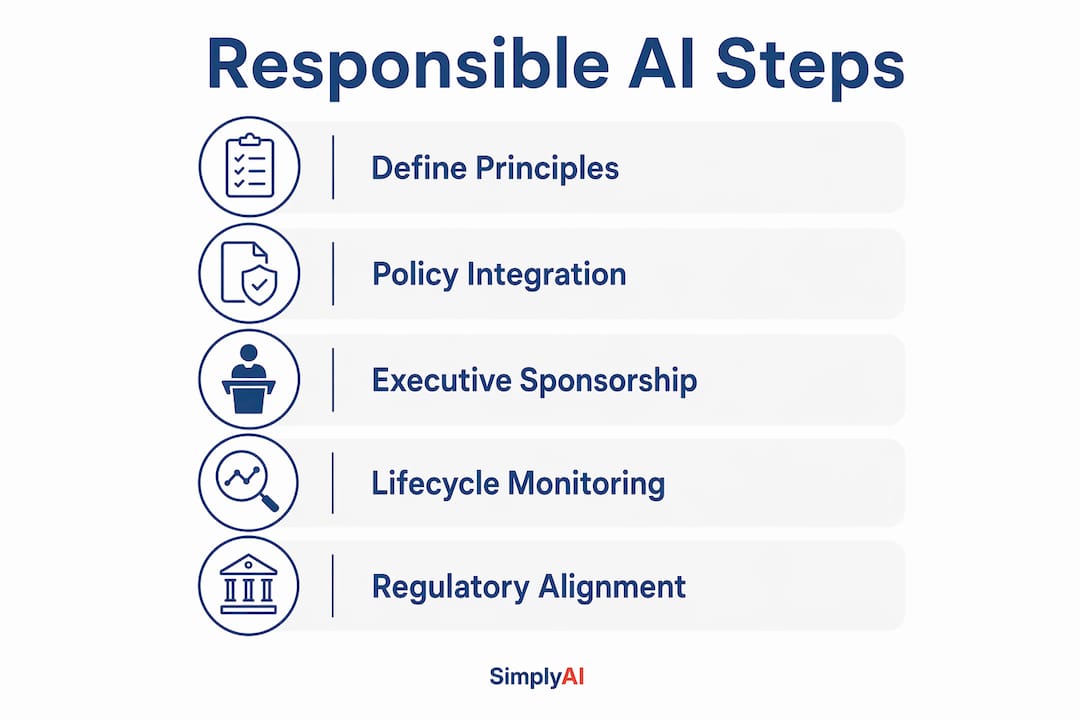
The OECD's Due Diligence Guidance for Responsible AI prescribes embedding responsible business conduct into enterprise management systems as the first step in a six-step framework. This sequencing matters. Organizations that jump straight to impact assessments without first anchoring ethics in their governance structure end up with compliance theater rather than genuine accountability. The management system comes before the checklist.
Practically, embedding ethical AI practices into enterprise policy requires six deliberate actions:
- Integrate AI ethics into existing corporate governance documents, including board-level risk frameworks and executive accountability structures.
- Define clear roles and responsibilities for AI oversight, including a named AI ethics lead or cross-functional AI governance committee.
- Develop training programs that build AI literacy and ethical awareness across business units, not just the technology team.
- Establish impact assessment protocols that evaluate AI systems before deployment and at defined intervals post-launch.
- Create escalation and incident response paths so that ethical violations or unexpected AI behaviors have a clear owner and resolution process.
- Integrate AI ethics metrics into performance management and audit cycles to make accountability measurable.
Iterative governance, training, and impact assessment are the critical tools for sustainable AI ethics programs, and they require continuous investment rather than one-time setup. Organizations that treat responsible AI as a project with a completion date consistently find governance gaps appearing within months of deployment. The OECD's framework explicitly addresses this by treating due diligence as an ongoing obligation tied to the full AI lifecycle, including changes to model versions, data sources, and deployment contexts.
Building an ethical AI culture also requires executive sponsorship that is visible and consistent. When the CEO or Chief Compliance Officer publicly champions AI ethics standards, business units take the governance requirements seriously. Without that signal from the top, ethics programs tend to stall at the policy document stage.
Pro Tip: Avoid treating responsible AI as a one-off compliance checklist. Schedule quarterly governance reviews tied to your AI system change log so that every model update or new deployment triggers a fresh ethics assessment.
How does AI lifecycle monitoring support responsible use of AI?
Microsoft's Responsible AI considerations require continuous monitoring and evaluation of AI agents to ensure ethical boundaries remain intact in live interactions. This is a critical distinction from traditional software governance: an AI agent's behavior can drift over time as it encounters new data, user inputs, and edge cases that were not present during testing. Monitoring is not optional post-deployment. It is the primary mechanism for maintaining compliance.
Key operational practices for lifecycle monitoring include:
- Assign explicit ownership for post-deployment monitoring to a named team or individual, with defined escalation paths for anomalies.
- Establish baseline behavioral benchmarks for each AI agent at launch, then run automated evaluations against those benchmarks on a defined schedule.
- Document all model updates, data source changes, and configuration modifications in a version-controlled AI system log.
- Conduct external expert reviews at least annually, particularly for AI systems operating in high-risk domains such as credit, hiring, or healthcare.
- Build incident response protocols that include immediate containment, root cause analysis, and stakeholder notification within defined timeframes.
When standard ethical requirements conflict with specific organizational needs, custom engine agents become necessary, which introduces architectural implications that must be assessed during feasibility planning rather than after deployment. This is one of the most underappreciated risks in enterprise AI programs. Organizations often discover mid-deployment that their use case requires a custom architecture, forcing costly redesigns and governance gaps during the transition period.
OpenAI's Frontier Governance Framework addresses advanced AI readiness by focusing on risk mitigation areas such as harmful manipulation, incident response, and external expert input with evolving updates. The framework separates internal safety and security controls from public governance obligations, which allows organizations to maintain proprietary safeguards while still meeting regulatory transparency requirements. That separation is a model worth adopting internally.
Pro Tip: Build your AI monitoring dashboard before you deploy, not after. Define what "normal" looks like for each agent at launch so you have a clear reference point when behavior deviates.
How do global regulations and frameworks converge in 2026?
The regulatory environment for AI governance has reached a point of meaningful convergence. The EU AI Act, California's Transparency in Frontier AI Act, the OECD's AI Principles, and UNESCO's Ethics Recommendation all address overlapping obligations around transparency, risk classification, and human oversight. OpenAI's Frontier Governance Framework aligns internal safety practices with public regulatory requirements including both the California Transparency Act and the EU AI Act, demonstrating that a single internal governance architecture can satisfy multiple jurisdictions simultaneously.
The distinction between voluntary standards and mandatory regulation is narrowing. What the OECD and UNESCO frame as best practices today frequently become the baseline for binding legislation within two to three legislative cycles. Organizations that adopt voluntary frameworks proactively find that regulatory compliance becomes significantly less disruptive when mandatory rules arrive.
| Framework | Type | Key Obligation | Geographic Scope |
|---|---|---|---|
| EU AI Act | Mandatory | Risk classification and conformity assessment | European Union |
| California Transparency in Frontier AI Act | Mandatory | Safety testing and public disclosure | California, USA |
| OECD AI Principles | Voluntary | Trustworthy AI and due diligence | OECD member countries |
| UNESCO AI Ethics Recommendation | Voluntary | Human rights impact assessment | 193 member states |
| Microsoft Responsible AI Standard | Voluntary | Product-level ethics and monitoring | Global (internal) |
For organizations operating across multiple jurisdictions, the practical strategy is to build governance to the highest applicable standard and document how that standard satisfies each regional requirement. This approach reduces compliance overhead and creates a defensible audit trail for regulators in any market.
Best practices and common challenges in implementing AI ethics standards
The OECD AI Governance Playbook breaks governance into 12 directives across strategy, risk and compliance, workforce readiness, and operational management, with executive sponsorship, cross-functional coordination, and continuous iteration identified as the three keys to effective implementation. Organizations that skip any of these three elements tend to produce governance frameworks that look complete on paper but fail in practice.
The most common implementation failures share a recognizable pattern. Governance gaps appear most frequently after AI system deployment, when monitoring ownership is unclear and escalation paths were never defined. Cross-functional collaboration breaks down when AI ethics is treated as a technology function rather than a business-wide responsibility. And transparency commitments erode when legal or security teams block disclosure without providing alternative accountability mechanisms.
Effective organizations address these challenges by treating AI ethics as a shared business function with representation from legal, compliance, technology, HR, and operations. They also leverage existing management systems rather than building parallel governance structures. An organization with a mature ISO 27001 information security program, for example, can extend that framework to cover AI data governance without creating a separate bureaucracy.
The continuous embedding of AI ethics into management systems creates more effective governance than episodic reviews. This means AI ethics considerations appear in vendor contracts, procurement checklists, product roadmaps, and employee performance criteria. When ethics is embedded at that level, it becomes self-reinforcing rather than dependent on periodic audits.
For organizations evaluating AI in HR processes, understanding AI screening risks and fairness is particularly relevant, as hiring decisions carry significant legal exposure under both employment law and emerging AI regulations.
Key takeaways
Responsible AI governance requires continuous, embedded oversight across the full AI lifecycle, not a one-time compliance exercise.
| Point | Details |
|---|---|
| Start with management systems | Embed AI ethics into existing governance structures before conducting impact assessments or deploying AI tools. |
| Map to multiple frameworks | Align internal standards to OECD, UNESCO, and Microsoft principles simultaneously to satisfy multiple regulatory requirements with one policy. |
| Monitor continuously post-deployment | Assign named ownership for AI agent monitoring and define escalation paths before launch, not after. |
| Build for regulatory convergence | Govern to the highest applicable standard across jurisdictions to reduce compliance overhead as mandatory rules expand. |
| Make ethics cross-functional | Include legal, compliance, HR, and operations in AI governance to prevent ethics from becoming a siloed technology function. |
Why responsible AI is a leadership imperative, not a compliance formality
From my perspective, the organizations that treat responsible AI guidelines as a legal obligation to satisfy are already behind. The frameworks published by the OECD, UNESCO, and Microsoft are not bureaucratic hurdles. They are the accumulated judgment of the most sophisticated AI governance thinkers in the world, distilled into actionable structure. Business leaders who engage with them seriously gain a competitive advantage: they build AI systems that earn user trust, attract regulatory goodwill, and avoid the reputational damage that follows high-profile AI failures.
What I find most telling is how often governance gaps appear not during development, but after deployment. Organizations invest heavily in pre-launch ethics reviews and then assign no one to monitor what the AI actually does in production. That is the single most predictable failure mode in enterprise AI programs, and it is entirely preventable with upfront planning.
The leaders I respect most in this space treat responsible AI as a signal of organizational maturity. They recognize that ethical AI practices are not constraints on innovation. They are the conditions under which sustainable innovation becomes possible. As regulations tighten and public scrutiny of AI intensifies, that perspective will separate organizations that thrive from those that spend their energy managing crises.
— Theodor
How Simplyai helps organizations deploy AI responsibly
Simplyai designs and implements AI automations and AI agents built with governance and ethical oversight in mind from the first line of architecture. For business leaders who need to move quickly without sacrificing accountability, Simplyai's approach integrates monitoring, transparency, and compliance considerations directly into the deployment process rather than treating them as afterthoughts. Explore Simplyai's AI automation services to see how responsible design translates into measurable operational results. For organizations deploying autonomous systems, Simplyai's enterprise AI agents are built with the lifecycle monitoring and escalation architecture that responsible AI standards require.
FAQ
What are responsible AI guidelines?
Responsible AI guidelines are ethical principles and operational frameworks that govern how organizations develop, deploy, and monitor AI systems. Leading frameworks from the OECD, UNESCO, and Microsoft converge on core values including fairness, transparency, accountability, privacy, and safety.
How do I start implementing AI ethics standards in my organization?
The OECD's Due Diligence Guidance recommends embedding responsible business conduct into existing management systems as the first step, before conducting impact assessments or deploying AI tools. Define roles, assign oversight ownership, and integrate ethics criteria into existing governance documents.
What is the difference between voluntary AI standards and mandatory regulations?
Voluntary standards like the OECD AI Principles and UNESCO Ethics Recommendation establish best practices without legal enforcement, while mandatory regulations like the EU AI Act and California's Transparency in Frontier AI Act carry legal obligations and penalties. Organizations that adopt voluntary standards proactively are better positioned when mandatory rules arrive.
Why is post-deployment monitoring critical for responsible AI?
AI agent behavior can drift after deployment as systems encounter new data and edge cases not present during testing. Microsoft's Responsible AI framework identifies continuous monitoring and named oversight ownership as non-negotiable requirements for maintaining ethical compliance in live environments.
How can AI governance satisfy multiple regulatory jurisdictions at once?
Build internal governance to the highest applicable standard across all relevant jurisdictions and document how that standard maps to each regional requirement. OpenAI's Frontier Governance Framework demonstrates this approach by aligning a single internal safety architecture with both the EU AI Act and California's Transparency in Frontier AI Act.