

TL;DR:
- Artificial intelligence reflects the values and assumptions of its creators, data, and objectives, making ethical considerations essential. Responsible AI emphasizes fairness, transparency, accountability, and privacy to ensure outcomes serve human well-being and societal justice. Integrating ethical principles into AI development and deployment across sectors enhances trust, mitigates risks, and promotes equitable progress.
Artificial intelligence does not arrive neutral. Every model carries the assumptions of the people who built it, the data it was trained on, and the objectives its creators chose to optimize. Understanding what is ethical AI means recognizing that performance benchmarks tell only part of the story. The fuller picture includes fairness, accountability, privacy, and the question of whether AI outcomes genuinely serve human well-being. For individuals and professionals working with AI today, grasping these principles is not an abstract exercise. It is a practical requirement for responsible participation in a world where AI shapes hiring decisions, medical diagnoses, and financial access.
Table of Contents
- Key Takeaways
- What is ethical AI: definitions and core principles
- Ethical challenges and risks in AI deployment
- Ethical AI vs responsible AI: frameworks in practice
- Applying ethical AI across sectors and roles
- My perspective on what ethical AI really demands
- How Simplyai helps you implement AI with confidence
- FAQ
Key Takeaways
| Point | Details |
|---|---|
| Ethical AI goes beyond accuracy | AI systems must align with human values, not just deliver high performance metrics. |
| Four foundational pillars guide ethical AI | Fairness, transparency, accountability, and privacy form the core of responsible AI design. |
| Bias is a structural risk, not an accident | Algorithmic discrimination can originate in training data, model design, or deployment context. |
| Ethical and responsible AI are not identical | Ethical AI defines what AI should do morally; responsible AI governs how those values are operationalized. |
| Ethics enables better outcomes, not just fewer risks | Ethical design expands AI's potential to address large societal challenges equitably. |
What is ethical AI: definitions and core principles
Ethical AI refers to AI systems designed and deployed to align with human values, fairness, transparency, and societal well-being. Stanford HAI emphasizes that this responsibility stretches across the entire lifecycle, from initial design through real-world deployment, and extends well beyond accuracy metrics. An AI system can score impressively on benchmarks and still produce outcomes that harm individuals or groups. Ethical AI asks a harder question: does the system produce outcomes that are fair, explainable, and respectful of human dignity?
The University of Virginia's 2026 generative AI ethics guide organizes the field into four major ethical pillars: fairness and bias mitigation, privacy and security, accountability and transparency, and societal impact. These categories help practitioners move from vague intentions to concrete checkpoints. Fairness means the system does not disadvantage protected groups. Transparency means users and regulators can understand how the system reaches its conclusions. Accountability means someone is clearly responsible when things go wrong. Privacy means personal data is handled with appropriate safeguards.
The OECD AI Recommendation adds two additional dimensions worth noting: inclusive growth and well-being, and robustness and safety. This intergovernmental framework, adopted by dozens of countries, establishes that ethical AI is not a voluntary preference but a governance expectation with real policy implications. For professionals working across borders, understanding this framework is increasingly non-negotiable.
Pro Tip: When evaluating any AI tool or vendor, ask specifically how they address each of the four foundational pillars. Vague claims about "responsible AI" without concrete answers to fairness audits, explainability mechanisms, and data governance should raise a flag.
Ethical AI also differs from simply effective or useful AI. Accuracy alone is insufficient as a measure of good AI. A hiring algorithm may be highly accurate at predicting job performance and still systematically disadvantage women or minority candidates if the training data reflects historical biases. The moral impact on individuals and communities matters as much as the technical result.
Ethical challenges and risks in AI deployment
Understanding ethical artificial intelligence requires confronting the real problems that emerge when ethics are neglected. These are not theoretical concerns. They appear in production systems today.
Algorithmic bias is among the most documented risks. Bias originates in training data, model design, or the deployment context itself and can perpetuate discrimination based on race, gender, age, or other protected characteristics. A facial recognition system trained predominantly on lighter-skinned faces performs poorly on darker-skinned individuals. A credit scoring model trained on historical loan data may encode decades of discriminatory lending practices. These are not edge cases; they are predictable failure modes when ethical considerations are excluded from the development process.
Privacy and data security represent a second major risk area. AI systems often require large volumes of personal data to function effectively, creating exposure risks that traditional software does not. Large language models trained on scraped web data may inadvertently memorize and reproduce private information. Surveillance systems powered by computer vision can erode civil liberties when deployed without appropriate legal constraints.

The transparency problem is equally serious. Explainability in AI systems allows users and regulators to understand and challenge AI outputs. Without it, a patient denied insurance coverage or a defendant scored as high-risk by a pretrial assessment tool has no meaningful way to contest the decision. Explainable AI (XAI) research addresses this directly, but many commercial models still operate as black boxes in contexts where explainability is morally and legally required.
Accountability gaps compound all of these problems. When an AI system causes harm, responsibility must be traceable and assignable, whether to developers, deployers, or operators. Without clear accountability structures, harms go unaddressed, victims have no recourse, and incentives to prevent future harms remain weak.
Perhaps the broadest risk is societal. Neglecting ethical AI risks amplifying systemic inequalities and causing disproportionate harm to already marginalized communities. UNESCO has made this point explicitly in its Recommendation on the Ethics of AI, noting that biased AI can compound existing societal inequalities rather than reduce them.
Ethical AI vs responsible AI: frameworks in practice
Many professionals use "ethical AI" and "responsible AI" interchangeably. They are related but distinct concepts, and the distinction has practical consequences for how you build governance structures.
Ethical AI focuses on societal values and moral correctness. It addresses the question of what AI should do: what outcomes are acceptable, what harms are intolerable, and what values must be upheld regardless of technical constraints. Responsible AI, by contrast, focuses on the how: the governance mechanisms, operational processes, and accountability structures that translate ethical commitments into practice.
The table below captures the difference clearly.
| Dimension | Ethical AI | Responsible AI |
|---|---|---|
| Primary question | What should AI do? | How should AI be managed? |
| Focus | Values, fairness, human rights | Governance, compliance, operationalization |
| Key tools | Ethical principles, impact assessments | Audits, oversight boards, transparency reports |
| Orientation | Philosophical and normative | Practical and procedural |
| Who leads | Ethicists, policy experts, affected communities | Engineers, legal teams, compliance officers |
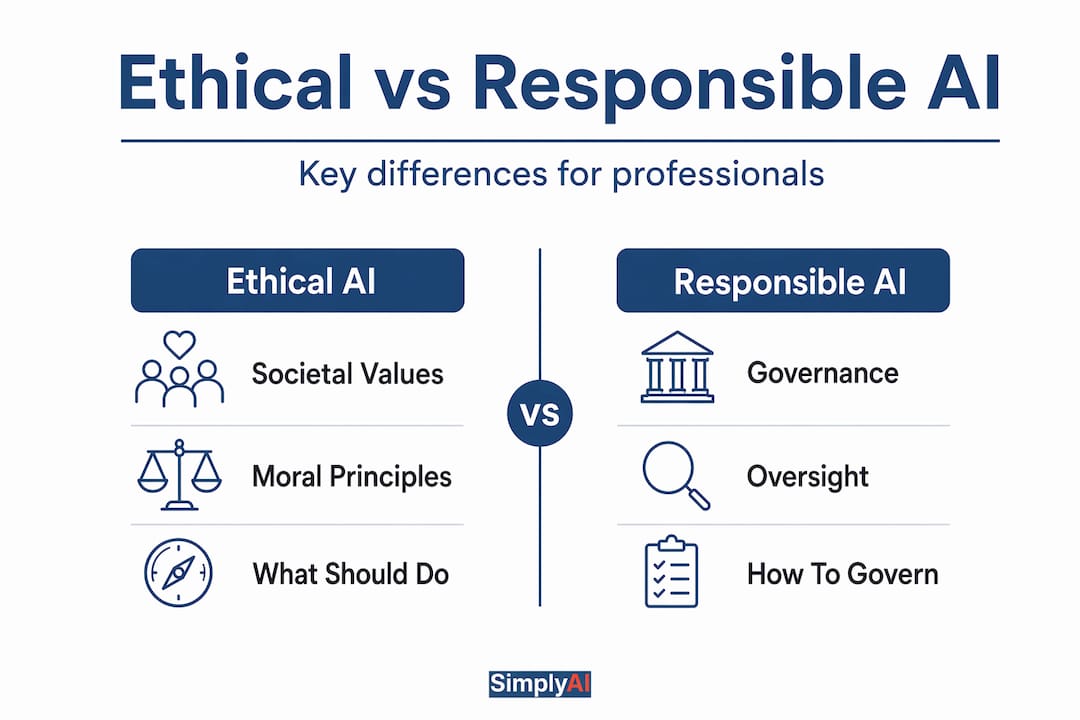
In practice, organizations need both. Ethical commitments without governance mechanisms are aspirational documents. Governance mechanisms without ethical grounding can produce technically compliant systems that still cause harm.
Practical ethical AI implementation includes fairness audits, human oversight requirements, impact assessments before deployment, transparency reports, and inclusive stakeholder participation. The OECD framework encourages multi-stakeholder governance and continuous monitoring, recognizing that risks evolve as systems are deployed in new contexts. Effective ethical AI also requires collaboration across disciplines including technology, philosophy, law, sociology, and public policy, because no single domain holds all the answers.
Pro Tip: If your organization is building an AI governance framework, start with impact assessments before deployment rather than audits after. Catching ethical problems in the design phase is far less costly than addressing harm once a system is live.
Applying ethical AI across sectors and roles
The importance of ethical AI becomes concrete when you look at how it plays out across industries. In healthcare, AI models that recommend diagnoses or treatment paths carry life-or-death stakes. An AI trained primarily on clinical data from one demographic population may produce unreliable recommendations for others. Ethical design in healthcare AI requires diverse training datasets, rigorous clinical validation, and transparent documentation of model limitations.
In financial services, AI tools that assess creditworthiness, detect fraud, or flag suspicious transactions must meet both ethical and regulatory standards. The U.S. Equal Credit Opportunity Act already prohibits discriminatory lending, and AI systems operating in this space are under increasing scrutiny to demonstrate that their outputs do not produce disparate impacts on protected classes.
Education technology presents its own ethical considerations. Adaptive learning platforms that personalize content based on student behavior can generate extraordinary value. They can also entrench performance gaps if the underlying models are trained on data that reflects existing inequalities in educational access.
For individual professionals, the question of what is ethical AI use translates into a set of practical responsibilities. Consider these steps when working with or evaluating AI systems:
- Scrutinize vendor claims about bias mitigation and ask for documentation, not marketing language.
- Advocate for human oversight in any AI-assisted decision that affects individuals materially, such as hiring, lending, or medical triage.
- Push for diverse representation in AI project teams, including input from the communities most likely to be affected by the system's outputs.
- Request transparency about training data sources, known limitations, and failure modes before deploying any AI tool organizationally.
- Treat ethics as an ongoing process rather than a pre-launch checklist. Systems drift, data changes, and new risks emerge over time.
Ethical AI benefits extend well beyond risk mitigation. Responsible design can expand AI's potential to address pressing challenges in medicine, education, and climate science equitably. Organizations that embed ethical considerations from the start tend to build more trustworthy products, face fewer regulatory challenges, and earn stronger user confidence. That is not an idealistic argument. It is a competitive one.
My perspective on what ethical AI really demands
I've seen a consistent pattern in conversations about ethical AI: organizations treat it as a compliance task. They produce a policy document, appoint a committee, and move on. What I've learned from working with AI tools across different business contexts is that ethical AI is not a project with a completion date. It is a design orientation that has to be rebuilt every time you introduce a new model, train on new data, or deploy in a new context.
The uncomfortable truth is that most AI ethics discussions focus on catastrophic failures while ignoring the quieter harms. A chatbot that consistently misunderstands non-native English speakers. A recommendation algorithm that subtly favors high-income users. A productivity tool that flags certain writing styles as lower quality. None of these make headlines, but they accumulate into real disadvantage for real people.
What I find most undervalued in the ethical AI conversation is the role of the user. Professionals who interact with AI tools daily have more power to shape ethical outcomes than most realize. Asking hard questions, refusing to accept opaque outputs for high-stakes decisions, and demanding explainability from vendors are not just policy positions. They are practical interventions that move the needle.
My advice: build your personal AI ethics literacy now, before your organization or regulator requires it. The professionals who understand the ethical considerations in AI today will be the ones shaping how it gets deployed tomorrow.
— Theodor
How Simplyai helps you implement AI with confidence
Adopting AI in your business comes with real questions about responsibility, fairness, and trust. Simplyai designs and implements AI automations and AI agents for small and medium-sized businesses with exactly those concerns in mind. Every solution, from AI-powered chatbots to workflow automation and CRM integrations, is built to deliver measurable results while respecting data privacy, maintaining human oversight, and giving your team clear visibility into how the AI is working.
If you are ready to move from understanding ethical AI principles to acting on them in your own operations, Simplyai offers practical, tailored solutions that make responsible AI adoption accessible. Explore what AI automation can do for your business and discover how ethical design and operational efficiency reinforce each other rather than compete. The organizations that get this right now will be best positioned as AI regulations and expectations continue to evolve.
FAQ
What is ethical AI in simple terms?
Ethical AI refers to artificial intelligence systems designed to align with human values, including fairness, transparency, accountability, and privacy, rather than optimizing purely for performance or efficiency.
How does ethical AI work in practice?
Ethical AI works through a combination of fairness audits, impact assessments, human oversight, explainability requirements, and inclusive stakeholder participation applied throughout the AI development and deployment lifecycle.
What are the main ethical considerations in AI?
The four major ethical considerations in AI are algorithmic bias and fairness, privacy and data security, transparency and explainability, and accountability for harmful outcomes.
What is the difference between ethical AI and responsible AI?
Ethical AI defines what AI should do based on moral values, while responsible AI focuses on the governance structures and operational practices that put those values into effect.
Why does ethical AI matter for business?
Organizations that build ethical AI earn stronger user trust, face fewer regulatory challenges, and create products that serve broader populations, making ethics a competitive advantage as well as a moral responsibility.