

TL;DR:
- Most organizations are implementing AI incrementally in supply chains to achieve tangible benefits without risking full redesigns. Data quality, system fragmentation, governance, and workforce readiness remain key barriers to scaling AI effectively. Starting with demand forecasting and focusing on high-impact, high-cost processes enables sustainable, self-funded AI transformation.
The role of AI in supply chains is generating more excitement than clarity right now. Most organizations are not deploying fully autonomous operations. They are making targeted, high-value improvements in forecasting, procurement, and logistics, and realizing genuine results in the process. A Gartner survey of 140 senior supply chain leaders found that only 17% of supply chain organizations pursue immediate transformational redesign. The other 83% are moving incrementally, and that is exactly the right call. This guide explains where AI is delivering now, what is holding organizations back, and how to build a supply chain AI strategy that creates lasting value.
Table of Contents
- Key takeaways
- The role of AI in supply chains today
- Barriers holding back full AI transformation
- Prioritizing AI investments for maximum return
- Emerging AI capabilities reshaping supply chain planning
- My perspective on realistic AI adoption
- How Simplyai accelerates your AI supply chain journey
- FAQ
Key takeaways
| Point | Details |
|---|---|
| AI is incremental, not a full overhaul | Most organizations use AI in specific, targeted areas rather than pursuing wholesale operational redesign. |
| Data quality limits AI impact | Inconsistent partner data and siloed systems remain the biggest barriers to scaling AI across supply chains. |
| Prioritize high-cost, high-impact areas | Focus early AI investments on planning, procurement, and fulfillment to generate savings that fund further rollout. |
| GPU-accelerated solvers speed up decisions | Faster scenario modeling compresses planning cycles from hours to minutes, enabling more responsive choices. |
| Governance is non-negotiable | Human oversight, data governance frameworks, and phased autonomy expansion are prerequisites for safe AI scaling. |
The role of AI in supply chains today
AI is no longer a pilot program in supply chain management. It is embedded in demand forecasting models, procurement workflows, logistics routing engines, and inventory replenishment systems. The question is not whether AI belongs in supply chains. It is which capabilities create the most value and in what order you deploy them.
Predictive analytics and machine learning are the most widely adopted AI technologies in supply chains today. Machine learning models analyze historical sales data, seasonal patterns, supplier lead times, and external signals like weather or geopolitical events to generate demand forecasts with a precision that traditional statistical models cannot match. That accuracy translates directly into fewer stockouts, lower carrying costs, and better service levels.
AI agents in procurement represent one of the most promising shifts in the role of AI in procurement. Modern AI agent frameworks can autonomously evaluate supplier bids, flag contract risks, and trigger purchase orders within defined approval thresholds. AI agents can analyze 60 to 70% of bids in sourcing events, freeing category managers to focus on strategic negotiations rather than administrative triage.
AI-powered orchestration gives supply chain leaders real-time monitoring and simulation of network-wide events. Real-time visibility and cross-functional analytics allow organizations to anticipate disruptions and test response scenarios before committing to a course of action. That simulation capability is the core of what makes smart supply chain technology genuinely useful during volatility.
Pro Tip: Start with demand forecasting as your first AI use case. It has clear input data, measurable output metrics, and quick payback cycles that build internal confidence for broader AI deployment.
Barriers holding back full AI transformation
Clarity about what AI can do is useful. Clarity about what is still getting in the way is more useful. The barriers are real, and underestimating them is a leading cause of failed AI deployments in supply chain operations.
Data quality is the most common constraint. AI models are only as reliable as the data they train on. Inconsistent product codes, missing delivery records, and unstandardized partner data create noise that degrades model accuracy. Multi-enterprise supply chains compound the problem, since data flows across dozens of trading partners with different systems, formats, and update frequencies.

Vendor fragmentation makes orchestration difficult. Most organizations run supply chain planning, transportation management, warehouse management, and procurement on separate platforms from different vendors. Integrating these systems into a unified AI layer requires significant technical effort. No single vendor currently offers a fully integrated end-to-end AI supply chain platform that works out of the box.
Governance and human expertise cannot be skipped. Strong governance and human oversight are foundational for safe AI scaling in supply chains. AI systems that operate without guardrails, clear decision thresholds, and human review processes create compliance exposure and operational risk. The goal is not to remove humans from the equation, but to position them where judgment and accountability matter most.
Workforce readiness is frequently underestimated. Deploying AI tools on top of undertrained teams produces poor adoption and wasted investment. Staff need to understand what the AI is doing, when to trust its recommendations, and when to override them.
Pro Tip: Before selecting an AI vendor, audit your internal data quality across at least six months of transactional history. Poor data upstream will defeat even well-designed AI tools.
Prioritizing AI investments for maximum return
Not all supply chain processes create equal value from AI investment. Directing resources toward functions with high cost concentration and measurable inefficiencies generates savings that fund the next phase of deployment. This self-funding model is how organizations sustain AI momentum without requiring repeated capital justification cycles.
Accenture's research on autonomous supply chains unlocking up to 20% cost reductions uses a 2x2 framework to identify where AI delivers the strongest ROI. The two dimensions are cost concentration and process complexity. High-cost, high-complexity functions benefit most from AI because the optimization headroom is larger. Lower-cost, simpler functions can wait.
The table below maps the four supply chain domains with the highest AI return potential against the primary value driver in each.
| Supply chain domain | Primary AI value driver | Typical cost impact |
|---|---|---|
| Planning and forecasting | Demand signal accuracy and scenario speed | High |
| Procurement and sourcing | Bid analysis and supplier risk scoring | High |
| Manufacturing scheduling | Constraint-based optimization and throughput | Medium to high |
| Fulfillment and logistics | Route optimization and carrier allocation | Medium |
Starting with planning and procurement makes strategic sense. These domains sit upstream of physical operations, meaning improvements cascade through the entire value chain. Better demand forecasts reduce manufacturing overruns. Smarter procurement reduces input costs. Both generate savings before a single warehouse robot is deployed.
Organizations that follow incremental AI adoption with measurable goals consistently outperform those that pursue comprehensive redesign from day one. The savings from early wins fund the infrastructure and skills investment needed to expand into more complex domains.
Emerging AI capabilities reshaping supply chain planning
The next wave of AI in supply chain operations is defined by speed, autonomy, and the integration of large language models with mathematical optimization. These capabilities are not five years away. They are in production today at leading organizations.
Agentic AI represents the most significant architectural shift in artificial intelligence supply management. Rather than a single model performing one task, AI agent frameworks orchestrate networks of specialized tools, each responsible for a specific function. In supply chain planning, an AI agent might receive a natural language query from a planner, translate it into a constrained optimization problem, invoke a solver, and return a ranked set of recommendations in seconds. Callable AI skills invoked dynamically by language models create a controlled interface between conversational AI and rigorous mathematical optimization, reducing the hallucination risks that make language models unreliable in standalone decision contexts.
GPU-accelerated solvers are compressing planning cycle times in ways that change how decisions get made. The Kinaxis Maestro platform, integrated with NVIDIA GPU acceleration, achieved up to 12X faster solve times for large-scale semiconductor supply chain planning, reducing planning cycles from three hours to seventeen minutes. That compression is not just about speed. It enables planners to evaluate dozens of scenarios within a single decision window instead of committing to a single plan developed overnight.
The table below summarizes how these emerging technologies compare to conventional supply chain planning approaches.
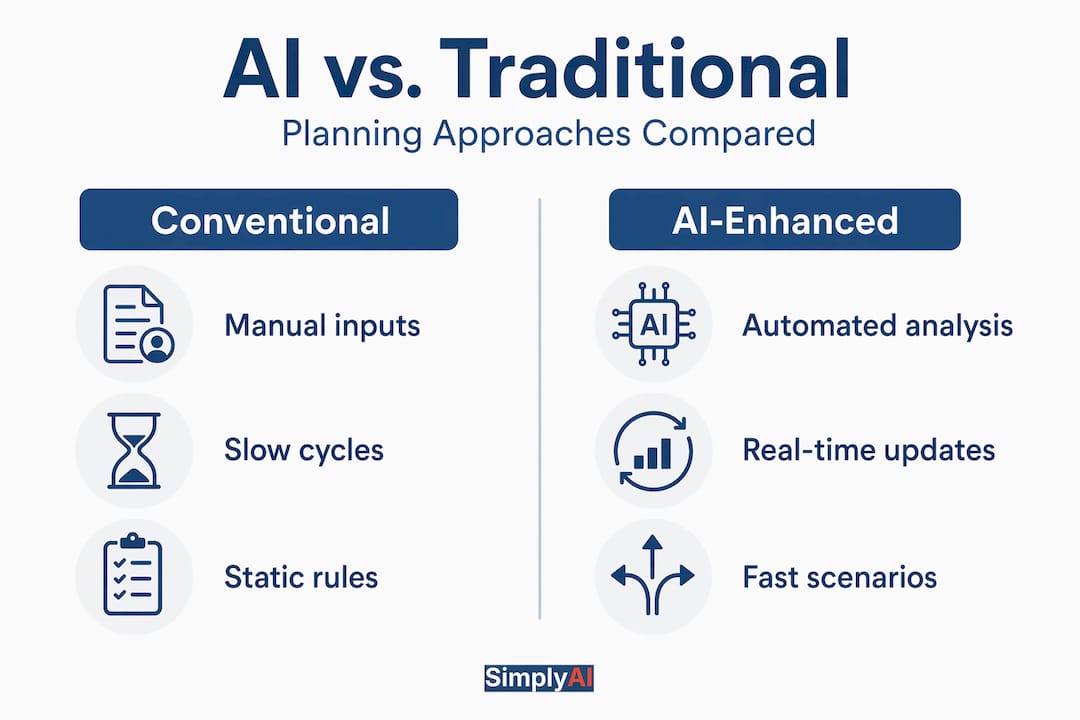
| Capability | Conventional approach | AI-enhanced approach |
|---|---|---|
| Demand planning cycle | Overnight batch runs | Real-time continuous updates |
| Scenario modeling | 1 to 3 scenarios per cycle | 10 or more scenarios per decision window |
| Disruption response | Manual analyst review | Automated alert with ranked response options |
| Procurement bid analysis | Manual category manager review | AI pre-scoring of 60 to 70% of bids |
| Route optimization | Static rule-based assignment | Dynamic re-routing based on live conditions |
Rapid scenario iteration enabled by GPU-accelerated solvers is the technical foundation for the next generation of agent-driven supply chain orchestration. Gartner projects that by 2031, AI may resolve 60% of supply chain disruptions without human intervention, a trajectory that depends entirely on this kind of infrastructure being in place today.
Pro Tip: When evaluating AI planning platforms, ask vendors specifically about their solver architecture. A platform built on GPU-accelerated optimization will handle large-scale scenario modeling at a speed that rule-based or legacy linear solvers simply cannot match.
My perspective on realistic AI adoption
I've worked closely enough with supply chain AI implementations to say this directly: the organizations that struggle most are the ones that anchor their AI strategy to a vision of full autonomy before they have the foundations in place. They chase the headline use case, skip the data work, and then wonder why their AI recommendations are unreliable six months in.
What I've learned is that the most durable AI deployments in supply chain operations start with something almost boring: data governance. Clean, consistent, agreed-upon data across systems and trading partners is what separates organizations that scale AI successfully from those that stall at pilot stage.
The second thing I keep coming back to is culture. People resist AI when they feel replaced by it. They adopt it enthusiastically when they see it as a tool that makes their judgment more powerful, not less necessary. The organizations getting the best results position their planners and buyers as the decision-makers, with AI surfacing options, flagging anomalies, and running scenarios. That human-AI collaboration model produces better outcomes than any fully automated system I've seen in real production environments.
My advice: pick one process, build a pilot with clear metrics, and let the results fund the next step. The organizations building AI-powered supply chains that will define competitiveness in the next decade are not starting with transformation. They are starting with discipline.
— Theodor
How Simplyai accelerates your AI supply chain journey
Understanding the role of AI in supply chains is the starting point. Executing it with limited internal AI expertise and fragmented technology is where most organizations lose time and money.
Simplyai designs and deploys AI automations and AI agents tailored to supply chain operations, from demand forecasting integrations and procurement automation to workflow orchestration and data pipeline setup. The focus is on practical, phased implementations that deliver measurable results quickly and build the organizational capability to scale further. Simplyai also offers corporate education programs to upskill supply chain and procurement teams on AI integration, governance, and decision-making frameworks. If you are ready to move from strategy to execution, Simplyai provides the technical depth and operational experience to get there without the waste. Explore AI deployment strategies that are already delivering results in similar operations.
FAQ
What is the role of AI in supply chains right now?
AI currently supports demand forecasting, procurement automation, inventory optimization, and logistics routing. Most organizations adopt it incrementally in specific use cases rather than as a wholesale operational redesign.
How does machine learning improve supply chain forecasting?
Machine learning models analyze historical data, seasonal trends, and external signals to generate demand forecasts more accurately than traditional statistical methods, reducing stockouts and excess inventory simultaneously.
What is agentic AI in supply chain management?
Agentic AI refers to systems where multiple AI tools work together autonomously, with a coordinating agent translating natural language inputs into mathematical optimization tasks and returning ranked recommendations to human decision-makers.
How do you prioritize AI investments in supply chain operations?
Focus first on high-cost, high-complexity domains such as planning and procurement. The savings generated in these areas fund subsequent AI deployments in manufacturing and fulfillment, creating a self-funding improvement cycle.
What governance is needed to scale AI in supply chains?
Successful AI scaling requires defined decision thresholds, human oversight protocols, data alignment across trading partners, and a phased approach to autonomy expansion that keeps compliance and accountability intact throughout.