

TL;DR:
- Most small and medium-sized businesses can gain a competitive edge by adopting structured, data-driven decision-making processes supported by AI tools.
- Reliance on intuition alone is increasingly risky in environments where real-time data, analytics, and automation optimize operational efficiency and customer experiences.
Most business owners have been there: a major decision looming, a spreadsheet open, and a gut feeling pulling in the opposite direction of the numbers. The uncomfortable truth is that intuition alone increasingly falls short in a business environment shaped by real-time data, AI-powered competitors, and customers who expect personalized experiences. Small and medium-sized businesses that adopt structured, data-driven decision making alongside practical AI tools are not just keeping pace, they are accelerating well past those still operating on instinct. This guide breaks down what that shift actually looks like in practice.
Table of Contents
- What is data-driven decision making?
- The role of AI in driving operational efficiency
- Validating your data: Common pitfalls and smart strategies
- Making data-driven decisions actionable in your business
- Why most businesses misuse data (and how to do better))
- Level up your business with AI-powered decisions
- Frequently asked questions
Key Takeaways
| Point | Details |
|---|---|
| Trust but verify data | Data is valuable only when you question its source, relevance, and accuracy. |
| AI amplifies efficiency | Combining data-driven methods with AI unlocks faster, more accurate operations. |
| Culture of accountability | Successful businesses assign responsibility and avoid the pitfalls of consensus-only decisions. |
| Start small, scale smart | Begin with manageable data projects and use quick wins to drive bigger results with AI. |
What is data-driven decision making?
At its core, data-driven decision making means using verified, measurable information to guide business choices rather than relying solely on experience, opinion, or instinct. It does not mean eliminating judgment. It means grounding that judgment in real evidence: sales figures, customer behavior patterns, operational performance metrics, and market trends that can be tracked, analyzed, and acted upon.
The contrast with gut-based approaches is significant. Traditional intuition-led decisions carry the weight of personal bias, incomplete memory, and limited visibility into patterns that only data can reveal. A business owner might feel confident that their busiest sales period is Friday afternoon, but actual transaction data might reveal that Wednesday mornings generate 30 percent more revenue per customer. Without the data, that insight never surfaces and resources get allocated in the wrong direction.
The core principles of data-driven decision making include:
- Objectivity: Decisions are anchored to measurable outcomes, not personal preference.
- Consistency: A repeatable process for gathering and analyzing data reduces variability in how choices are made.
- Adaptability: Trend analysis and real-time data allow businesses to respond to changing conditions quickly.
- Accountability: When decisions are tied to data, it becomes easier to evaluate outcomes and refine strategy.
This approach is especially relevant when integrating AI, because AI systems require reliable, structured data to function effectively. You can make better business decisions with AI only when the underlying data feeding those systems is trustworthy and well-organized. That intersection is where genuine competitive advantage begins to emerge.
One important nuance deserves attention here. Harvard research confirms that data-driven decisions can go wrong when leaders treat evidence as unquestionable or ignore validity limits, with separating correlation from causation being a critical discipline. Data is a powerful tool, but it requires skilled interpretation. Understanding predictive analytics for SMBs is one practical way to sharpen that skill and move beyond surface-level reporting.
The role of AI in driving operational efficiency
With a firm grasp of the fundamentals, the next logical step is understanding how AI amplifies the potential of data-driven approaches in day-to-day business operations. AI does not simply automate repetitive tasks. It actively processes large volumes of data, identifies patterns that humans would miss, and surfaces actionable recommendations in near real time. That is a seismic shift for small and medium-sized businesses that previously lacked the analytical horsepower to compete with larger enterprises.
Consider a retail business managing inventory. Manually tracking stock levels, seasonal demand, and supplier lead times is time-consuming and error-prone. An AI-augmented, data-driven system can predict stock depletion before it happens, automatically trigger reorders, and even factor in external signals like weather patterns or local events that correlate with demand spikes. The result is fewer stockouts, less overstock, and a measurably better customer experience.

The following table illustrates how AI-driven, data-informed processes compare directly to their manual counterparts across key operational dimensions:
| Business Function | Manual Process | AI-Augmented, Data-Driven Approach |
|---|---|---|
| Inventory management | Weekly manual counts, reactive reordering | Predictive restocking based on real-time sales data |
| Customer service | Staff handle all inquiries, no pattern tracking | AI chatbots handle routine queries, escalate complex ones |
| Marketing targeting | Broad campaigns based on demographic assumptions | Hyper-targeted campaigns driven by behavioral analytics |
| Financial forecasting | Monthly spreadsheet reviews | Continuous cash flow modeling with anomaly alerts |
| Staff scheduling | Fixed rosters based on historical habits | Demand-based scheduling using foot traffic data |
Understanding the full range of automation types for SMB efficiency helps clarify which AI-driven tools deliver the fastest return on investment for businesses at different stages of digital maturity. And when evaluating whether to move from manual to automated processes, a detailed look at AI automation vs manual work provides a clear, honest comparison.
One persistent risk in the AI era is the instinct to build consensus before acting on data insights. Decision making by consensus does not work well in fast-paced AI environments where speed and precision matter more than collective agreement. When everyone must sign off before a data-driven action is taken, the competitive window often closes before the decision lands.
Pro Tip: Assign explicit data decision owners within your organization. Rather than seeking agreement from every stakeholder, designate one accountable person per data-informed initiative. This keeps momentum high and reduces the organizational friction that kills good insights before they become action.
Validating your data: Common pitfalls and smart strategies
Even with smart AI tools, the advantage comes only if the data you use and how you interpret it is truly solid. One of the most persistent problems in data-driven business practice is overconfidence: the assumption that because the numbers say something, that something is definitively true. This is where many businesses, despite good intentions, veer into risky territory.
Two concepts matter enormously here. Internal validity asks whether a pattern you observe in your data actually reflects what you think it reflects within your specific business context. External validity asks whether that pattern holds up beyond your current dataset, in different time periods, geographies, or customer segments. A business that sees a spike in weekend sales and immediately restructures its entire staffing model may be reacting to a seasonal anomaly rather than a durable trend.
Common mistakes businesses make when working with data include:
- Treating correlation as causation. Two metrics moving in the same direction does not mean one is causing the other. An increase in social media followers alongside a revenue increase may be coincidental, not connected.
- Using samples that are too small or too narrow. Drawing conclusions from two weeks of data or a single customer segment creates false confidence.
- Ignoring the source quality. Data pulled from inconsistent CRM entries, manual logs, or third-party sources without verification introduces noise that distorts analysis.
- Failing to account for external factors. Economic shifts, seasonal effects, or competitor moves can all influence your data in ways that have nothing to do with your internal decisions.
- Anchoring on the first interpretation. Initial readings of data can create cognitive anchors that make it harder to see alternative explanations even when the evidence points elsewhere.
Smart validation strategies involve testing assumptions against multiple data sources, running results across different time periods, and actively seeking disconfirming evidence. Using AI data analysis for SMBs tools that flag statistical anomalies and confidence intervals can significantly reduce the risk of misinterpretation. Similarly, business insights from semantic analysis of customer communications can surface qualitative context that raw numbers alone cannot capture.
"Data-driven decisions can go wrong when leaders treat evidence as unquestionable or when they ignore validity limits. Separating correlation from causation, and checking internal and external validity, are key nuances that cannot be overlooked." — Harvard Kennedy School research on data-driven decision making
Pro Tip: Before acting on any data insight, ask one simple question: "What else could explain this result?" If the answer produces two or three equally plausible alternatives, your data needs further validation before it drives a major decision.
Making data-driven decisions actionable in your business
Understanding the pitfalls is only half the battle. The real value emerges when you apply data-driven methods systematically in day-to-day operations, not just during quarterly reviews or strategic planning sessions. Embedding this approach requires a deliberate process that small businesses can implement without massive technology investments or a dedicated data science team.
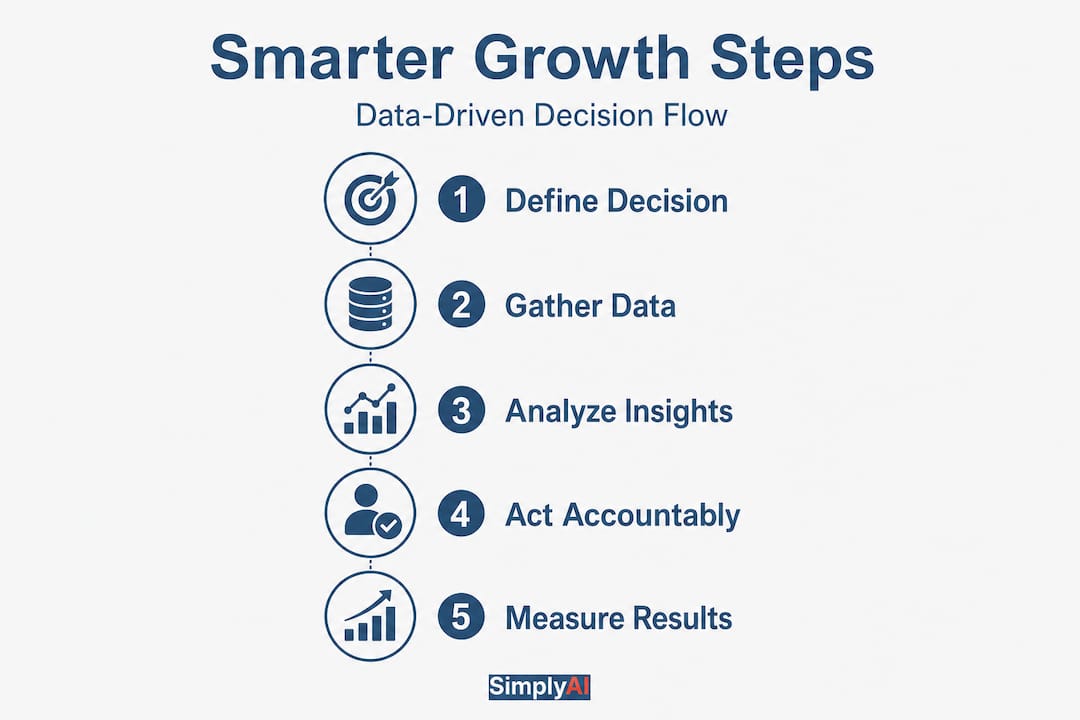
Here is a practical, step-by-step framework business owners can apply immediately:
- Define the decision before collecting data. Identify precisely what question you are trying to answer. Vague objectives lead to vague data collection.
- Identify the right data sources. Match your question to the metrics that actually measure what matters, whether that is conversion rates, churn rates, average order value, or operational cycle times.
- Set a validation threshold. Decide in advance how much data, across what time period, constitutes enough evidence to act. This prevents both premature action and paralysis by analysis.
- Assign a decision owner. As consensus-based decision making increasingly fails in fast-moving AI environments, designating one accountable owner per data-driven initiative is essential.
- Act, measure, and iterate. Implement the decision, track its impact against pre-defined success metrics, and adjust based on what the new data reveals.
The following table maps each step to the tools and techniques best suited for small and medium-sized business contexts:
| Step | Key Action | Recommended Tool or Technique |
|---|---|---|
| Define the decision | Write a one-sentence decision statement | Business intelligence dashboards |
| Identify data sources | Audit existing CRM, sales, and operational data | CRM platforms, analytics integrations |
| Set validation threshold | Agree on sample size and time window | Statistical significance calculators |
| Assign decision owner | Document accountability in a decision log | Project management tools |
| Act and iterate | Launch, monitor, and adjust in real time | AI automation and feedback loops |
Leveraging AI and business intelligence for growth makes each of these steps faster and more reliable. For businesses ready to move beyond manual tracking entirely, decision automation for small businesses offers a concrete path to removing human bottlenecks from routine, rules-based choices. Businesses seeking an integrated approach can also explore a centralized AI intelligence layer that consolidates data signals across functions into a single, coherent decision-support system.
Why most businesses misuse data (and how to do better)
Here is an uncomfortable truth that most guides on data-driven decision making avoid: having more data does not automatically lead to better decisions. In fact, the organizations that accumulate the most data without a disciplined interpretation framework often make worse decisions than those working with less information but applying sharper analytical thinking.
The pattern we observe most often among small and medium-sized businesses is not a lack of data. It is a misplaced reverence for data. When a team sees a chart moving in a favorable direction, the instinct is to celebrate the metric rather than question whether that metric is measuring what actually matters. Revenue can increase while customer satisfaction quietly deteriorates. A social media engagement rate can spike because of a viral post that attracts entirely the wrong audience for your core offer.
The validity limits of data-driven decisions are real, and ignoring them is a strategic error. Every dataset has a context in which it is reliable and boundaries beyond which it misleads. The discipline of asking "Is this data actually telling me what I think it's telling me?" is not pessimism. It is the mark of analytical maturity.
Equally important is the accountability dimension. Consensus-based decision cultures feel psychologically safe, but they fail in AI-driven environments where speed and clarity are prerequisites for acting on real-time insights. When no single person is responsible for a data-informed decision, the decision either stalls or gets diluted into a compromise that satisfies everyone but optimizes nothing.
The businesses that truly benefit from data-driven approaches build a culture of questioning and learning. They celebrate decisions made with rigor, even when those decisions produce unexpected results, because unexpected results are themselves data. They treat the common SMB data mistakes not as failures but as calibration opportunities. That mindset is the real competitive differentiator, and no software tool can install it. It requires intentional leadership and a genuine commitment to using data as a thinking tool rather than a validation shortcut.
Level up your business with AI-powered decisions
Transforming how your business makes decisions is one of the highest-leverage moves available to a small or medium-sized company in 2026. The frameworks in this article give you a foundation, but sustainable results require the right tools, workflows, and expertise working together consistently.
SimplyAI designs and implements practical AI solutions that help businesses move from data overload to actionable intelligence. Whether you need AI automations for businesses that eliminate manual bottlenecks, or sophisticated AI agents for business workflows that make decisions autonomously based on real-time data, the goal is always the same: measurable results without unnecessary complexity. If you are ready to build a smarter, more responsive business, the tools and expertise to get there are within reach.
Frequently asked questions
How is data-driven decision making different from traditional decision making?
Data-driven decision making relies on measurable data and analytics to guide choices, while traditional decision making often leans on intuition or experience. The key distinction is accountability to evidence, though even data-driven decisions can go wrong without careful interpretation and validity checks.
What challenges should businesses watch for when implementing data-driven decision making?
The most common challenges include misinterpreting data, acting on incomplete datasets, and confusing correlation with causation. Recognizing the limits of data-driven approaches early prevents costly mistakes down the line.
Why is clear accountability important in data-driven organizations?
Clear accountability prevents slow or diluted decisions by removing the need for broad consensus and making individual responsibility explicit. Research shows that consensus decision making is particularly ineffective in AI-driven environments where speed and precision are critical.
Can small businesses use data-driven decision making without large IT investments?
Yes. Many affordable AI and analytics tools are purpose-built for small businesses, offering powerful data integration, reporting, and automation capabilities without requiring a dedicated IT infrastructure or a full data science team.