

TL;DR:
- Contextual AI uses multiple layers of relevant information, including external data, to generate accurate, personalized responses. Unlike traditional chatbots, it maintains cross-session memory and integrates governed data sources for reliability. Effective implementation requires ongoing context engineering and strict data governance to ensure high-quality AI outputs in production environments.
Contextual AI is defined as artificial intelligence that interprets and responds to multiple layers of situation-specific information, including prior interactions, user identity, real-time data, and business rules, rather than treating each prompt as an isolated input. Unlike generic large language models that guess from a single message, contextual AI systems use structured memory and signals to generate responses that are accurate, relevant, and aligned with organizational goals. Google DeepMind's acquisition of a startup called Contextual AI, valued at approximately $80 to $90 million, signals how seriously the industry now treats this capability. Salesforce, WalkMe, and Zilliz have each built contextual intelligence into their core product architectures, confirming that context is no longer optional. It is the foundation of AI that actually works in production.
What is contextual AI and how does it differ from basic AI?
Contextual AI is the practice of equipping AI systems with layered, governed information so they can make decisions that reflect reality rather than probability. A standard language model receives a prompt and generates a statistically likely response. A contextual AI system receives that same prompt plus the user's history, their role in the organization, the current workflow state, and relevant external data, then generates a response calibrated to all of those inputs simultaneously.

Salesforce frames AI context as structured information and memory that includes business rules and real-time signals, specifically to prevent AI from guessing. That framing matters because guessing is expensive in enterprise settings. A sales assistant that does not know a customer's contract tier, recent support tickets, or renewal date will give advice that sounds plausible but creates friction. Contextual AI eliminates that gap.
The contextual AI definition also extends beyond enterprise software. In programmatic advertising, semantic contextual targeting reads the meaning and sentiment of a webpage rather than matching keywords. In digital adoption platforms, AI assistants read the user's current interface environment to deliver relevant guidance without requiring the user to explain their situation. The common thread across all of these applications is the same: the AI knows where it is, who it is talking to, and what has happened before.
How does contextual AI work: components and mechanisms
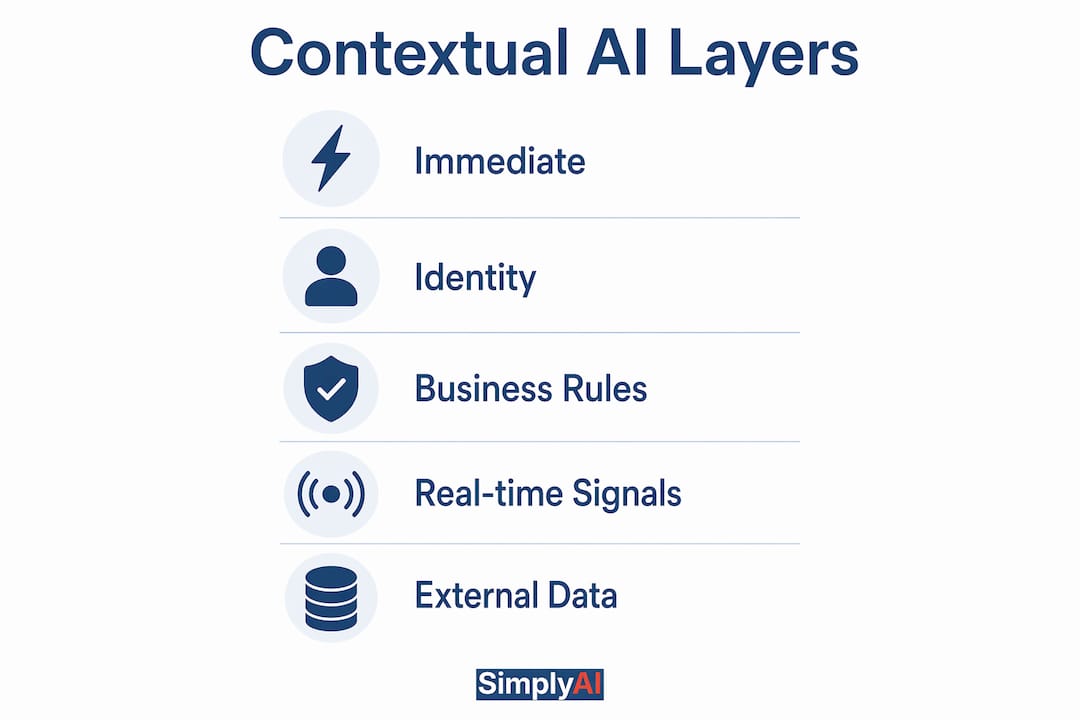
Contextual AI operates through five distinct input layers that work together during inference. The first is the immediate prompt, the message the user sends right now. The second is conversation history, the prior exchanges within the current session. The third is user identity and intent, meaning the system knows who is asking and what they are trying to accomplish. The fourth is real-time and external data, such as CRM records, inventory systems, or live market signals. The fifth is business rules and organizational policies that constrain or guide the AI's outputs.
Each of these layers feeds into what practitioners call context engineering, the deliberate design of what information gets retrieved, formatted, and injected into the model's input before it generates a response. Context engineering is distinct from retrieval-augmented generation (RAG), though the two overlap. RAG is a specific technical method for pulling relevant documents from a knowledge base. Context engineering is the broader discipline of deciding which signals matter, how fresh they need to be, and how they should be structured.
One of the most persistent misconceptions in this field is that the model's context window and true contextual AI are the same thing. They are not. The context window is simply the transcript of the current conversation. True contextual AI requires explicit integration of external, governed data sources during inference. A model with a large context window but no external data integration is still operating blind relative to the real business situation.
Pro Tip: When evaluating an AI tool's "contextual" capabilities, ask specifically whether it integrates external data sources during inference or only references the current conversation. The answer reveals whether you are looking at genuine contextual AI or a well-marketed chatbot.
Governed, fresh, and certified data sources are the operational backbone of any contextual AI system. Stale or uncertified data corrupts downstream AI output, making source governance the binding constraint on system reliability. A model can be state-of-the-art in every other dimension and still produce wrong answers if the context it receives is outdated.
Contextual AI vs traditional chatbots and basic AI models
The practical difference between contextual AI and a traditional chatbot becomes clear the moment a conversation spans more than one session or requires knowledge the user never typed. Traditional chatbots operate on scripted decision trees or single-session context with no memory of past interactions and no access to external systems. Each conversation starts from zero.
Contextual AI systems, by contrast, continue memory beyond a single session and integrate structured business rules to align interactions with organizational workflows. WalkMe describes enterprise AI context as the briefing that removes the need for users to explain details repeatedly to AI assistants. That shift from reactive to proactive is what separates contextual AI from its predecessors.
| Feature | Traditional chatbot | Contextual AI |
|---|---|---|
| Memory persistence | Single session only | Cross-session, continuous |
| Data integration | None or scripted | Live external data sources |
| Personalization | Rule-based, generic | Identity and intent-aware |
| Workflow execution | Limited, linear | Autonomous, policy-governed |
| Decision support | Scripted responses | Situation-specific reasoning |
The impact on accuracy and user experience is measurable. When AI systems understand who the user is, what they have done before, and what the current business context requires, response quality improves and user frustration drops. For decision-makers, this translates directly into faster resolutions, fewer escalations, and more reliable automation outputs.
Key benefits and applications of contextual AI in business
The benefits of contextual AI concentrate in five areas that matter most to business professionals: relevance, personalization, workflow automation, risk reduction, and decision quality. Each of these improves when AI systems receive governed, layered context rather than isolated prompts.
- Relevance: Responses reflect the actual situation rather than a generic interpretation of the question.
- Personalization: AI adapts to individual users based on identity, history, and stated preferences, a capability that drives measurable SMB engagement when implemented correctly.
- Workflow automation: AI agents execute multi-step processes autonomously because they understand the current state of the workflow and the rules that govern it.
- Risk reduction: Contextual AI in programmatic advertising uses semantic targeting to understand content meaning, which improves brand safety by reducing false positives from keyword blocklists.
- Decision quality: AI recommendations improve when systems have access to governed external data, such as financial records, customer history, or operational metrics.
The applications span industries with notable force. In adtech, Zilliz's semantic contextual targeting recovers 76% of premium inventory incorrectly blocked by keyword filters. That is not a marginal improvement. It represents a significant recovery of advertiser ROI through better content environment alignment. In enterprise software, WalkMe's workplace AI assistants use interface context and user identity to deliver guidance without requiring employees to explain their situation from scratch each time.
In marketing and CRM, contextual AI enables systems to recommend the next best action based on a customer's full interaction history, current lifecycle stage, and real-time behavioral signals. In data analysis, integrating external data and business rules into AI models produces recommendations that reflect actual business conditions rather than historical averages.
Pro Tip: Use contextual AI to reduce hallucinations in high-stakes workflows. When the model receives verified, current business data as part of its input, the probability of confident but incorrect outputs drops significantly. Governing the context layer is more effective than fine-tuning the model.
Challenges in implementing and governing contextual AI systems
Implementing contextual AI at production scale introduces governance challenges that most organizations underestimate until they encounter them in deployment. The following sequence reflects the order in which these challenges typically surface.
-
Source data governance. The quality of contextual AI output is bounded by the quality of the data it receives. Teams must actively govern the context pipeline to maintain AI validity. This means establishing clear ownership, update schedules, and certification processes for every data source that feeds the context layer.
-
Distinguishing conversation context from business context. Many teams assume that giving the AI access to conversation history is sufficient. Conversation history alone creates an illusion of context. Authentic contextual AI requires retrieval and integration of external, governed sources. Conflating the two leads to systems that feel intelligent in demos but fail in production.
-
Staleness and consistency. Business definitions change. Pricing updates, policy revisions, and organizational restructuring all affect what the correct AI response should be. Stale context produces errors that only surface after deployment, often in customer-facing interactions where the cost is highest.
-
Auditability and trust. Regulated industries require that AI decisions be explainable. Contextual AI systems must log which context sources informed each output, making the reasoning chain traceable and auditable.
-
Scope creep in context design. More context is not always better. Injecting irrelevant or low-quality signals into the context layer increases noise and can degrade output quality. Effective context engineering requires discipline about what to include, not just what is available.
Atlan's research on contextual intelligence identifies source governance as the binding constraint on system reliability, a finding that holds across industries and use cases. Organizations that treat context engineering as a one-time setup task rather than an ongoing operational discipline consistently encounter reliability problems at scale.
Key takeaways
Contextual AI delivers accurate, personalized outputs because it integrates governed, layered data sources into inference, not because the underlying model is more powerful.
| Point | Details |
|---|---|
| Contextual AI definition | AI that uses multiple context layers, including identity, history, and external data, to generate situation-specific responses. |
| Context window vs. true context | A model's conversation history is not full context; genuine contextual AI requires governed external data integration. |
| Governance is the binding constraint | Stale or uncertified data degrades output quality more than model limitations do. |
| Business applications | Adtech, enterprise automation, CRM, and digital adoption platforms all benefit from contextual AI at scale. |
| Implementation discipline | Context engineering is an ongoing operational practice, not a one-time configuration task. |
Why context is the most underrated variable in AI adoption
From working closely with businesses at various stages of AI adoption, one pattern stands out clearly: organizations that invest in model selection before investing in context architecture almost always rebuild later. The model is rarely the bottleneck. The context layer is.
Most teams I observe treat context as a feature to configure once and forget. In practice, it behaves more like a data product. It requires ownership, versioning, and regular validation. When a business changes its pricing structure or reorganizes its customer segments, the context layer must reflect those changes before the AI does. If it does not, the AI confidently delivers outdated guidance, which is often worse than no guidance at all.
The acquisition of Contextual AI by Google DeepMind is not a coincidence. It reflects a broader recognition that the intelligence of an AI system is inseparable from the quality of the context it receives. Businesses that understand this early gain a durable advantage. Those that treat context as an afterthought will find themselves debugging AI behavior that is technically correct but practically wrong.
My recommendation for any organization evaluating contextual AI is to start with the data governance question, not the model question. Map your context sources, assess their freshness and reliability, and establish ownership before you write a single prompt template. That sequence produces systems that work in production rather than systems that impress in pilots.
— Theodor
How Simplyai helps you put contextual AI to work
Simplyai designs and implements AI automations that incorporate contextual intelligence at every layer, from customer-facing chatbots that remember interaction history to workflow automation systems that execute decisions based on live business data.
If your business is ready to move beyond generic AI responses and deploy systems that understand your customers, your processes, and your organizational rules, Simplyai's AI automation services are built for exactly that outcome. Every solution Simplyai delivers is grounded in governed data integration and context engineering, not just model configuration. The result is AI that performs reliably in production, reduces manual work, and improves the quality of every customer interaction.
FAQ
What is the contextual AI definition in simple terms?
Contextual AI is artificial intelligence that uses multiple layers of relevant information, including user history, identity, real-time data, and business rules, to generate accurate and personalized responses rather than generic outputs.
How does contextual AI differ from a standard chatbot?
Standard chatbots operate on scripted inputs or single-session conversation history with no memory between sessions. Contextual AI maintains cross-session memory, integrates external data sources, and adapts responses based on user identity and organizational policies.
What are the main benefits of contextual AI for businesses?
The primary benefits include improved response relevance, deeper personalization, autonomous workflow execution, better brand safety in advertising, and higher-quality decision support across CRM, marketing, and operations.
Why is data governance critical for contextual AI systems?
Stale or uncertified data in the context layer corrupts AI output regardless of model quality, making source governance the binding constraint on system reliability. Teams must actively maintain and certify every data source that feeds the context pipeline.
What industries use contextual AI applications most actively?
Adtech, enterprise software, CRM platforms, digital adoption tools, and programmatic advertising are among the most active adopters. Zilliz's semantic targeting in adtech and WalkMe's enterprise AI assistants are two concrete examples of contextual AI delivering measurable results at scale.