

TL;DR:
- Prescriptive analytics recommends optimal actions by integrating data models, business constraints, and objectives. It builds upon predictive insights to automate decision-making processes, enhancing efficiency and consistency across operations. Implementing it requires precise constraint definition, data readiness, and workflow integration for measurable success.
Prescriptive analytics is defined as the branch of data analytics that recommends the best course of action among available options, using data models, optimization algorithms, and business constraints to guide decisions. Where descriptive analytics tells you what happened and predictive analytics forecasts what might happen, prescriptive analytics answers the most consequential question: what should you do next? IBM describes this as going beyond forecasting to deliver recommendations that account for objectives and trade-offs. Organizations apply it across recommendation engines, dynamic pricing systems, fraud detection, and churn mitigation. For data analysts and business leaders, understanding prescriptive analytics is the foundation for building decision-making processes that are faster, less biased, and measurably more effective.
What is prescriptive analytics and how does it work?
Prescriptive analytics works by combining predictive models, optimization techniques, and defined business constraints to generate specific, ranked recommendations. The process begins with data: historical records, real-time feeds, and external signals are fed into mathematical models that evaluate multiple possible actions simultaneously. The system then scores each option against defined objectives, such as maximizing revenue or minimizing operational cost, and surfaces the action most likely to achieve the desired outcome.
Four core methodologies power most prescriptive systems:
- Optimization algorithms search through feasible decision options to find the one that best satisfies the objective function. Linear programming and mixed-integer programming are the most common forms, used in supply chain routing and workforce scheduling.
- Simulation and scenario analysis model how different decisions play out under uncertainty. A retailer, for example, can simulate the revenue impact of three different pricing strategies before committing to one.
- Machine learning and AI process large, high-dimensional datasets to identify patterns that traditional optimization models would miss. Neural networks and gradient boosting models refine recommendations as new data arrives.
- Constraint and trade-off management ensures recommendations are operationally feasible. A loan approval engine does not just predict default risk; it weighs that risk against regulatory requirements, portfolio targets, and customer lifetime value before issuing a decision.
TechTarget notes that optimization algorithms and mathematical models help prescriptive analytics choose actions that align directly with business goals, not just statistical probabilities. This distinction matters because a recommendation that ignores budget caps or regulatory limits is not a recommendation at all. It is a liability.
Pro Tip: Before building a prescriptive model, document every business constraint that must hold true for a recommendation to be executable. Constraints defined late in the process are the most common reason prescriptive systems produce outputs that operations teams reject.

Prescriptive vs. descriptive analytics: what makes it unique?
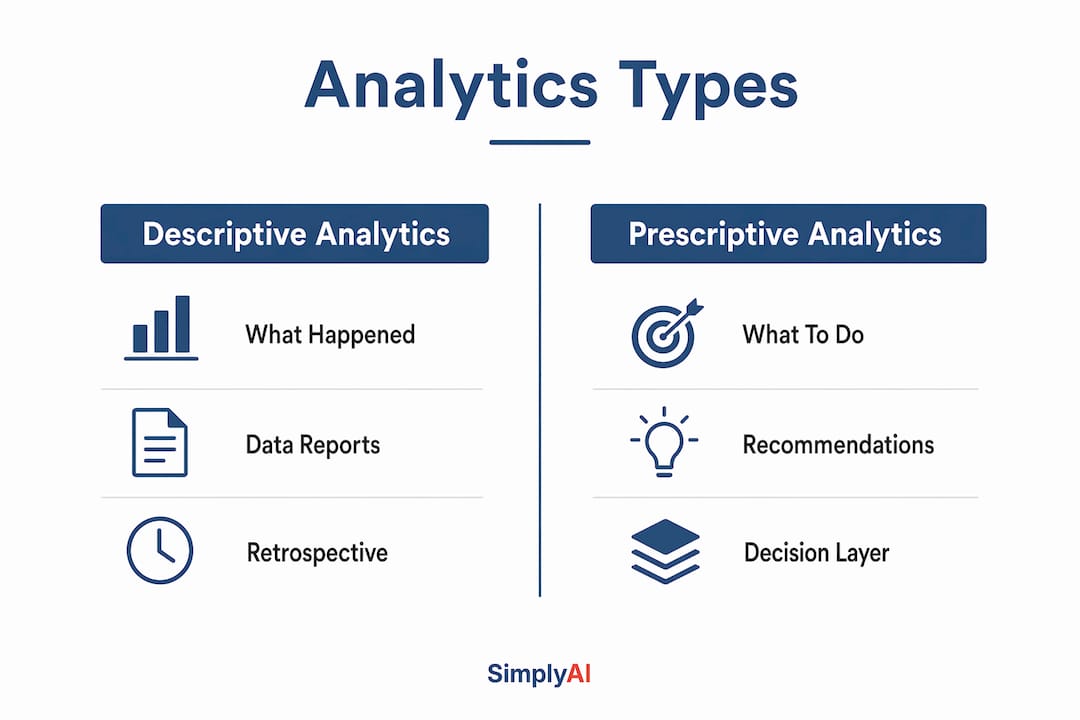
The four analytics types form a hierarchy of increasing complexity and decision automation. Each layer builds on the previous one, and understanding where prescriptive analytics sits clarifies when and why to use it.
The table below organizes the key distinctions:
| Analytics type | Core question | Output | Example use case |
|---|---|---|---|
| Descriptive | What happened? | Reports, dashboards | Monthly sales summary |
| Diagnostic | Why did it happen? | Root cause analysis | Identifying why churn spiked in Q3 |
| Predictive | What will happen? | Forecasts, probability scores | Predicting which customers will churn |
| Prescriptive | What should we do? | Ranked action recommendations | Offering a targeted discount to retain at-risk customers |
Descriptive and diagnostic analytics are retrospective. They are indispensable for understanding business performance, but they do not tell you what to do about it. Predictive analytics moves forward in time, generating probability estimates about future events. Stripe's analysis confirms that prescriptive analytics operationalizes predictions into concrete decisions by factoring in resource constraints, which is the step most organizations skip when they stop at forecasting.
The critical distinction between predictive and prescriptive analytics is the presence of a decision layer. A predictive model tells you there is a 74% probability that a customer will cancel their subscription. A prescriptive model tells you to send that customer a specific offer at a specific price point within a specific time window, because that action produces the highest expected retention value given current inventory and margin constraints. Tableau describes this as reducing decision paralysis by providing data-backed recommendations with explanations of why those actions are effective.
The practical implication for business leaders is clear. Stopping at predictive analytics means your team still has to interpret forecasts and decide what to do, which reintroduces human bias and slows response time. Prescriptive analytics removes that gap. It is the difference between a weather forecast and an automated system that reroutes your delivery fleet before the storm arrives.
Key business applications and benefits of prescriptive analytics
Prescriptive analytics is applied across industries wherever decisions are frequent, data is available, and the cost of a suboptimal choice is measurable. IBM identifies churn prediction, fraud detection, risk assessment, demand forecasting, and personalized recommendations as the primary application domains, each of which translates directly into revenue protection or cost reduction.
The most mature applications include:
- Dynamic pricing: Airlines, hotels, and e-commerce platforms use prescriptive models to adjust prices in real time based on demand signals, competitor behavior, and inventory levels. The model does not just predict demand; it recommends the exact price that maximizes yield at each moment.
- Customer churn mitigation: Telecom and SaaS companies combine churn probability scores with prescriptive recommendations about which intervention, whether a discount, a feature unlock, or a customer success call, produces the highest retention rate per dollar spent.
- Fraud detection and prevention: Financial institutions use prescriptive systems to not only flag suspicious transactions but to recommend the specific response: block the transaction, request additional authentication, or allow it with enhanced monitoring.
- Supply chain and inventory optimization: Manufacturers use prescriptive analytics to recommend order quantities, reorder timing, and supplier selection based on lead times, demand forecasts, and carrying costs simultaneously.
- Loan and credit approvals: Lending platforms embed prescriptive models that weigh default risk, regulatory exposure, and portfolio diversification to recommend approval, denial, or a modified offer in milliseconds.
For small and medium-sized businesses, the importance of prescriptive analytics lies in its ability to automate decisions that would otherwise require senior analyst time. A mid-sized retailer cannot afford a pricing team that manually reviews thousands of SKUs daily. A prescriptive pricing engine does that work continuously, without fatigue or inconsistency.
Pro Tip: Start with one high-frequency, high-stakes decision in your business, such as inventory reordering or lead scoring, and build your first prescriptive model around it. Narrow scope produces faster results and builds organizational confidence in the technology.
The benefits extend beyond efficiency. IBM's research shows that prescriptive analytics shifts decision-making from human intuition to data-driven recommendations, reducing cognitive bias and increasing consistency across teams. When every regional sales manager follows the same prescriptive playbook for at-risk accounts, performance variance across regions narrows significantly.
Implementing prescriptive analytics: challenges and best practices
Deploying prescriptive analytics is more demanding than deploying descriptive or predictive systems, because the stakes of a wrong recommendation are operational, not just analytical. TechTarget notes that successful implementation requires mature data processes, cross-functional teamwork, and continuous monitoring. Organizations that treat prescriptive analytics as a pure data science project, rather than a business operations initiative, consistently underperform.
The most common implementation challenges are:
- Data readiness gaps: Prescriptive models require clean, timely, and complete data across multiple systems. Organizations with siloed CRM, ERP, and operational data often find that integration work consumes more time than model development.
- Constraint definition failures: Business constraints, such as budget limits, regulatory requirements, and capacity ceilings, must be encoded precisely. Vague or incomplete constraints produce recommendations that operations teams cannot execute, which erodes trust in the system.
- Workflow integration: TechTarget's research confirms that most value from prescriptive analytics comes when recommendations are embedded into execution layers rather than delivered as standalone reports. A recommendation that lives in a dashboard but requires manual action to implement captures only a fraction of its potential value.
- Model drift and monitoring: Prescriptive models degrade as business conditions change. A pricing model calibrated during a period of low inflation will make systematically wrong recommendations during an inflationary period unless it is retrained and monitored continuously.
- Organizational change management: Frontline employees and managers sometimes resist prescriptive systems because they perceive them as replacing judgment. Framing recommendations as decision support rather than mandates accelerates adoption.
Best practices for effective deployment follow a clear sequence. First, align the model's objective function with a specific business KPI that leadership already tracks. Second, involve operations and compliance teams in constraint definition before any modeling begins. Third, deploy in a shadow mode where recommendations run in parallel with human decisions for a defined period, allowing you to measure accuracy before full automation. Fourth, build a data-driven decision workflow that routes prescriptive outputs directly into the systems where decisions are executed, whether that is a CRM, an ERP, or a customer-facing application. Fifth, establish a retraining cadence tied to measurable performance thresholds, not arbitrary calendar intervals.
Stripe's implementation insights confirm that high-performing prescriptive systems evaluate multiple feasible options using optimization and simulation techniques rather than simply extending trend forecasts. The difference in outcome quality between a system that evaluates 10 options and one that evaluates 10,000 is substantial, particularly in pricing and logistics applications.
Key takeaways
Prescriptive analytics delivers its greatest value when recommendations are embedded directly into operational workflows, not delivered as standalone analytical outputs.
| Point | Details |
|---|---|
| Core definition | Prescriptive analytics recommends the best action among options using data models, objectives, and constraints. |
| Analytics hierarchy | It builds on descriptive, diagnostic, and predictive analytics to add a decision-execution layer. |
| Primary applications | Dynamic pricing, churn mitigation, fraud detection, supply chain optimization, and credit approvals are the leading use cases. |
| Implementation priority | Embed recommendations into execution systems; standalone outputs capture only a fraction of the potential value. |
| Adoption success factor | Define business constraints precisely before modeling begins to produce recommendations that operations teams will actually execute. |
Why prescriptive analytics is the next frontier for serious operators
I have watched organizations invest heavily in predictive analytics and then stall at the last mile. They build models that forecast churn with impressive accuracy, then hand those scores to a sales team that applies inconsistent follow-up. The forecast was right. The decision process was broken. That gap is exactly what prescriptive analytics closes, and it is why I consider it the most operationally significant layer of the analytics stack.
What I find underappreciated is the cultural shift required. Prescriptive analytics does not just change how decisions are made. It changes who makes them, and at what speed. Leaders who frame this as a threat to human judgment will struggle with adoption. Leaders who frame it as a force multiplier for their best people will see compounding returns. The organizations I have seen succeed treat the model's recommendation as the starting point of a conversation, not the end of one, at least during the first year of deployment.
The future of this field points toward real-time prescriptive systems that consider interactions between multiple decisions and constraints simultaneously, a level of complexity that manual decision-making cannot match. Businesses that build this capability now will have a structural advantage over those that wait. The window for early-mover advantage in prescriptive analytics is open, but it will not stay open indefinitely.
— Theodor
How Simplyai puts prescriptive analytics to work for your business
Simplyai designs and implements AI automation solutions that embed prescriptive analytics directly into business workflows, turning data into decisions without manual intervention.
Simplyai's AI automation services are built for small and medium-sized businesses that need the decision intelligence of enterprise analytics without the enterprise overhead. Whether the goal is optimizing customer retention, automating pricing decisions, or reducing fraud exposure, Simplyai builds systems that recommend and execute the right action at the right moment. Every solution is tailored to the specific objectives and constraints of your business, so recommendations are always operationally executable. If you are ready to move beyond dashboards and forecasts into decisions that happen automatically, Simplyai is the partner to make that transition measurable and fast.
FAQ
What does prescriptive analytics do exactly?
Prescriptive analytics recommends the best course of action among multiple options by analyzing data, applying optimization algorithms, and accounting for business constraints and objectives. It goes beyond predicting outcomes to tell decision-makers specifically what to do next.
How is prescriptive analytics different from predictive analytics?
Predictive analytics forecasts what is likely to happen, while prescriptive analytics recommends the specific action to take based on that forecast. Prescriptive analytics adds a decision layer that factors in constraints, trade-offs, and operational feasibility.
What are common prescriptive analytics tools and systems?
Prescriptive analytics is operationalized through recommendation engines, dynamic pricing models, loan approval engines, and supply chain optimization platforms. These systems embed recommendations directly into business workflows for automated or semi-automated decision execution.
What industries benefit most from prescriptive analytics?
Financial services, retail, telecommunications, logistics, and healthcare are the leading adopters, applying prescriptive analytics to fraud detection, pricing, churn reduction, inventory management, and clinical decision support respectively.
How do small businesses start with prescriptive analytics?
The most effective starting point is identifying one high-frequency decision with measurable outcomes, such as lead prioritization or inventory reordering, and building a focused prescriptive model around it before scaling to more complex use cases.