

TL;DR:
- Human-in-the-loop AI enforces critical checkpoints outside the AI model's reasoning path, requiring human approval to proceed. This architecture enhances legal compliance, reduces errors, and ensures accountability, especially in high-risk sectors. Effective HITL relies on durable state, approval queues, and comprehensive audit logs to support scalable, trustworthy oversight.
Human-in-the-loop (HITL) AI is defined as a system architecture where AI workflows halt at designated checkpoints and cannot proceed until a human takes explicit action. This is not passive monitoring or a vague policy commitment. It is an engineering constraint built outside the AI model's reasoning path, enforced by control planes, approval queues, and durable state management. For business leaders evaluating AI and human in the loop strategies in 2026, understanding this distinction separates compliant, trustworthy deployments from systems that carry serious legal and operational risk.
What is human-in-the-loop AI and why does it matter?
Human-in-the-loop AI is an architectural gate outside the AI model's execution path that blocks workflow progression until a human explicitly approves, modifies, or rejects an AI-generated action. This definition matters because many organizations believe they have HITL simply because a human can theoretically intervene. Theoretical access is not the same as enforced control.
IBM's explanations of HITL and Microsoft's Agent Framework both treat human involvement as a structural requirement, not a feature toggle. The distinction carries weight: a system where a human could review an output is fundamentally different from one where the system cannot proceed without human sign-off. The first is a monitoring arrangement. The second is true HITL.
The business case for this architecture is direct. High-stakes AI decisions in finance, healthcare, and customer operations carry legal liability, reputational exposure, and regulatory consequences. Building human judgment into the workflow at the right points reduces error rates, satisfies audit requirements, and creates a defensible record of accountability.
How does HITL compare to on-the-loop and out-of-the-loop models?
Three oversight models define the spectrum of human involvement in AI systems, and confusing them leads to misaligned risk management.
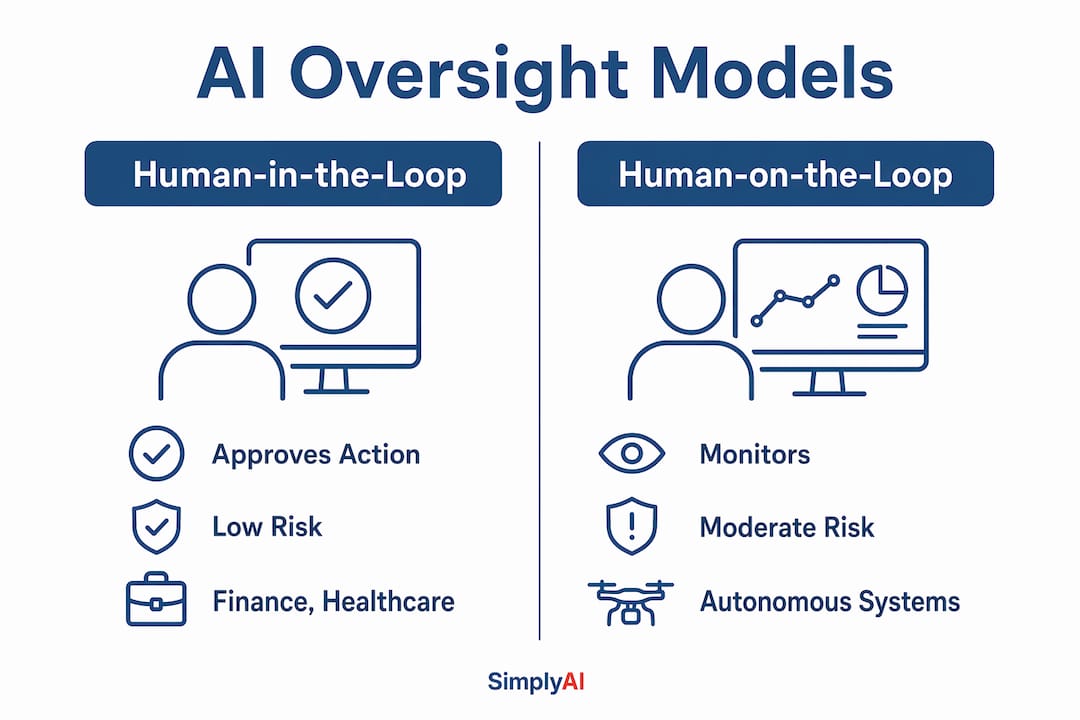
Human-in-the-loop (HITL): The AI system pauses and waits. No action is dispatched until a human approves. This is the highest-control model and is appropriate for irreversible, high-stakes decisions.
Human-on-the-loop (HOTL): The AI acts autonomously but a human monitors in real time and retains the ability to intervene. This model suits situations where speed matters and actions are partially reversible.
Human-out-of-the-loop (HOOTL): The system operates fully autonomously. Humans review outcomes after the fact. This is appropriate only for low-risk, high-volume tasks where errors are cheap to correct.
| Model | Human role | Risk profile | Example use case |
|---|---|---|---|
| HITL | Approves before action | Low risk, high control | Contract approval, financial transactions |
| HOTL | Monitors and can override | Medium risk | Fraud detection alerts, content moderation |
| HOOTL | Reviews outcomes post-hoc | High risk if misapplied | Email categorization, log analysis |
One common misconception deserves direct correction: prompt-level confirmations are not true HITL. Asking an AI agent to "confirm before proceeding" inside a prompt is a soft instruction the model can misinterpret or bypass. Architectural enforcement outside the model, through policy engines and approval queues, is the only reliable mechanism.
What do EU AI Act regulations require for human oversight?
The EU AI Act imposes specific, enforceable obligations on human oversight for high-risk AI systems, with enforcement beginning in August 2026. Two articles define the technical floor for compliance.
Article 14 mandates effective oversight with practical override and stop mechanisms. Operators must be able to halt AI outputs or reverse decisions using real controls, not just documented policies. The regulation explicitly addresses automation bias, requiring interface designs that promote healthy skepticism rather than passive acceptance of AI recommendations.
Article 12 requires automatic event logging across the system's entire lifetime. Logs must be generated continuously and must capture decisions, updates, retraining events, and configuration changes. This is an architectural mandate. A system that logs selectively or only on request does not meet the standard.
For business leaders, these requirements translate into four concrete design obligations:
- Override controls must be accessible to operators in real time, not buried in admin panels.
- Stop functions must halt AI action immediately, not queue a request for later processing.
- Audit logs must be tamper-evident, time-stamped, and reconstructable for regulatory review.
- Human reviewers must receive enough context to make independent judgments, not just raw AI outputs.
Organizations operating in the EU that deploy AI in credit scoring, medical diagnostics, recruitment, or critical infrastructure face direct exposure if these controls are absent. Consulting responsible AI guidelines before deployment is no longer optional for these sectors.
How do you build the technical architecture for effective HITL?
The infrastructure challenge behind HITL is more demanding than most business leaders anticipate. The core requirement is durable state persistence with pause and resume capabilities. When a workflow halts for human review, the system must save the full execution context so that the human's decision can be applied and the workflow resumed without data loss or context drift.

Microsoft's Agent Framework implements this through a request/response HITL pattern where executors send approval requests externally, human decisions route back asynchronously, and the workflow resumes based on the response. This architecture separates the AI model's reasoning from the control plane, which is the critical design principle. The AI agent never calls tools or dispatches actions directly. Every action passes through a policy engine that enforces approval gates before execution.
For teams building or procuring HITL systems, the system design considerations include three infrastructure layers: the state store (which must survive failures and support long pauses), the approval queue (which routes requests to the right reviewer with full context), and the audit trail (which logs every decision with timestamps and reviewer identity).
Scalability introduces a real tension. At low volumes, 100% human review is feasible. At production scale, selective oversight strategies become necessary. Teams move to reviewing only the highest-risk action categories or sampling audit trails to maintain safety evidence without creating reviewer fatigue. This is not a compromise on safety. It is a recognition that overwhelmed reviewers produce worse outcomes than well-designed selective review.
Pro Tip: Place HITL checkpoints based on action reversibility and consequence severity, not on process convenience. An irreversible financial transfer warrants a hard gate. A draft email recommendation warrants a soft review. Misaligning checkpoint placement with actual risk is the most common and costly HITL design error.
How do human factors affect HITL effectiveness?
The technical architecture of HITL is only as effective as the humans operating within it. Research confirms that HITL success depends on managing cognitive load and trust calibration, not on maximizing the number of human touchpoints. More reviews do not produce better outcomes if reviewers are fatigued, under-informed, or conditioned to approve automatically.
Automation bias is the primary human factor risk. When AI systems present confident outputs, humans tend to accept them without independent verification. This tendency is well-documented and directly addressed in EU AI Act Article 14. Interface design is the primary countermeasure. Approval UIs that show only raw AI outputs without supporting context produce rubber-stamping. Effective HITL interfaces provide the AI's proposal, its confidence level, the justification for the recommendation, and the relevant input data, giving reviewers the information needed to disagree.
Three practices reduce cognitive load without reducing oversight quality:
- Risk-tiered review routes only high-consequence actions to senior reviewers, reducing volume without reducing scrutiny where it matters.
- Sampled audits replace exhaustive review for lower-risk action categories, maintaining accountability through statistical coverage.
- Reviewer training aligned with AI reliability data builds calibrated trust, so humans know when to scrutinize and when to proceed with confidence.
The accountability gap identified in recent research is instructive: many organizations place humans too late in the workflow, after consequential decisions are already shaped by AI outputs. Moving the checkpoint earlier, before the AI recommendation becomes the default, preserves the independence of human judgment.
Pro Tip: Treat reviewer interface design as a first-class engineering concern. The quality of the information presented at a HITL checkpoint determines whether human oversight is genuine or ceremonial. Invest in context-rich approval UIs before scaling review volumes.
Where does HITL deliver the most business value?
HITL delivers the highest return in situations where actions are irreversible, consequences are significant, and errors carry legal or reputational cost. The clearest candidates are financial transactions above defined thresholds, outbound customer communications that cannot be recalled, medical or clinical recommendations, and contract generation or modification.
In financial services, HITL gates on large transfers or unusual transaction patterns provide both fraud protection and regulatory evidence. In healthcare, AI diagnostic support systems with HITL checkpoints satisfy clinical governance requirements while preserving physician accountability. In autonomous systems and robotics, HITL approval for novel or out-of-distribution situations prevents costly physical errors.
The evolution of HITL from quality control toward formal regulatory compliance changes the procurement calculus for business leaders. Selecting an AI vendor or platform now requires evaluating HITL capabilities as a compliance feature, not an optional add-on. Four questions define vendor readiness:
- Does the platform enforce approval gates architecturally, outside the model execution path?
- Does it support durable state persistence and pause/resume for long-running workflows?
- Does it generate tamper-evident audit logs that satisfy Article 12 requirements?
- Does it provide reviewer interfaces with sufficient context to support independent human judgment?
Phased adoption is the practical path for most organizations. Start with HITL on the highest-risk, lowest-volume action categories. Measure reviewer accuracy, latency, and fatigue. Expand coverage as infrastructure matures and reviewer workflows are optimized. Exploring AI automation vs. manual work frameworks helps clarify which processes are ready for automation and which require sustained human oversight.
Key takeaways
Effective HITL AI requires architectural enforcement outside the AI model, not policy statements or prompt-level instructions.
| Point | Details |
|---|---|
| HITL is an architectural constraint | Approval gates must be enforced by control planes outside the AI model's execution path. |
| EU AI Act compliance is mandatory | Articles 12 and 14 require override controls, stop functions, and continuous audit logging by August 2026. |
| Cognitive load determines effectiveness | Risk-tiered review and context-rich interfaces prevent automation bias and rubber-stamping. |
| Infrastructure is the critical challenge | Durable state persistence and pause/resume capabilities are non-negotiable for production HITL. |
| Start with high-risk, irreversible actions | Phased HITL adoption focused on consequential decisions delivers compliance value fastest. |
Why I think most organizations are building HITL wrong
The organizations I see struggling with HITL share a common pattern: they treat it as a governance checkbox rather than a system design discipline. They add a human review step to an existing workflow, call it HITL, and move on. The result is a process where reviewers see confident AI outputs stripped of context, approve them in seconds, and create an audit trail that documents compliance without delivering it.
The regulatory pressure from the EU AI Act is forcing a reckoning with this approach. Article 14's explicit attention to automation bias signals that regulators understand the difference between nominal oversight and effective oversight. A human who approves 98% of AI recommendations in under five seconds is not providing meaningful control. That is a liability, not a safeguard.
What I find genuinely encouraging is the maturation of infrastructure tooling. Platforms that support durable state, asynchronous approval queues, and context-rich reviewer interfaces are now accessible to mid-sized organizations, not just enterprises with dedicated AI engineering teams. The barrier to building real HITL has dropped significantly.
The strategic opportunity here is real. Organizations that build genuine HITL infrastructure now will have a compliance and trust advantage as regulations tighten and customers increasingly demand explainable, accountable AI. The ethical AI principles underlying HITL are not constraints on AI capability. They are the foundation for deploying AI at scale with confidence.
— Theodor
How Simplyai helps you implement AI with human oversight
Simplyai designs and implements AI automation systems that incorporate human oversight from the ground up, not as an afterthought. For business leaders who need to meet EU AI Act requirements while capturing the productivity benefits of AI agents, Simplyai's AI automation services include approval gate architecture, audit logging, and reviewer interface design tailored to your specific workflows. Whether you are deploying AI-powered chatbots, CRM automations, or multi-step agentic workflows, Simplyai builds the control infrastructure that makes human oversight real and auditable. The result is AI that your compliance team can defend and your operations team can trust.
FAQ
What is the difference between HITL and human-on-the-loop AI?
Human-in-the-loop AI blocks workflow progression until a human explicitly approves an action. Human-on-the-loop AI allows the system to act autonomously while a human monitors and retains the ability to intervene, making it a lower-control model suited to partially reversible decisions.
Does the EU AI Act require human-in-the-loop for all AI systems?
The EU AI Act's human oversight requirements under Article 14 apply specifically to high-risk AI systems, including those used in credit scoring, medical diagnostics, recruitment, and critical infrastructure. Lower-risk systems face lighter obligations, but all AI systems must meet basic transparency standards.
Why are prompt-level confirmations not true HITL?
Prompt instructions asking an AI to confirm before acting are soft constraints that the model can misinterpret or bypass. True HITL requires enforcement by a control plane outside the model's execution path, using approval queues that the AI cannot circumvent.
How does automation bias undermine human oversight in AI systems?
Automation bias causes humans to accept confident AI outputs without independent verification, effectively rendering oversight ceremonial. Effective HITL interfaces counter this by presenting the AI's proposal alongside its confidence level, justification, and relevant input data, enabling reviewers to make genuinely independent judgments.
What infrastructure does a production HITL system require?
Production HITL requires durable state persistence to save workflow context during pauses, an asynchronous approval queue to route decisions to reviewers, and tamper-evident audit logging to satisfy regulatory traceability requirements under EU AI Act Article 12.