

TL;DR:
- Most SMBs fail to retain qualified leads because their follow-up breaks down due to ineffective automation and poor data hygiene. Implementing AI-powered lead nurturing with clear workflows, precise scoring, and ongoing optimization can significantly improve conversion rates and pipeline quality. Success depends on human infrastructure, trust, and continuous refinement rather than technology alone.
Most small and medium-sized businesses lose qualified leads not because their product is weak or their pricing is off, but because follow-up breaks down. A prospect downloads your guide, visits your pricing page, and then nothing happens for five days. By then, they've moved on. Learning how to automate lead nurturing is how you close that gap — delivering the right message at the right moment without relying on a sales rep to remember every touchpoint. This guide walks you through every layer of building an AI-powered nurturing system that works around the clock.
Table of Contents
- Understanding the essentials of automated lead nurturing
- Preparing your SMB for AI-powered lead nurturing automation
- Building and executing effective automated lead nurturing workflows
- Common pitfalls and pro tips for successful lead nurturing automation
- Measuring, optimizing, and scaling your automated lead nurturing program
- Why most SMBs underestimate the complexity of lead nurturing automation — and how to win
- Elevate your lead nurturing with SimplyAI's AI automation solutions
- Frequently asked questions
Key Takeaways
| Point | Details |
|---|---|
| Automate to save time | Lead nurturing automation helps SMBs maintain consistent, personalized engagement without manual effort. |
| Clean data is key | Accurate, updated CRM data and alignment between sales and marketing ensure effective lead nurturing. |
| Segment and score leads | Behavioral segmentation and lead scoring prioritize follow-ups to boost conversion rates significantly. |
| Test and optimize | Thorough pre-launch testing and ongoing analysis of metrics and lead scores improve campaign results. |
| Use AI tools | AI enhances personalization, timing, and lead qualification, making nurturing campaigns more efficient and effective. |
Understanding the essentials of automated lead nurturing
Automated lead nurturing is the practice of using software to deliver personalized, behavior-triggered communications that guide prospects through your sales funnel with minimal manual intervention. For SMBs, this is not a luxury — it is the difference between a pipeline that compounds and one that leaks. The core promise of automation is consistency: every lead gets the right follow-up, every time.
The foundation rests on three pillars: lead scoring, behavioral segmentation, and trigger logic. Lead scoring assigns numeric values to actions a prospect takes, such as opening an email, visiting a product page, or requesting a demo. Behavioral segmentation groups prospects by what they actually do, not just what category they fall into. Trigger logic fires a specific action when a score threshold or behavior is met. Together, these create a system that responds intelligently rather than broadcasting blindly.
Automated lead nurturing lifts MQL-to-SQL conversion by 30-50% when behavioral triggers and lead scoring are applied correctly. That is not a marginal improvement — it is a structural shift in how efficiently your pipeline fills. Successful automation, however, does require clean CRM data and sales-marketing alignment as foundational inputs. Without both, even the best workflow logic will produce unreliable results.
Here is what automated lead nurturing typically includes:
- Lead scoring models that assign points to demographic fit and behavioral signals
- Segmented nurture tracks tailored to where a lead is in the buying journey
- Behavioral triggers that fire emails or tasks based on specific actions
- CRM integration that keeps sales and marketing working from the same data
- Performance dashboards that surface what is working and what needs adjustment
Understanding marketing automation platforms and how they connect to your existing tools is the necessary first step before building anything.
Preparing your SMB for AI-powered lead nurturing automation
Now that you know the basics, let's prepare your systems and data to enable AI-powered nurturing automation. Preparation is where most SMBs skip ahead too fast — and pay for it later with broken workflows and irrelevant outreach.
Start with your CRM data. Deduplicate contacts, fill in missing fields like industry and company size, and standardize how lead sources are recorded. AI-powered nurturing depends on data signals to make decisions. Garbage in, garbage out is not a cliché here — it is a technical reality. A lead record missing a job title or company size cannot be accurately scored or routed.

Choose a CRM and automation platform suited to your scale. HubSpot holds 30% of marketing automation market share among SMBs, largely because it bundles CRM, email automation, lead scoring, and reporting at a price point that makes sense for growing companies. AI tools save time and improve personalization, making them essential rather than optional for SMB lead nurturing in 2026. The right platform reduces the manual overhead of maintaining sequences so your team can focus on closing.
Before writing a single email, define measurable goals. What does a marketing qualified lead look like for your business? What score threshold should trigger a sales handoff? How many touches should occur before a lead is marked inactive? These decisions should be documented and agreed upon by both marketing and sales before automation goes live.
- Set a lead score threshold (e.g., 50 points) that signals sales-readiness
- Define at least three lead segments: awareness, consideration, and decision-stage
- Agree on a shared definition of "qualified lead" across sales and marketing
- Audit your CRM for duplicate records and incomplete contact profiles
AI personalization for SMBs becomes far more effective when your data infrastructure is clean and your goals are precise from the outset. Choosing the right marketing automation platform from the start saves significant rework later.
Pro Tip: Run a data audit before activating any automation. Filter for contacts missing three or more key fields and either enrich them using a data tool or suppress them from active sequences until records are complete.
Building and executing effective automated lead nurturing workflows
With your systems ready, let's build and launch workflows that move leads effectively through the funnel. The sequence design phase is where strategy meets execution — and where specificity matters more than creativity.
A well-structured nurture sequence moves through three distinct phases. First, the education phase delivers content that addresses awareness-level problems, such as blog posts, industry data, and explainer content. Second, the consideration phase introduces your solution, including case studies, comparison resources, and product demos. Third, the decision phase focuses on conversion triggers: free trials, limited-time offers, direct sales outreach, and testimonials. Each phase should feel like a natural progression, not a sudden gear shift.
Typical B2B nurture sequences include 5-8 emails over 4-8 weeks with engagement-based branching applied after the third email. That branching logic is critical. If a lead opens email three and clicks through to your case study, they move to an accelerated track. If they ignore it, they receive a re-engagement message before the sequence continues.
Here is a step-by-step workflow build:
- Map your buyer journey into the three phases above and assign content assets to each stage
- Define trigger events such as form submissions, page visits, or score thresholds that enroll a lead into the sequence
- Build the email sequence with appropriate spacing — typically every 3-5 days for the first half, then stretching to weekly
- Add branching logic after email 3 based on opens, clicks, and page visits
- Set up a sales alert or CRM task when a lead reaches your score threshold
- Test the entire workflow with internal email addresses before activating
Use webhook triggers for instant enrollment and AI to auto-tag responses, which measurably improves reply rates and reduces the delay between intent signal and follow-up.
| Email number | Timing | Purpose | Engagement action |
|---|---|---|---|
| Email 1 | Day 1 | Welcome and education | Branch if opened |
| Email 2 | Day 4 | Problem awareness content | Branch if clicked |
| Email 3 | Day 8 | Social proof or case study | Accelerate or re-engage |
| Email 4 | Day 13 | Solution introduction | Score update |
| Email 5 | Day 19 | Demo or trial offer | Sales alert if clicked |
| Email 6 | Day 26 | Final nurture or breakup email | Suppress or recycle |
Building lead nurturing workflows with AI requires thinking in conditional logic — anticipate what a lead might do and plan a response for each path. To streamline workflows with AI, eliminate manual handoffs wherever data can trigger actions automatically.
Pro Tip: Use AI-generated subject line variants and test them across the first two emails before scaling your sequence. Small differences in subject lines can shift open rates by 15-20%, and those early opens determine whether your entire sequence is effective.
Common pitfalls and pro tips for successful lead nurturing automation
Even with the best setup, avoiding common traps and following expert tips ensures your automation performs smoothly. Most SMBs launch their first automation system with confidence and then discover the problems only after leads start complaining or disappearing from the pipeline.
The most consequential mistake is failing to test workflow branches end-to-end. Most failures come from untested branching logic that surfaces only after real contacts experience broken sequences, duplicate messages, or missed follow-ups. Before going live, simulate every path: the lead who opens every email, the lead who clicks nothing, and the lead who unsubscribes on day two.
Lead score decay is another overlooked mechanism. A lead who visited your pricing page six months ago and has not engaged since should not carry a high score. Decay rules automatically reduce scores over time when no engagement occurs, keeping your sales team focused on genuinely warm prospects rather than cold records that looked hot months ago.
Without frequency controls, fast triggers can overwhelm leads, eroding trust and driving unsubscribes. Balancing rapid response with patient, measured nurturing is what separates effective automation from aggressive spam.
Key guardrails to put in place:
- Apply email frequency caps of no more than one message every 48 hours per contact
- Implement negative scoring for unsubscribe attempts and spam reports
- Set suppression lists for current customers and recently closed-lost deals
- Test with at least three internal addresses across different email clients before launch
"Automation is a system, not a silver bullet. The SMBs that win with it are the ones that treat it like a product — testing, iterating, and improving it continuously rather than setting it and forgetting it."
Addressing AI solutions for automation challenges proactively means building review cycles into your workflow calendar from day one.
Pro Tip: Schedule sends during Tuesday through Thursday, between 9 a.m. and 11 a.m. in your audience's local time zone. Engagement data consistently shows these windows outperform early morning, late afternoon, and weekend sends for B2B communications.
Measuring, optimizing, and scaling your automated lead nurturing program
Finally, learn how to monitor and refine your automation for sustained revenue growth and scaling. Launching a nurture program is the beginning, not the finish line. The data you collect in the first 60 days reveals where prospects stall, which content resonates, and which score thresholds need adjustment.
The key performance metrics to track are email open rate, click-through rate, sequence completion rate, and lead-to-opportunity conversion rate. Open rate tells you whether your subject lines and sender reputation are working. Click-through rate reveals whether your content matches what the lead actually wants. Sequence completion rate shows where drop-off occurs. Conversion rate is the number that ultimately justifies the investment.
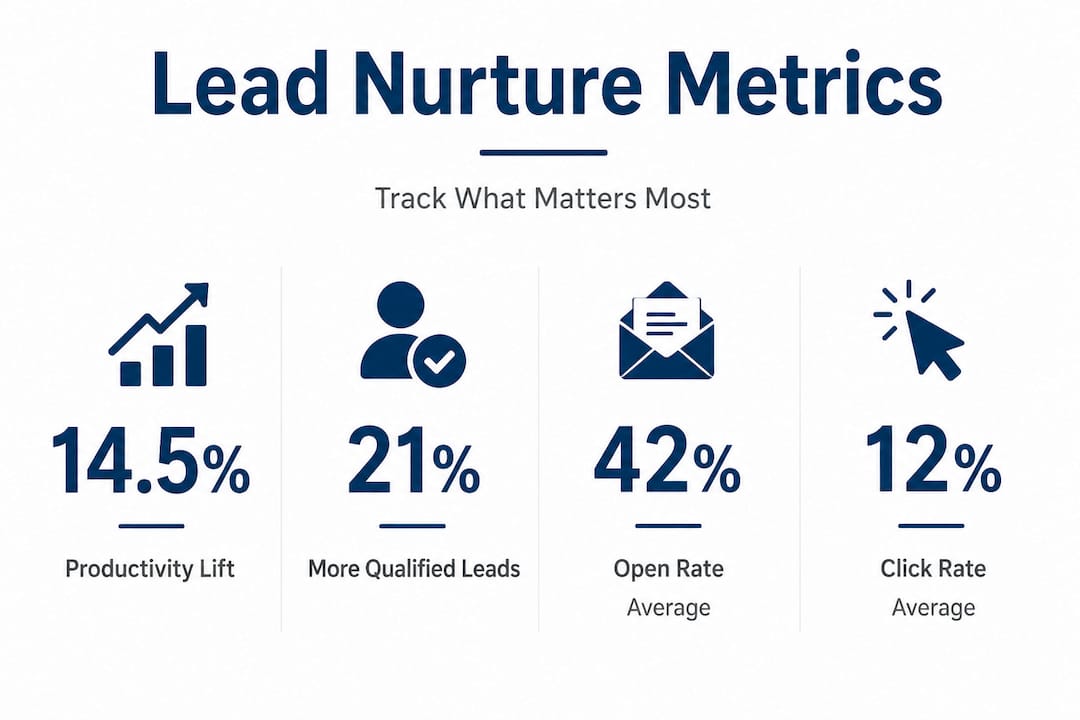
Lead scoring must evolve quarterly using revenue cycle analytics to maintain predictive accuracy. What qualified a lead six months ago may no longer reflect what your closed-won customers looked like. Reviewing closed deals and mapping them back to scoring behaviors is one of the highest-impact optimization activities an SMB can invest in.
The productivity numbers make the case clearly: automation lifts sales productivity by 14.5% and can increase qualified leads by over 450% at scale. These are not aspirational figures — they reflect what happens when scoring, content, and routing work together consistently over time.
| Metric | Benchmark | Action if below benchmark |
|---|---|---|
| Email open rate | 20-30% | Revise subject lines, test sender name |
| Click-through rate | 3-8% | Improve CTA clarity, match content to stage |
| Sequence completion | 40-60% | Reduce frequency, improve email 3 content |
| Lead-to-opportunity | 10-20% | Adjust score threshold, review sales handoff |
Key optimization actions to run quarterly:
- Review closed-won deals and map behaviors back to score assignments
- Update content assets in the consideration phase to reflect new case studies
- Align with sales on lead quality feedback — what is converting, what is not
- Use AI dashboards to surface engagement anomalies and drop-off points
Understanding the AI support impact for SMBs extends well beyond marketing, reinforcing why a unified AI automation strategy pays dividends across the business. Continuing to optimize automation workflows as your lead volume grows is what turns a functional system into a competitive advantage.
Pro Tip: Create a shared Slack channel or weekly report where marketing sends sales a summary of top-scoring leads from the prior week. This keeps both teams aligned and reduces the time between a lead reaching threshold and a sales rep making contact.
Why most SMBs underestimate the complexity of lead nurturing automation — and how to win
Here is the uncomfortable reality that most automation guides skip over: the technology is rarely the hard part. Platforms are capable, AI tools are accessible, and integration options have never been broader. What breaks automated lead nurturing programs for SMBs is almost always the human infrastructure around the technology — messy data, undefined lead definitions, and sales teams who do not trust the leads marketing sends them.
Many teams lose more pipeline to slow sales lead routing than to weak nurture content. A prospect who hits a score threshold and waits 72 hours for a sales rep to follow up is a prospect who has already moved on. Speed of routing matters as much as quality of content. Automating the alert and making the handoff instant is not a nice-to-have — it is a revenue decision.
The second underestimated factor is score maintenance. Most SMBs build their lead scoring model at launch and never revisit it. The market changes, buyer behavior shifts, and the scoring model drifts further from reality with every passing quarter. Treating effective automation workflows as living systems rather than completed projects is what separates organizations that scale their pipeline from those that plateau.
The businesses that genuinely win with automation are relentlessly specific. They know exactly what behavior pattern predicts a closed deal, and they build their entire system around surfacing that pattern faster. That specificity only comes from iteration, from reviewing real closed-won data and being willing to rebuild scoring models when the evidence demands it. Automation rewards precision, not optimism.
Elevate your lead nurturing with SimplyAI's AI automation solutions
If this guide has made one thing clear, it is that effective lead nurturing automation requires more than picking a platform and sending a welcome email. It requires clean data, thoughtful workflow design, behavioral scoring, and ongoing refinement — all working together.
SimplyAI specializes in building exactly this kind of end-to-end AI automation services for small and medium-sized businesses. From CRM integration and lead scoring setup to AI-driven nurture sequences and sales routing automation, the team designs systems that deliver measurable pipeline results — not just activity metrics. If you are ready to move from manual follow-up to an AI-powered nurturing engine that works around the clock, SimplyAI can design, implement, and optimize it with you.
Frequently asked questions
What is lead nurturing automation and why is it important for SMBs?
Lead nurturing automation uses software to deliver personalized, timely content that guides prospects through the sales funnel, and automated lead nurturing improves conversion rates with significantly less manual effort — making it essential for SMBs competing with larger teams.
How long should an automated lead nurturing sequence be?
A typical B2B sequence runs 5-8 emails over 4-8 weeks with 3-5 day gaps between messages and engagement-based branching after email 3 to balance persistence with respect for the prospect's attention.
How does lead scoring improve lead nurturing automation?
Lead scoring assigns points to behaviors and demographic fit to identify which prospects are sales-ready, and score thresholds trigger sales alerts while decay rules reset inactive leads — keeping your pipeline focused on genuinely warm opportunities.
What common mistakes should SMBs avoid when automating lead nurturing?
The most damaging errors are skipping full workflow testing, neglecting score decay, sending emails too frequently, and leaving sales and marketing operating with different definitions of a qualified lead, all of which cause automation failures and unsubscribes that erode pipeline quality over time.