

TL;DR:
- End-to-end automation connects all steps of a business process, eliminating manual handoffs and delays. It significantly boosts productivity by up to 30% and cuts operational costs by 20-25%, surpassing siloed automation. Successful scaling begins with small, well-understood workflows and emphasizes governance, human oversight, and incremental expansion.
Most organizations already use some form of automation. They automate email responses, generate reports, or process invoices in isolation. But knowing what is end-to-end automation, and understanding why it delivers fundamentally different results, is what separates companies that maintain efficiency from those that scale it. Research shows that end-to-end automation increases productivity by 20 to 30% and reduces operational costs by 20 to 25%, numbers that partial, siloed automation simply cannot match. This guide explains the definition, the mechanics, the real-world applications, and the strategic path forward for decision-makers ready to move beyond patchwork solutions.
Table of Contents
- Key Takeaways
- What end-to-end automation actually means
- The measurable benefits of end-to-end automation
- From RPA to agentic automation: the evolution that matters
- How to start and scale end-to-end automation
- End-to-end automation examples across business functions
- My perspective: why governance and starting small are the real differentiators
- See how Simplyai builds end-to-end automation for your business
- FAQ
Key Takeaways
| Point | Details |
|---|---|
| Full-process coverage | End-to-end automation eliminates manual handoffs by connecting every step of a workflow into one continuous system. |
| Measurable business impact | Organizations report up to 50% fewer data entry errors and significant cost reductions compared to manual processes. |
| Evolution to agentic automation | Modern solutions go beyond rule-based RPA by using AI agents that handle context-aware decisions and exceptions. |
| Start small, scale deliberately | Successful implementations begin with one well-understood process and expand organically, avoiding costly big-bang projects. |
| Governance is non-negotiable | Clear decision logic, human oversight, and auditability separate enterprise-grade automation from fragile workarounds. |
What end-to-end automation actually means
The definition of end-to-end automation is straightforward in principle but often misunderstood in practice. It refers to the automation of an entire business process from its initial trigger to its final output, with no manual handoffs between steps. A customer submits a request. That request is validated, routed, processed, and confirmed without a human touching a keyboard at any intermediate stage. Comprehensive workflow coverage is what distinguishes this approach from simply automating individual tasks.
Contrast that with siloed automation, where a team uses one tool to extract data, another to process it, and still relies on a human to copy results into a third system. Each handoff point introduces delay, error, and operational risk. End-to-end automation eliminates those gaps by integrating systems, orchestrating workflows, and processing data in real time across the entire chain.
The core components of any end-to-end automation architecture include:
- System integration: Connecting applications such as ERP, CRM, and communication platforms so data flows automatically between them.
- Workflow orchestration: Defining the sequence of steps, conditions, and decision points that govern how a process moves forward.
- Real-time data processing: Acting on information as it arrives rather than batching it for manual review.
- Exception handling: Automatically detecting anomalies and either resolving them via predefined rules or escalating to a human reviewer.
- Human oversight: Building in approval gates and audit trails where human judgment remains necessary.
Two primary models have emerged as the dominant end-to-end automation solutions. Robotic Process Automation (RPA) applies rule-based scripts to repetitive tasks across existing interfaces. Agentic Process Automation (APA) goes further, deploying AI agents that reason, plan, and adapt across complex, multi-step workflows.
The measurable benefits of end-to-end automation
The business case for full-process automation is no longer theoretical. The benefits of end-to-end automation show up across every function that adopts it, and the numbers are specific enough to build a credible ROI model before a single workflow is deployed.
Productivity improvements in the 20 to 30% range come from eliminating the time employees spend on copy-pasting, manual status checks, and coordination between systems that do not communicate natively. Error reduction is equally significant. Data entry errors drop by up to 50% when humans are removed from repetitive data transfer tasks. In regulated industries, this is not just a quality metric. It is a compliance requirement.

Processing speed is another dimension where the gains are visible immediately. Workflows that previously took days to complete due to queuing and manual approvals can collapse to hours or even minutes. Scalability follows naturally. When your processes run on automated logic rather than human effort, adding volume does not mean adding headcount at the same rate.
The qualitative benefits are equally compelling for decision-makers. Customer experience improves when response times shrink and errors in order fulfillment or service delivery decrease. Employees shift their attention from low-value data handling to higher-judgment work. Compliance workflows become auditable by default because every step is logged automatically.
Pro Tip: Before calculating ROI, map your current process and measure the actual time humans spend on each handoff. That baseline makes the financial case for automation concrete and defensible to any executive audience.
One finding that reshapes how organizations should think about timelines: low-code automation ROI can arrive in 3 to 6 weeks for targeted processes like lead qualification or operational reporting, not the 12 to 18 months that legacy enterprise projects historically required. That compression changes the risk calculus for mid-market companies that previously assumed automation was a long-horizon investment.
From RPA to agentic automation: the evolution that matters
Understanding how does end-to-end automation work in 2026 requires understanding how dramatically the technology has evolved. Traditional RPA was, and in many deployments still is, brittle. It follows scripts. When a screen layout changes or an unexpected input arrives, the bot breaks. Maintenance costs accumulate, and the automation that was supposed to save time starts consuming engineering hours to keep running.
Agentic Process Automation represents a structural leap beyond that model. APA uses AI agents built on large language models and AI agent frameworks to plan workflows dynamically, interpret context, and make decisions that RPA could never handle. An APA system processing a supplier invoice does not just match fields. It understands exceptions, cross-references business rules, and escalates edge cases with a clear explanation of why.
The comparison below illustrates why the distinction matters for platform selection:
| Capability | Traditional RPA | Intelligent Process Automation | Agentic Process Automation (APA) |
|---|---|---|---|
| Decision logic | Rule-based, rigid | Partially adaptive | Context-aware, dynamic |
| Exception handling | Fails or escalates all | Handles common exceptions | Reasons through novel exceptions |
| Integration depth | UI-level scripting | API and UI combined | Native ERP, CRM, and API integration |
| Auditability | Log-based | Partial traceability | Full traceability with decision rationale |
| Human oversight | Minimal governance | Moderate governance | Explicit human-in-the-loop governance |
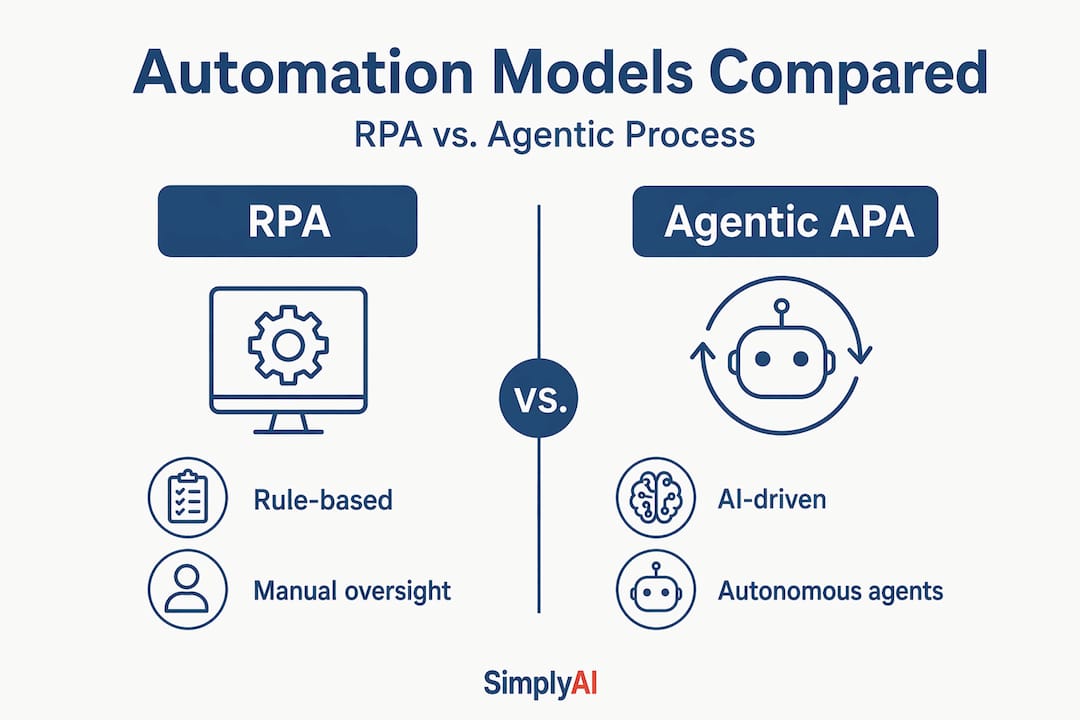
Enterprise adoption of APA is accelerating because disconnected workflows fail when they lack integration with actual business logic and regulatory context. The future of enterprise automation centers on that contextual layer. An AI agent that processes a refund request needs to know the refund policy, the customer's history, the inventory status, and the applicable regulation. Rule-based RPA cannot hold that context. APA can.
Governance in APA means every agent operates with explicit permissions, declared decision logic, and a human escalation path when confidence thresholds are not met. This is what makes the technology enterprise-grade rather than experimental.
Pro Tip: When evaluating automation platforms, ask specifically how exceptions are handled and how decisions are logged. Any platform that cannot answer those questions clearly is not ready for regulated or customer-facing workflows.
How to start and scale end-to-end automation
The single most common mistake organizations make is treating end-to-end automation as a single, large project. The big-bang approach consistently produces expensive failures because it requires fully specifying complex processes upfront before anyone has learned what the automation actually needs to handle.
The approach that produces lasting results is deliberately incremental. Here is how successful organizations build toward full-process automation maturity:
- Identify one high-impact, well-understood process. Finance approvals, customer onboarding, or compliance reporting workflows are common starting points because they are high-frequency and their steps are already documented.
- Deploy a minimum viable automation (MVA). Build enough to automate the core path and measure real performance. Rapid MVP deployment reduces time-to-value and surfaces edge cases that no requirements document would have anticipated.
- Instrument and refine. Measure cycle time, error rate, and exception frequency. Use that data to expand the automation's decision coverage before adding new processes to the platform.
- Expand to adjacent processes on a shared platform. Connecting related workflows on a common automation layer is what transforms isolated automations into an enterprise-level orchestration system.
- Embed governance from the start. Define who approves exceptions, which decisions require human sign-off, and how the automation's actions are logged. Retrofitting governance onto a mature automation estate is significantly harder than building it in early.
A mid-sized financial services firm that starts by automating its monthly reporting process will, within two or three iterations, have learned enough about data flows and exception patterns to extend the same platform to client onboarding and compliance checks. That organic growth is precisely how complex automation systems emerge successfully. For a practical walkthrough of the optimization process, the AI workflow optimization guide from Simplyai offers a step-by-step framework built for exactly this kind of incremental scaling.
Pro Tip: Treat your first automation as a learning investment, not a finished product. The process map you have before deployment will almost always differ from the one you discover after two weeks of live operation.
End-to-end automation examples across business functions
Seeing end-to-end automation examples across different functions makes its scope concrete and the opportunity more tangible for teams skeptical of broad claims.
- Finance and accounts payable: An invoice arrives by email. The automation extracts the data using computer vision, cross-references it with the purchase order in the ERP, flags discrepancies, routes approved invoices for payment, and records the transaction. No human touches the process unless an exception is flagged.
- HR onboarding: When a new hire accepts an offer, the automation creates system accounts, sends welcome materials, schedules orientation sessions, triggers background check workflows, and notifies IT for equipment provisioning. Automated HR workflows are proving especially valuable as organizations scale hiring without expanding HR headcount proportionally.
- Customer service: A customer complaint submitted through a web form is classified by an AI agent, matched to a resolution workflow, and either resolved automatically or assigned to the right team with full context already populated. Response time drops from hours to minutes.
- Compliance reporting: Regulatory data is collected from multiple systems, validated against current rule sets, compiled into the required format, and submitted on schedule. The entire chain is logged for audit purposes with no manual assembly required.
Each of these scenarios shares the same structural characteristic: interconnected applications that eliminate information silos and give every stakeholder real-time visibility into process status. That visibility alone drives faster decisions and reduces the coordination overhead that quietly drains operational capacity. For agencies and service businesses, the impact of process automation on scaling follows the same pattern across client delivery workflows.
My perspective: why governance and starting small are the real differentiators
I've reviewed dozens of automation projects across industries, and the pattern in failed implementations is almost always the same. Organizations treated automation as a technology problem when it was actually a process design and governance problem. The platforms worked. The decision logic was never clearly defined.
What I've learned is that the organizations achieving the most durable results start by asking a different question. Instead of "what can we automate?" they ask "what decisions need to happen in this process, and who is accountable for each one?" That reframe immediately surfaces the governance requirements that separate a resilient automation from a fragile one.
The other lesson that consistently proves true: the first automation you deploy will teach you more about your actual processes than any discovery workshop. I've seen teams discover that what they described as a five-step approval process was actually a twelve-step process with three undocumented exception paths. You find that out in production. Starting small means that discovery is cheap and correctable.
AI agents change the calculus significantly, but they do not eliminate the need for human judgment. They extend where human judgment is applied, moving it from routine execution to true exception handling. That is the right use of human attention in any organization that wants to scale without proportional cost growth.
— Theodor
See how Simplyai builds end-to-end automation for your business
Simplyai designs and implements AI-powered automation systems tailored to the specific workflows, integrations, and compliance requirements of your business. Whether you are starting with a single high-impact process or building toward a fully orchestrated automation architecture, Simplyai's team brings the technical depth and practical experience to get there efficiently. For organizations ready to deploy AI agents across complex, multi-step workflows, Simplyai's AI agent solutions provide the governance frameworks and enterprise integration capabilities that agentic automation demands. Teams looking to build internal adoption capacity can also explore Simplyai's corporate AI training programs designed to accelerate organizational readiness.
FAQ
What is the definition of end-to-end automation?
End-to-end automation is the practice of automating an entire business process from its initial trigger to its final output, eliminating all manual handoffs between steps. It combines system integration, workflow orchestration, real-time data processing, and exception handling into a single continuous system.
How does end-to-end automation differ from regular automation?
Regular or partial automation addresses individual tasks in isolation, leaving humans to transfer data and manage transitions between steps. End-to-end automation connects every step in a workflow so the process runs continuously without manual intervention at any stage.
What are the measurable benefits of end-to-end automation?
Organizations implementing end-to-end automation report productivity gains of 20 to 30%, operational cost reductions of 20 to 25%, and data entry error reductions of up to 50% compared to manual processes.
How long does it take to see ROI from end-to-end automation?
For targeted, low-code automations such as lead qualification or reporting workflows, ROI can arrive within 3 to 6 weeks. Larger, multi-process implementations take longer but compound returns as each additional workflow is connected to the shared platform.
What is the difference between RPA and Agentic Process Automation?
RPA follows rigid, rule-based scripts and breaks when inputs change unexpectedly. Agentic Process Automation uses AI agents to plan workflows dynamically, handle context-aware exceptions, and integrate with enterprise systems while maintaining full auditability and human oversight.