

TL;DR:
- Process intelligence is an AI-powered, continuous analysis of end-to-end workflows that provides real-time operational insights. It integrates process mining, task mining, and contextual AI to monitor, predict, and optimize business processes beyond traditional retrospective methods. Implementing it requires assessing data landscapes, involving business owners, and aligning tools with organizational needs for sustained process improvements.
Process intelligence is defined as the continuous, AI-powered capture and analysis of end-to-end business workflows, combining process mining, task mining, and machine learning to deliver real-time operational visibility. Unlike traditional process mapping or standalone process mining, it gives decision-makers a factual, data-grounded picture of how work actually happens across every system, team, and application in their organization. Tools like Celonis, UiPath Process Mining, and ABBYY Timeline have made this discipline accessible at enterprise scale. The result is a shift from reactive process audits to proactive, predictive process management that directly improves operational efficiency and data-driven decision-making.
What is process intelligence and how does it work?
Process intelligence is the cornerstone of modern Process Excellence, replacing slow, subjective manual mapping with real-time, data-backed operational visibility. At its core, it merges three distinct technologies: process mining, task mining, and AI-driven analysis. Each layer contributes something the others cannot provide alone.

Process mining works by extracting event logs from enterprise systems like SAP, Salesforce, or ServiceNow and reconstructing the actual sequence of steps that occurred in a given process. This reveals deviations, rework loops, and compliance gaps that no process diagram would ever show. Task mining goes one level deeper, capturing desktop-level activity through computer vision and user interaction tracking to record exactly what employees do on their screens, including the manual steps that never touch a core system.
AI ties these two data streams together. Machine learning models identify patterns, flag anomalies, and generate automated recommendations without requiring analysts to manually review thousands of process variants. The system learns continuously, which means its insights improve over time rather than becoming stale after a single audit cycle.
The data sources involved extend well beyond structured IT systems. Process intelligence captures end-to-end work across legacy platforms, manual desktop tools, and even unstructured interactions that traditional process mining cannot reach. This matters because a significant share of enterprise work happens outside integrated systems entirely.
- Event logs from core platforms: SAP, Oracle, Microsoft Dynamics, Salesforce
- Desktop activity capture: keystrokes, application usage, copy-paste sequences, manual data entry
- Unstructured data sources: spreadsheets, email threads, messaging tools, local files
- Real-time monitoring feeds: live process dashboards updated continuously, not on a quarterly reporting cycle
Pro Tip: Before selecting a process intelligence platform, audit which of your critical workflows generate structured event logs and which rely on manual desktop work. Tools like Celonis excel at log-based mining, while platforms like Skan AI are built specifically for observation-first, desktop-level capture. Matching the tool to your data reality prevents blind spots from day one.
How does process intelligence differ from process mining and BPM?
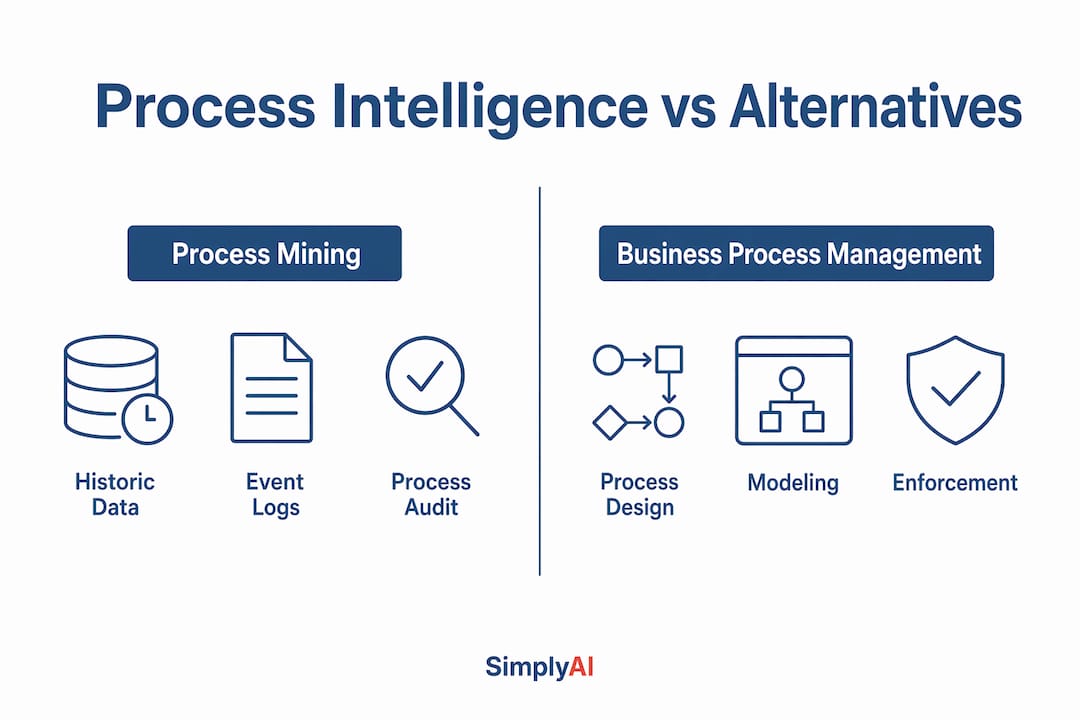
These three terms are often used interchangeably, but they describe fundamentally different scopes of capability. Understanding the distinction is not academic. It determines what your organization can actually do with the technology you invest in.
Process mining is the analytical foundation. It reads historical event logs and reconstructs what happened in a process after the fact. The analysis is retrospective by nature, meaning it tells you what went wrong last quarter, not what is about to go wrong tomorrow. Process mining is powerful for compliance audits and one-time process discovery, but it operates on a snapshot of reality rather than a living picture.
Business Process Management, or BPM, is a discipline focused on designing, modeling, and enforcing how processes should work. Platforms like IBM Business Automation Workflow or Appian define process rules and route work accordingly. BPM is prescriptive. It tells people and systems what to do. It does not, however, observe what they actually do in practice.
Process intelligence adds contextual analysis including business rules, user decisions, and environmental exceptions that explain why processes succeed or fail, not just what happened. This is the critical distinction. A process mining tool tells you that 23% of invoices were processed outside the standard path. Process intelligence tells you that this deviation happens specifically when a vendor is flagged in a legacy system that does not integrate with your ERP, and it happens most frequently on Fridays when senior approvers are unavailable.
The shift from process mining to process intelligence reflects a move from static, retrospective audit-style analysis to real-time, predictive monitoring using machine learning to forecast bottlenecks before they obstruct workflows. That predictive capability is what separates a diagnostic tool from a strategic asset.
| Dimension | Process Mining | BPM | Process Intelligence |
|---|---|---|---|
| Primary focus | Historical event log analysis | Process design and enforcement | Continuous, real-time process observation |
| Data sources | Structured system logs only | Defined process models | Logs, desktop activity, unstructured data |
| Analysis type | Retrospective | Prescriptive | Predictive and contextual |
| Output | Process maps and deviation reports | Workflow rules and routing | Live insights, forecasts, and recommendations |
| Scope of coverage | IT-integrated systems | Modeled processes only | End-to-end, including dark work |
What are the benefits of process intelligence for operational efficiency?
The business case for process intelligence rests on a straightforward premise: many process improvement efforts fail because leaders rely on incomplete information about how work is actually done. Process intelligence closes that gap by providing the factual ground truth of operations. The benefits that follow are concrete and measurable.
Process intelligence allows businesses to monitor process health, forecast issues before they occur, and automatically suggest workflow optimizations in real time. This transforms process management from a periodic review exercise into a continuous operational discipline. A finance team using Celonis, for example, can see in real time which purchase orders are at risk of missing payment terms and intervene before a penalty is incurred.
The practical applications span industries and functions:
- Finance and accounts payable: Identify invoice processing bottlenecks, reduce duplicate payments, and enforce three-way matching compliance without manual audits.
- Manufacturing and supply chain: Monitor order-to-delivery cycle times, detect deviations in production workflows, and predict equipment-related process delays before they cascade.
- Customer service operations: Map the actual resolution paths agents take across CRM, ticketing, and communication tools to identify training gaps and reduce handle time.
- Compliance and risk management: Continuously verify that regulated processes follow approved paths, generating audit-ready evidence without manual documentation.
- IT service management: Track incident resolution workflows in tools like ServiceNow to identify recurring escalation patterns and reduce mean time to resolution.
The connection to automation is equally significant. Process intelligence does not just identify what to fix. It identifies what to automate. When a process intelligence platform reveals that a specific manual step is performed identically thousands of times per month, that is a precise, data-backed mandate for robotic process automation or an AI agent deployment. You can explore how AI integrations reduce manual workflows in practice to see how this plays out across real business functions.
Pro Tip: Do not start with your most complex process. Start with a high-volume, well-documented process where event log data is clean and abundant, such as accounts payable or IT ticket resolution. A fast, visible win builds organizational confidence in the technology and funds the next phase of adoption.
How to implement process intelligence in your organization
Successful implementation of process intelligence requires more than selecting the right software. Organizations that treat it as a purely technical project rather than a cultural and operational transformation consistently produce noisy dashboards and unactionable insights. The following considerations separate implementations that deliver results from those that stall.
The first step is assessing your current data landscape honestly. Identify which processes generate structured event logs, which rely heavily on desktop-level manual work, and which involve significant dark work through spreadsheets, messaging, and local files that falls outside any integrated system. This assessment determines which process intelligence tools are appropriate and where observation-first AI approaches are necessary.
- Define process health criteria before you start mining. Decide what "good" looks like for each process, including acceptable cycle times, compliance thresholds, and exception rates. Without this baseline, the platform will surface thousands of variants with no way to prioritize them.
- Choose tools aligned with your data reality. Celonis and UiPath Process Mining are strong choices for organizations with mature ERP environments. Skan AI and similar observation-first platforms are better suited for environments with significant unstructured, desktop-based work.
- Address the dark work problem explicitly. Any implementation that ignores unstructured manual work will produce an incomplete picture. Build task mining or desktop observation into the scope from the beginning, not as an afterthought.
- Assign process owners, not just IT administrators. The business stakeholders who own each process must be involved in interpreting insights and driving changes. Technology surfaces the data. Humans must act on it.
- Plan for continuous management, not a one-time deployment. Process intelligence is a living system. Business rules change, exceptions evolve, and new process variants emerge. Allocate ongoing resources to maintain and refine the model.
For organizations earlier in their AI adoption journey, understanding AI automation for small business provides a practical foundation before scaling to enterprise-grade process intelligence platforms.
Key takeaways
Process intelligence delivers its full value only when organizations combine the right technology with clearly defined process health criteria and active, ongoing management.
| Point | Details |
|---|---|
| Process intelligence definition | It is the continuous, AI-powered capture and analysis of end-to-end workflows, not a one-time audit. |
| Beyond process mining | Process intelligence adds real-time prediction and contextual analysis that retrospective log mining cannot provide. |
| Dark work is a blind spot | Unstructured work in spreadsheets and messaging tools must be explicitly observed for complete operational insight. |
| Implementation requires culture | Defining process health criteria and assigning business owners matters as much as selecting the right software. |
| Automation follows intelligence | Process intelligence identifies precisely which manual steps are candidates for AI automation or RPA deployment. |
Why process intelligence is the decision I'd make first
From where I sit, the most common mistake I see organizations make is investing in automation before they understand what they are actually automating. They deploy RPA bots on processes they believe are standardized, only to discover months later that the real process has dozens of undocumented variants, manual workarounds, and exception-handling steps that nobody documented because nobody thought to look.
Process intelligence flips that sequence. It forces you to observe before you act. The observation-first AI approach that platforms like Skan AI advocate is not just a technical preference. It is a fundamentally more honest way to engage with how your organization operates. Most process maps in most organizations are aspirational documents, not operational realities. Process intelligence replaces aspiration with evidence.
What I find most underappreciated is the contextual analysis dimension. Knowing that a process deviates 30% of the time is useful. Knowing that it deviates specifically because of a legacy system interaction, a specific team's behavior, or a seasonal volume spike is what actually enables you to fix it. The "why" is where the value lives, and most organizations stop at the "what."
The future of this discipline points clearly toward AI agents that not only observe and analyze but intervene autonomously when a process deviates from its optimal path. That is not science fiction. It is the logical extension of what Celonis and similar platforms are already building. Organizations that build their process intelligence foundation now will be positioned to deploy those agents effectively. Those that wait will be automating guesswork.
— Theodor
How Simplyai can help you act on process intelligence
Understanding your processes is only half the equation. Acting on that understanding requires the right AI automation infrastructure, and that is exactly what Simplyai builds for businesses ready to move from insight to execution. Simplyai designs and implements AI automations, AI agents, and workflow automation systems that translate process intelligence findings into measurable operational improvements. Whether you need to automate a high-volume manual task identified through process mining or deploy an AI agent to handle exception routing, Simplyai delivers solutions built around your specific process reality. Explore Simplyai's AI automation services to see how your organization can move from process visibility to process transformation.
FAQ
What is the process intelligence definition in simple terms?
Process intelligence is the continuous, AI-powered analysis of how business processes actually operate, combining data from IT systems, desktop activity, and unstructured work sources to deliver real-time insights and predictive recommendations.
What is process mining and how does it relate to process intelligence?
Process mining is a component of process intelligence that analyzes historical event logs from enterprise systems to reconstruct process flows. Process intelligence extends this by adding task mining, real-time monitoring, and contextual AI analysis.
What are the main benefits of process intelligence for businesses?
The primary benefits include real-time process visibility, predictive identification of bottlenecks before they occur, data-backed automation targeting, and continuous compliance monitoring across regulated workflows.
How is process intelligence different from business intelligence?
Business intelligence analyzes structured business data such as sales figures and financial metrics to report on outcomes. Process intelligence analyzes operational workflow data to reveal how work is executed and where it breaks down, making it focused on process behavior rather than business results.
What tools are used for process intelligence?
Leading process intelligence tools include Celonis, UiPath Process Mining, ABBYY Timeline, and Skan AI. The right choice depends on whether your critical workflows generate structured event logs or rely heavily on manual, desktop-based work.