

TL;DR:
- Effective customer journey automation relies on clear objectives, high-quality data, and behavior-driven branching to increase engagement and reduce churn. Choosing a platform that supports complex, multi-step, event-triggered workflows is essential, especially for intricate journeys with multiple decision points. Short, concise sequences with stage-specific KPIs and vigilant management of delivery status lead to more successful and measurable outcomes.
Step by step customer journey automation is the process of systematically designing and executing automated customer experiences based on behavior, lifecycle stage, and real-time engagement signals. Done well, it replaces manual follow-up with intelligent, event-driven workflows that move prospects through your sales funnel without constant human intervention. Platforms like Braze, Adobe Journey Optimizer, and Salesforce Marketing Cloud give marketing teams the infrastructure to build these workflows at scale. The payoff is measurable: tighter engagement, shorter sales cycles, and KPIs you can actually act on. This guide walks you through every stage, from prerequisites to performance tracking, with the operational detail most articles skip.
What prerequisites and tools does customer journey automation require?
Effective step by step customer journey automation starts before you touch a single platform setting. You need three things in place first: clear objectives, defined buyer personas, and clean, segmented data.

Objectives determine which journeys to build. A SaaS company focused on reducing churn builds different workflows than a retailer trying to recover abandoned carts. Buyer personas tell you which channels, messages, and timing windows matter. Without them, your automation fires the right message to the wrong person at the wrong moment.
Data quality is the most underestimated prerequisite. Automation platforms can only act on the data they receive. Incomplete CRM records, duplicate contacts, or missing behavioral events produce broken journeys that frustrate customers rather than engage them. Audit your data before you build.
Choosing the right platform for your journey complexity
The platform you choose should match the complexity of the journeys you intend to run. The table below contrasts two common automation approaches:
| Approach | Best For | Key Limitation |
|---|---|---|
| Triggered Sends | High-volume, single-step communications | No multi-step branching logic |
| API Event Journeys | Complex, multi-step flows with branching | Requires developer integration |
API Event Journeys offer better flexibility and multi-step branching than basic Triggered Sends, making them the right choice for any journey that involves more than one decision point. Triggered Sends work well for transactional messages like order confirmations, but they cannot adapt to changing customer behavior mid-sequence.
Adobe Journey Optimizer and Salesforce Marketing Cloud both support API Event Journeys natively. Braze adds a canvas-based visual builder that makes branching logic easier to configure without deep developer involvement. For small and medium businesses, HubSpot's workflow builder offers a lower barrier to entry while still supporting behavioral triggers.
Pro Tip: Before selecting a platform, map your most complex planned journey on paper first. If it has more than three decision branches, rule out any tool that does not support API-level event triggers.
How to execute step by step customer journey automation
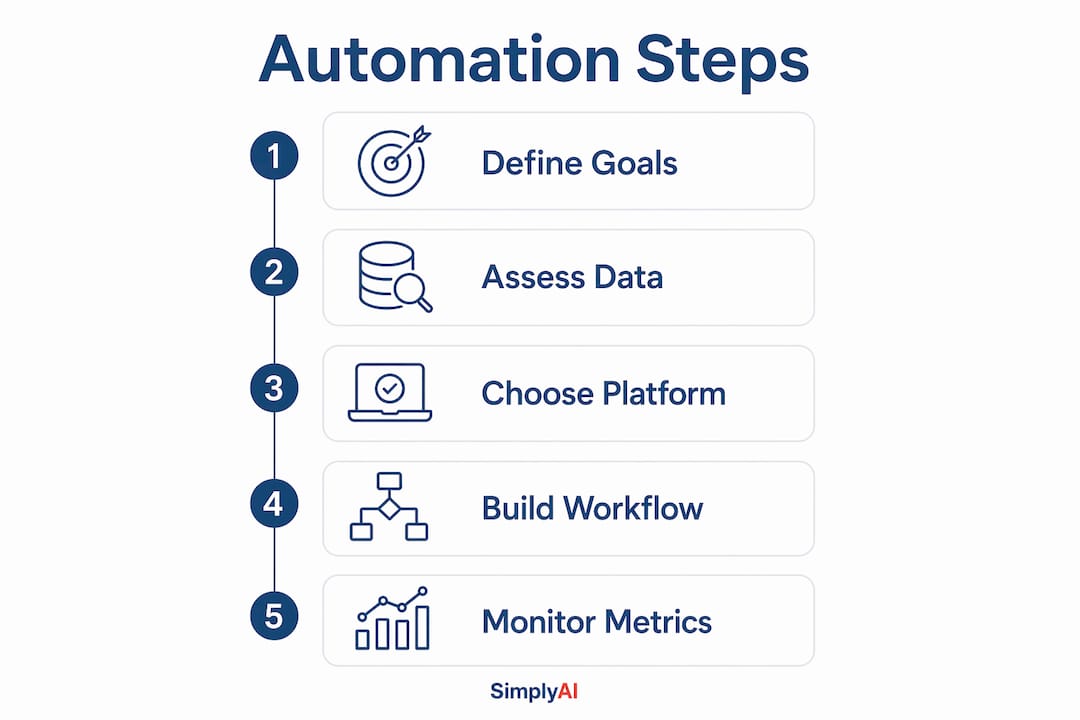
The execution phase is where most teams either build something powerful or create a maintenance headache. Follow these five steps to build journeys that perform.
-
Auto-segment audiences by behavior and lifecycle stage. Group contacts by what they have done, not just who they are. A contact who visited your pricing page three times in one week belongs in a different segment than someone who opened one welcome email. Behavioral segmentation makes every subsequent step more relevant.
-
Build personalized journeys with event-driven branching. Behavior-driven branching logic, not time-based delays alone, is the foundation of effective journey automation. A customer who completes onboarding on Day 2 should not receive the same Day-7 nudge as someone who has not logged in since signup. Branch on actions and events, not just elapsed time.
-
Set control rules including suppression and frequency caps. Journey automation platforms include suppression, frequency caps, and throttling guardrails that prevent over-messaging. These rules protect your sender reputation and your customer relationships. Configure them before you launch, not after your unsubscribe rate spikes.
-
Automate next best action using AI-driven logic. AI-driven next best action adapts journeys in real time to changing customer signals and engagement patterns. Instead of a fixed sequence, the system evaluates each contact's current state and selects the most relevant next step. This is where automation moves from scheduled messaging to genuine personalization.
-
Measure using stage-specific KPIs. General metrics like total email opens tell you very little. Track metrics tied to specific journey stages, such as onboarding completion rate, Day-7 retention, and Time to First Value (TTFV). These numbers reveal exactly where your journey is working and where contacts are dropping off.
Pro Tip: Gate each message in a sequence by the delivery status of the previous one. If Message 1 was suppressed, suppressed messages do not automatically retry, so Message 2 will fire out of sequence unless you add an explicit delivery-status condition.
What metrics and kpis should you track to optimize automated journeys?
Tracking the wrong metrics is one of the most common reasons automated journeys underperform. General CX scores like Net Promoter Score tell you how customers feel overall. They do not tell you which specific touchpoint in your onboarding sequence caused a drop-off on Day 4.
Stage-specific KPIs transform qualitative journey maps into decision tools you can act on. Each stage of your journey should have at least one primary metric that signals whether that stage is working. The following KPIs cover the most critical stages:
- Onboarding completion rate: Target above 70%. Below this threshold, contacts are leaving before they experience your product's core value.
- Day-7 retention: Target above 80%. This is your first real signal of whether onboarding created a habit.
- Day-30 retention: Target 65%–80%. Contacts who reach this milestone have a significantly higher lifetime value.
- Time to First Value (TTFV): The single most predictive leading indicator. Shorter TTFV correlates directly with higher retention and lower churn.
- Support ticket volume by journey stage: A spike in tickets at a specific stage signals a broken or confusing touchpoint.
Building a lifecycle dashboard that actually gets used
A lifecycle dashboard consolidates these metrics into one view so your team can spot trends without pulling reports manually. HubSpot's reporting module lets you build stage-specific dashboards that update in real time. For teams using Salesforce, Einstein Analytics provides similar functionality with deeper CRM integration.
The key design principle is comparability over time. A single data point tells you nothing. The same metric tracked weekly across eight weeks tells you whether a journey change improved or hurt performance. Build your dashboard to show trends, not snapshots.
Tracking TTFV as a leading indicator gives you an early warning system. If TTFV increases after a journey change, downstream metrics like Day-30 retention will likely follow. You do not have to wait 30 days to know whether a change worked.
How do you troubleshoot common mistakes in journey automation?
Even well-designed journeys break in predictable ways. Knowing the failure patterns in advance saves significant debugging time.
The most damaging mistake is ignoring message suppression logic. When a platform's frequency cap or suppression rule blocks a message, the contact's profile continues moving through the journey. Message delivery state must be treated as a separate gating condition. Adobe Journey Optimizer, for example, logs a suppressed message as ExcludedForControlRules and does not retry it. If your sequence does not check whether Message 1 was actually delivered before sending Message 2, the customer receives a follow-up to a message they never saw.
Fixing suppression gaps requires adding explicit delivery-status conditions at each step. Check whether the previous message was delivered, not just sent.
The second common mistake is building sequences that are too long. A three-step sequence with clear decision points outperforms a ten-step generic series in engagement. Long sequences accumulate suppressed messages, create confusing customer experiences, and become difficult to maintain as your product evolves.
The third mistake is relying on passive triggers like email opens instead of behavioral signals that indicate buying intent. Prioritize triggers like pricing page visits, product demo views, or feature activation events. These signals indicate forward momentum. An email open indicates only that the subject line worked.
Pro Tip: Keep sequences to five steps or fewer with a decision point after each step. If a contact does not take the expected action, branch them into a re-engagement path rather than continuing the primary sequence.
You can also explore customer support automation as a complementary layer that handles reactive touchpoints while your journey automation handles proactive ones.
Key takeaways
Effective customer journey automation requires behavioral segmentation, event-driven branching, explicit delivery-status gating, and stage-specific KPIs to produce measurable engagement gains.
| Point | Details |
|---|---|
| Start with clean data | Audit CRM records and behavioral events before building any automated journey. |
| Use event-driven branching | Branch journeys on customer actions, not just time delays, to maintain relevance. |
| Gate messages by delivery status | Add explicit conditions to check prior message delivery before triggering the next step. |
| Track stage-specific KPIs | Monitor onboarding completion, Day-7 retention, and TTFV rather than general CX scores. |
| Keep sequences concise | A three-step sequence with decision points outperforms a ten-step generic series. |
What i have learned about journey automation after seeing it fail
The most persistent myth in customer journey automation is that more steps equal more engagement. Teams spend weeks building elaborate 12-step sequences, then wonder why contacts disengage by Step 4. The data is clear on this: shorter sequences with real decision branches outperform long linear ones every time.
The second lesson is harder to accept. Most teams underinvest in the data layer and overinvest in the platform. A well-configured HubSpot workflow running on clean, well-segmented data will outperform a poorly configured Adobe Journey Optimizer instance with messy CRM data. The platform is not the differentiator. The data and the logic are.
On KPIs, I have seen teams track 15 metrics and act on none of them. Pick two or three stage-specific metrics, build a dashboard that shows weekly trends, and review it on a fixed cadence. That discipline produces more improvement than any platform feature.
The future of this space belongs to AI agent frameworks that can evaluate customer context in real time and select the next best action without a human configuring every branch. That shift is already underway. Teams that build strong behavioral data foundations now will be positioned to take full advantage of it. Those still debating which platform to use will be two years behind.
For a deeper look at how AI is reshaping this space, the customer journey mapping AI guide from Simplyai covers the 2026 landscape in detail.
— Theodor
How Simplyai powers your automated customer journeys
Simplyai designs and implements AI-powered automation systems that handle the full customer lifecycle, from first touch to retention, without adding headcount. The team builds CRM and marketing automations, AI agents for real-time customer interaction, and custom workflow integrations tailored to each business's existing stack.
For small and medium businesses that want the capabilities of enterprise journey automation without the enterprise complexity, Simplyai's AI automation services are built to deliver measurable results from day one. The approach combines behavioral data integration, AI-driven personalization, and stage-specific KPI tracking into a system your team can actually manage. Explore what Simplyai's AI agents can do for your customer engagement strategy and request a consultation to see a live build.
FAQ
What is step by step customer journey automation?
Step by step customer journey automation is the practice of designing automated, behavior-triggered workflows that move customers through defined lifecycle stages without manual intervention. Each step responds to customer actions rather than fixed time delays.
Which tools are best for journey automation?
Braze, Adobe Journey Optimizer, and Salesforce Marketing Cloud are the leading enterprise platforms. HubSpot is the most practical choice for small and medium businesses due to its lower technical barrier and built-in CRM integration.
How do you handle suppressed messages in a sequence?
Suppressed messages are logged but not retried automatically. You must add explicit delivery-status gating conditions at each step so the next message only fires if the previous one was actually delivered.
What is time to first value and why does it matter?
Time to First Value (TTFV) measures how quickly a new customer reaches their first meaningful outcome with your product. It is the strongest leading indicator of Day-30 retention and long-term customer lifetime value.
How many steps should an automated journey have?
Research shows a three-step sequence with clear decision points outperforms a ten-step generic series. Keep sequences concise, add a decision branch after each step, and route non-responders into a separate re-engagement path rather than continuing the primary flow.