

TL;DR:
- AI anomaly detection automatically identifies data deviations by learning dynamic behavioral baselines, surpassing static rule-based systems.
- It employs techniques like deep learning models and statistical methods to detect point, contextual, collective, and seasonal anomalies across various industries.
AI anomaly detection is defined as the automated process by which machine learning systems identify data points, events, or patterns that deviate significantly from learned normal behavior, enabling real-time detection of threats, failures, and fraud. Unlike traditional monitoring tools that rely on fixed thresholds, AI-based outlier detection builds dynamic baselines from historical data and adapts as conditions change. Platforms like Oracle and Microsoft Azure have embedded these capabilities into their enterprise monitoring stacks precisely because static rules miss contextual anomalies that only become suspicious in sequence or behavioral context. For data analysts and IT professionals, understanding how these systems work is the difference between catching a breach in minutes and discovering it weeks later.

What is AI anomaly detection and how does it differ from traditional methods?
AI anomaly detection replaces rigid, expert-written rules with models that learn what "normal" looks like from data itself. Traditional rule-based systems set a fixed threshold, say a server CPU above 90% triggers an alert, and anything below that threshold passes silently. The problem is that traditional threshold-based systems cannot recognize a CPU at 70% that is anomalous because it has never exceeded 50% in three years of operation. That contextual gap is where AI closes the distance.
Machine learning models trained on historical time series, log data, or transactional records build a probabilistic picture of normal behavior. When new data arrives, the model scores it against that picture. Deviations beyond a learned confidence interval trigger alerts, not arbitrary numbers. This means the system adapts when your infrastructure scales, your transaction volume grows, or seasonal patterns shift, without a human rewriting rules each time.
There are four anomaly types every analyst should recognize before deploying any detection system. A point anomaly is a single data point far outside the normal range, such as a $50,000 transaction on an account that averages $200. A contextual anomaly is normal in magnitude but abnormal given its context, like high login volume at 3 a.m. A collective anomaly is a sequence of individually normal events that together signal a problem, such as a slow-building distributed denial-of-service pattern. A seasonal anomaly deviates from an expected periodic pattern, for example, sales dropping during a historically high-demand week.
Pro Tip: When scoping your detection system, classify which anomaly types matter most for your use case before selecting a model. Fraud detection typically demands contextual and collective anomaly coverage, while infrastructure monitoring often centers on point and seasonal deviations.
How does AI detect anomalies? Core techniques explained
AI anomaly detection techniques span three learning paradigms, each suited to different data availability scenarios. Supervised learning trains a classifier on labeled examples of normal and anomalous data. It produces high precision when labeled anomalies are plentiful, but in practice, labeled anomaly datasets are rare and expensive to produce. Unsupervised learning, by contrast, requires no labels at all. The model learns the structure of normal data and flags anything that does not fit. Semi-supervised learning occupies the middle ground, training on abundant normal data with a small set of labeled anomalies to sharpen boundaries.
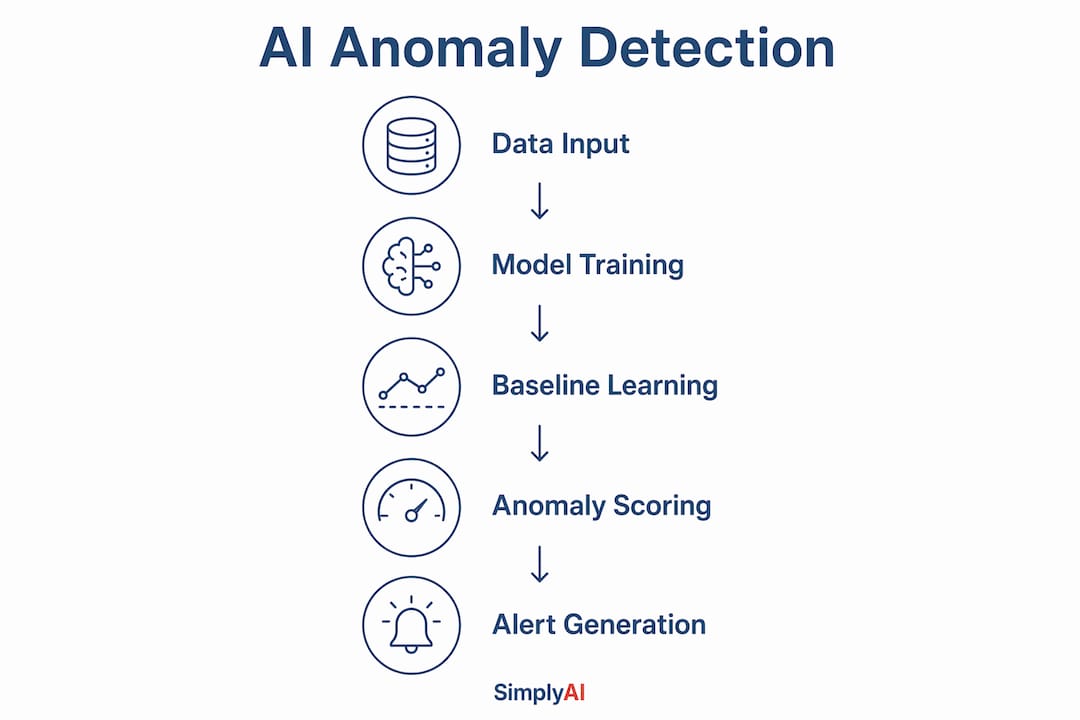
Deep learning architectures dominate the current state of the art. Autoencoders learn to compress and reconstruct normal data. When an anomalous input arrives, reconstruction error spikes, and that spike becomes the detection signal. Transformer-based models apply self-attention mechanisms to capture long-range dependencies in time series, making them particularly effective for multivariate sensor streams. Long Short-Term Memory networks, or LSTMs, model sequential dependencies across time steps, which is critical for detecting slow-building anomalies in network traffic or financial transactions. CNNs excel at spatial anomaly detection in image and video data by learning hierarchical feature representations, while Simple Recurrent Units, or SRUs, offer faster temporal processing for high-frequency time series.
Statistical methods remain relevant alongside deep learning. Gaussian mixture models, isolation forests, and one-class support vector machines each offer interpretable, computationally lighter alternatives when data volume or latency constraints make neural networks impractical. Many production systems combine statistical baselines with deep learning layers, using the statistical layer for fast triage and the neural layer for nuanced scoring.
What are the latest frameworks advancing anomaly detection accuracy?
Research in 2025 and 2026 has produced several frameworks that push accuracy and scalability well beyond earlier baselines. The P-ALIGN framework applies prototypical contrastive learning with patch-based spatio-temporal alignment to multivariate time series. It achieves an 11% F1-score improvement and a 12.23% increase in Normalized Affinity compared to prior models. That margin is significant in production environments where a single percentage point of precision can translate to thousands of fewer false alerts per day.
The STGAD framework takes a generative adversarial approach. It combines a WGAN-GP critic with a Transformer encoder and a stochastic generator, then fuses residual scores with critic scores to produce a final anomaly ranking. This dual-score fusion makes STGAD particularly resilient to noise in unsupervised multivariate settings, where a single scoring signal often collapses under data drift.
ISA-MTAD introduces a dual-decoder semi-supervised architecture that learns normal and abnormal features separately, eliminating the need for manual threshold configuration entirely. For IT teams that dread the quarterly threshold-tuning exercise, this design represents a meaningful operational improvement.
| Framework | Approach | Key Metric | Primary Strength |
|---|---|---|---|
| P-ALIGN | Prototypical contrastive learning | +11% F1-score | Multivariate spatio-temporal alignment |
| STGAD | GAN + Transformer dual-score | Robust unsupervised scoring | Noise-resilient time-series detection |
| ISA-MTAD | Dual-decoder semi-supervised | No manual thresholds | Separate normal/abnormal feature learning |
| Isolation Forest | Ensemble tree-based | Fast inference | Lightweight point anomaly detection |
Pro Tip: When evaluating frameworks against your own data, always benchmark on your specific domain's dataset rather than relying solely on published benchmark results. F1-score improvements on public datasets like SMD or MSL do not always transfer directly to proprietary infrastructure telemetry.
Key applications of AI anomaly detection across industries
AI anomaly detection applies across cybersecurity, financial fraud, and system health monitoring to enable early warning and reduce false alarms. Each domain places different demands on the underlying model, but the core value proposition is consistent: catch deviations before they become incidents.
In cybersecurity, network intrusion detection systems use LSTM and autoencoder models to baseline normal traffic patterns and flag lateral movement, credential stuffing, or data exfiltration attempts in real time. The shift from signature-based detection to behavioral anomaly detection means zero-day threats, which have no known signature, become visible through their behavioral footprint. For a deeper look at how AI reshapes security monitoring, the AI fraud detection guide from Simplyai covers the domain in detail.
In financial services, AI anomaly detection powers fraud prevention at scale. Transaction monitoring systems trained on billions of historical transactions can score each new transaction in milliseconds, flagging contextual anomalies like a card used in two geographically distant locations within minutes. The shift to data-driven AI models from expert-written heuristics enables proactive fault management that static rule engines simply cannot match.
Operational monitoring in manufacturing, cloud infrastructure, and IoT deployments benefits from collective and seasonal anomaly detection. A predictive maintenance system monitoring 500 sensors on a production line can detect the subtle correlated drift across three sensors that precedes a bearing failure, hours before any single sensor crosses a threshold. The benefits of AI methods over traditional detection include:
- Adaptive baselines that update continuously without manual reconfiguration
- Detection of contextual and collective anomalies invisible to threshold systems
- Severity-ranked alerts with context and probable causes to accelerate triage
- Reduced false positive rates through probabilistic scoring rather than binary rules
- Scalability across thousands of data streams simultaneously
Challenges and best practices for implementing AI anomaly detection
The most persistent challenge in deploying anomaly detection using machine learning is the scarcity of labeled anomaly data. Anomalies are, by definition, rare. A model trained on imbalanced data where normal examples outnumber anomalies by 10,000 to 1 will learn to predict "normal" for everything and still achieve 99.99% accuracy. Precision and recall on the anomaly class are the metrics that matter, not overall accuracy.
Noise and environmental complexity compound this problem. In real infrastructure, what looks like an anomaly is often a scheduled maintenance window, a planned deployment, or a known seasonal spike. Without context injection, models generate alert fatigue that causes analysts to start ignoring the system entirely. The best implementations feed contextual metadata, such as deployment schedules, business calendars, and known event flags, directly into the model or use it to suppress alerts during expected deviation windows.
Threshold setting remains a challenge even for AI systems. While adaptive thresholding removes the need for static numbers, the sensitivity parameter that governs how aggressively the model flags deviations still requires calibration. Setting it too low floods the queue; setting it too high misses subtle threats.
Best practices for successful deployment include:
- Start with semi-supervised methods when labeled anomaly data is limited, training on abundant normal data with a small labeled set to anchor the decision boundary
- Implement continuous learning pipelines that retrain models on recent data to prevent concept drift from degrading detection quality over time
- Prioritize explainability by selecting models or wrappers that surface feature contributions alongside each alert, giving analysts the context to act quickly
- Use AI-powered data analysis to complement anomaly detection with broader pattern recognition across your data estate
Pro Tip: Build a feedback loop where analyst dispositions on alerts, confirmed anomaly, false positive, or known event, feed back into the model as labeled training data. Over six to twelve months, this loop dramatically sharpens precision without requiring a separate labeling effort.
Key takeaways
AI anomaly detection outperforms traditional threshold systems because it learns dynamic behavioral baselines, detects contextual and collective anomalies, and scales across thousands of data streams simultaneously.
| Point | Details |
|---|---|
| Core definition | AI anomaly detection automatically identifies deviations from learned normal behavior without manual rules. |
| Technique selection | Match the learning paradigm to your data: supervised for labeled data, unsupervised for unlabeled, semi-supervised for mixed. |
| Framework advances | P-ALIGN and STGAD deliver measurable F1-score gains over prior models on multivariate time series benchmarks. |
| Top applications | Cybersecurity, financial fraud detection, and operational monitoring each benefit from adaptive, real-time anomaly scoring. |
| Implementation priority | Build analyst feedback loops and continuous retraining pipelines to prevent model drift and reduce false positive rates. |
Why adaptive AI detection is the only defensible approach
The organizations I see struggling most with anomaly detection are not the ones with too little data. They are the ones still defending static rule sets written three years ago by engineers who have since left the team. Rules decay. Infrastructure evolves, traffic patterns shift, and attack techniques adapt. A rule written to catch a 2022 credential stuffing pattern will not catch its 2026 variant.
What strikes me most about the P-ALIGN and STGAD research is not the headline F1-score numbers. It is the architectural decision to model temporal and spatial relationships jointly rather than treating each sensor or metric as an independent stream. That design choice reflects how real anomalies actually manifest: not as a single metric spiking, but as a correlated pattern across multiple dimensions unfolding over time.
The interpretability gap is the challenge I find most underestimated in enterprise deployments. A model that flags an anomaly without explaining which features drove the score forces the analyst to either trust it blindly or investigate from scratch. Neither outcome is acceptable in a security operations center operating under time pressure. The frameworks moving toward enterprise AI governance standards are the ones building explainability into the detection pipeline from the start, not bolting it on afterward.
My advice: treat anomaly detection as a living system, not a deployment. The teams that get the most value from it are the ones that review model performance monthly, inject new contextual signals as their environment changes, and treat analyst feedback as training data. That discipline separates a detection system that improves over time from one that quietly degrades until a breach proves it has.
— Theodor
How Simplyai can help you deploy AI anomaly detection
Simplyai designs and implements AI automation systems that bring real-time anomaly detection and proactive alerting within reach for small and medium-sized businesses. Whether you need to monitor transaction streams for fraud, track infrastructure health across cloud environments, or flag unusual customer behavior in your CRM, Simplyai builds custom AI integrations tailored to your data and workflows.
The AI automation services from Simplyai cover the full implementation stack, from model selection and data pipeline setup to alert routing and continuous retraining. You get a detection system that adapts to your environment rather than one you have to manually maintain. If you are ready to move beyond static thresholds and build a detection capability that actually scales, Simplyai is the practical next step.
FAQ
What is AI anomaly detection in simple terms?
AI anomaly detection is the automatic identification of data points or patterns that deviate from what a machine learning model has learned to expect as normal. It replaces manual rules with adaptive models that update as data conditions change.
How does AI detect anomalies in real time?
AI systems score incoming data continuously against a learned baseline, flagging deviations that exceed a trained confidence threshold. Frameworks like STGAD use Transformer encoders and dual scoring to produce low-latency anomaly rankings on live multivariate streams.
What are the main types of anomalies AI can detect?
AI models detect four primary types: point anomalies (single outlier values), contextual anomalies (normal values in an abnormal context), collective anomalies (sequences of events that together signal a problem), and seasonal anomalies (deviations from expected periodic patterns).
What industries benefit most from AI anomaly detection?
Cybersecurity, financial services, and industrial operations see the strongest returns. Applications span intrusion detection, transaction fraud prevention, and predictive maintenance across manufacturing and cloud infrastructure.
How is AI anomaly detection different from rule-based monitoring?
Rule-based monitoring triggers alerts when data crosses fixed thresholds. AI anomaly detection builds dynamic baselines from historical data and detects contextual and collective anomalies that static rules cannot recognize, reducing both missed detections and false positive alert volumes.