

TL;DR:
- Explainable AI makes decision processes understandable and trustworthy for human users across diverse sectors.
- Regulatory demands, particularly the EU AI Act, are driving widespread adoption of interpretability methods for high-risk applications.
Explainable AI (XAI) is defined as the set of methods and technologies that make AI system decisions understandable and justifiable to human users. Formally recognized by organizations including IBM, Red Hat, and the OECD, XAI addresses a fundamental gap between AI accuracy and human trust. As AI systems take on decisions in healthcare, hiring, lending, and operations, knowing why a model reached a conclusion matters as much as whether it was correct. This guide breaks down how explainable artificial intelligence works, what techniques power it, where it applies in the real world, and why regulatory frameworks like the EU AI Act are making it a business necessity in 2026.
What is explainable AI and how does it work?

Explainable AI is the discipline of making AI model outputs interpretable by humans, covering both the logic behind individual decisions and the overall behavior of a model. Red Hat frames XAI as encouraging AI systems to "show their work," which becomes critical when the internal logic of a model is too complex to interpret directly. This applies to neural networks, gradient boosting models, and large language models alike. Without explainability, even a highly accurate model functions as a black box, producing outputs that users cannot verify, challenge, or trust.
The OECD identifies XAI as closely tied to transparency, accountability, traceability, and trustworthiness. These are not just technical properties. They are governance elements that determine whether an organization can responsibly deploy AI at scale. A model that predicts loan defaults with 94% accuracy but cannot explain its reasoning is a liability in any regulated environment. XAI converts that liability into an auditable, defensible process.
There is no universal method for achieving explainability. Red Hat notes that organizations must tailor their approach based on model complexity, stakeholder needs, and where they are in the AI lifecycle. A data scientist debugging a model needs different explanations than a compliance officer reviewing a credit decision or a customer asking why their application was denied.
What techniques make AI decisions interpretable?
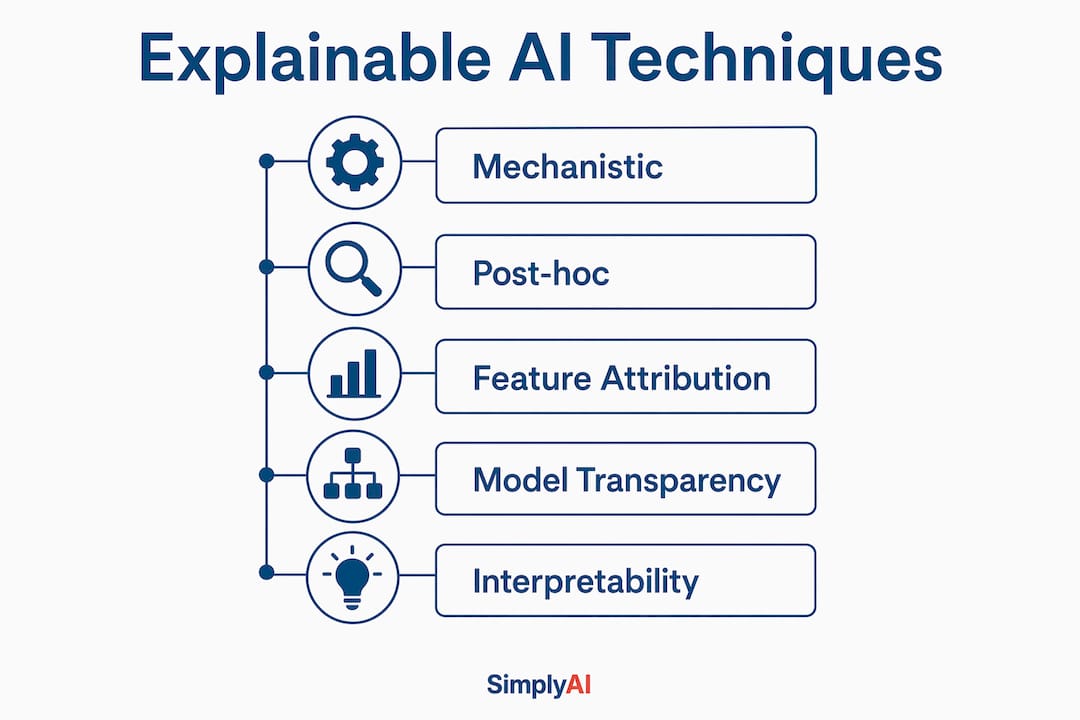
Two broad categories define the technical landscape of AI interpretability: mechanistic interpretability and post-hoc explainability. Mechanistic interpretability examines the internal structure of a model, mapping neurons, layers, and pathways to understand what the model has actually learned. Post-hoc methods, by contrast, analyze a trained model from the outside, generating explanations without modifying the model itself.
Within post-hoc explainability, feature attribution is the most widely used approach. Feature attribution assigns importance scores to each input variable, indicating how much each feature contributed to a specific prediction. The 2026 npj Artificial Intelligence paper distinguishes between global explanations, which describe overall model behavior across all predictions, and local explanations, which explain a single decision for one specific input. SHAP (SHapley Additive exPlanations) and LIME (Local Interpretable Model-agnostic Explanations) are the two most widely deployed tools for local feature attribution. SHAP uses game theory to assign each feature a fair contribution score, while LIME builds a simpler surrogate model around a specific prediction to approximate the complex model's behavior locally.
A critical limitation exists here. Feature attribution methods often assume feature independence, which can produce false attributions when input variables are correlated. A model predicting employee attrition might attribute high importance to "years at company" while ignoring that this variable correlates strongly with "salary band," distorting the explanation. Testing explanation correctness with purpose-aligned metrics is not optional. It is the difference between a useful explanation and a misleading one.
Pro Tip: Select your explanation method based on who will read it. A SHAP summary plot works well for data scientists. A plain-language "top three reasons" output works better for a loan officer or a customer service team. Matching the format to the audience is as important as the technical accuracy of the explanation itself.
How does explainable AI solve high-stakes decision problems?
The black box problem is the core challenge XAI addresses. Stanford GSB defines the black box problem as the condition where AI outputs are accurate but the reasoning is opaque, leading to mistrust even when the model performs well. This is not a theoretical concern. In housing, hiring, and healthcare, opaque AI decisions carry real consequences for real people, and regulators in the United States and Europe are paying close attention.
Consider three sectors where explainability is not optional:
-
Healthcare diagnostics. A model that flags a patient for high readmission risk must explain which clinical factors drove that flag. Physicians will not act on a recommendation they cannot interrogate, and hospitals cannot defend a care protocol built on unexplained outputs.
-
Credit and lending. Under the Equal Credit Opportunity Act in the United States, lenders must provide specific reasons for adverse credit decisions. An AI model that denies a mortgage application must generate a compliant, human-readable explanation, not just a probability score.
-
Hiring and HR. Automated resume screening tools that cannot explain why a candidate was rejected expose organizations to discrimination claims. Explainability provides the audit trail that legal and HR teams require.
Accuracy alone does not guarantee AI acceptance. Users must understand the reasoning behind decisions to trust and act on AI recommendations. This insight has significant implications for AI adoption inside organizations. A sales team that does not understand why a CRM model ranks certain leads as high-priority will ignore those rankings. Explainability is the mechanism that converts model output into human behavior change. For professionals working on data-driven decision making, this distinction between a model that predicts and a model that persuades is operationally significant.
Pro Tip: When deploying AI in a team setting, invest in a brief explanation session alongside the tool rollout. Show users one or two concrete examples of how the model reached a decision. This single step dramatically increases adoption rates and reduces the resistance that kills otherwise well-built AI projects.
Comparing explanation approaches: trade-offs and how to choose
Choosing the right XAI approach requires understanding the trade-offs between model transparency and model performance. Interpretable models like decision trees and linear regression are transparent by design. You can trace every decision path without any additional tooling. The cost is predictive power. Complex problems, such as image classification or natural language understanding, require deep learning architectures that no decision tree can match.
The table below summarizes the key differences between the main explanation approaches:
| Approach | Model type | Explanation scope | Key limitation |
|---|---|---|---|
| Interpretable models (decision trees, linear regression) | Simple, transparent | Global and local | Lower predictive accuracy on complex tasks |
| SHAP | Any model (post-hoc) | Global and local | Assumes feature independence; computationally expensive |
| LIME | Any model (post-hoc) | Local only | Unstable across similar inputs; approximation errors |
| Mechanistic interpretability | Neural networks, LLMs | Internal structure | Requires deep technical expertise; still maturing |
Current popular XAI methods lack formal problem definitions and rigorous evaluation standards, which means organizations can generate explanations that look credible but are technically unreliable. The npj Artificial Intelligence research argues for problem-driven development, where the explanation method is selected based on the specific question being answered, not on what tool is most familiar. This is a meaningful shift from current practice, where SHAP is often applied by default regardless of whether it fits the use case.
Effective explanations must address specific questions like "why this decision for this person" rather than presenting raw model statistics. A compliance officer asking whether a model discriminates by zip code needs a different explanation than a developer asking why validation accuracy dropped. Aligning the explanation to the question is the discipline that separates mature XAI practice from checkbox compliance.
Regulations and future directions shaping XAI in 2026
Regulatory pressure is the single largest driver of XAI adoption in 2026. The EU AI Act requires high-risk AI systems to be designed so that deployers can interpret outputs appropriately. High-risk categories include AI used in employment, education, credit, law enforcement, and critical infrastructure. For any organization operating in or selling into the European Union, explainability is now a compliance requirement, not a best practice.
The concept of trustworthy AI, promoted by the OECD and the European Commission, places explainability alongside fairness, privacy, and human oversight as a core pillar. OECD.AI notes particular challenges for large language models, where the sheer scale of parameters makes traditional feature attribution methods difficult to apply meaningfully. This is where mechanistic interpretability is emerging as a critical frontier.
Goodfire's Silico tool, highlighted by MIT Technology Review in 2026, enables developers to map neurons and pathways inside large language models, allowing parameter-level adjustments and targeted debugging. This moves XAI from passive explanation to active model control. For developers working on AI output quality, tools like Silico represent a significant advance in AI output observability and model governance. The research direction points toward a future where AI systems can be debugged and corrected with the same precision currently applied to traditional software.
Key takeaways
Explainable AI is the technical and governance discipline that makes AI decisions trustworthy, auditable, and legally defensible across every sector where AI affects human outcomes.
| Point | Details |
|---|---|
| XAI defined | Explainable AI makes model decisions understandable to humans through feature attribution, interpretable models, and mechanistic tools. |
| Technique selection matters | SHAP and LIME are widely used but carry limitations; match the method to the specific question and audience. |
| High-stakes sectors demand it | Healthcare, lending, and hiring require explainability for legal compliance and user trust, not just technical accuracy. |
| Regulation is accelerating adoption | The EU AI Act mandates interpretability for high-risk AI systems, making XAI a compliance requirement in 2026. |
| Mechanistic interpretability is emerging | Tools like Goodfire's Silico allow developers to debug and control large language models at the neuron level. |
Why accuracy without explanation is a trust problem, not a technical one
The most common misconception I encounter is that explainability is a feature you add after a model is built. It is not. The decision about how a model will be explained should be made before the first line of training code is written, because the explanation method constrains the model architecture and vice versa. Organizations that treat XAI as an afterthought consistently produce explanations that satisfy no one: too technical for business users, too shallow for regulators, and too imprecise for data scientists.
What I have observed in practice is that the organizations making the most progress with AI adoption are not the ones with the most accurate models. They are the ones where non-technical stakeholders can look at an AI recommendation and say, "I understand why it said that, and I agree." That moment of comprehension is worth more to adoption than a two-point improvement in F1 score. It is also what separates a model that gets used from one that sits in a dashboard nobody opens.
The field still has real problems to solve. The npj Artificial Intelligence research is correct that most XAI methods lack formal evaluation standards, and that is a genuine risk for organizations relying on them for compliance. But the direction is clear. Mechanistic interpretability tools are maturing fast, the EU AI Act is forcing rigor into the market, and the research community is moving toward problem-driven explanation design. For professionals building or procuring AI systems today, understanding ethical AI governance alongside explainability is not optional. It is the foundation of any AI program that will survive regulatory scrutiny and earn organizational trust.
— Theodor
How Simplyai builds transparency into AI automation
Simplyai designs AI automation solutions for small and medium-sized businesses that deliver results you can understand and defend. Every workflow automation, AI agent, and data-driven integration Simplyai builds is structured so that decision outputs are traceable and interpretable by the people who use them. For businesses in regulated sectors or those scaling AI across customer-facing operations, that transparency is not a nice-to-have. It is what makes AI adoption stick. Explore Simplyai's AI automation services to see how explainability is built into practical business solutions from day one.
FAQ
What is explainable AI in simple terms?
Explainable AI is a set of methods that help humans understand why an AI system made a specific decision. It answers questions like "why was this loan denied" or "what factors drove this prediction," making AI outputs auditable and trustworthy.
What is the difference between interpretable and explainable AI?
Interpretable AI refers to models that are transparent by design, such as decision trees, where the logic is directly readable. Explainable AI applies post-hoc techniques like SHAP or LIME to explain complex models that are not inherently transparent.
Why does explainable AI matter for businesses?
Explainability builds user trust, supports regulatory compliance, and enables organizations to identify and correct model errors or bias. Without it, even accurate AI models face rejection from the teams and regulators who need to rely on them.
What are SHAP and LIME used for?
SHAP and LIME are post-hoc feature attribution tools that explain individual AI predictions by identifying which input variables most influenced the output. SHAP uses game theory for consistent attribution, while LIME builds a local surrogate model around a single prediction.
Is explainable AI required by law?
The EU AI Act requires high-risk AI systems to produce interpretable outputs, making explainability a legal obligation for AI deployed in employment, credit, healthcare, and other regulated domains within the European Union.