

TL;DR:
- Successful digital transformation requires a step-by-step approach, starting with strong leadership, clear vision, and process mapping. Prioritizing pilots, designing architecture before implementation, and continuous optimization are essential for lasting results. Treat transformation as a strategic, organization-wide effort rather than just a technology project to avoid failure.
Digital transformation is defined as a structured, organization-wide process of integrating technology, people, and process changes to achieve measurable business outcomes. The phrase "step by step digital transformation" captures exactly how successful companies approach it: not as a single technology purchase, but as a sequenced program of strategic change. 70% of transformation programs fail to meet their objectives because they skip the strategy and jump straight to software. This guide walks you through every phase, from vision to continuous optimization, so your program lands in the successful 30%.
What prerequisites are essential before you start?
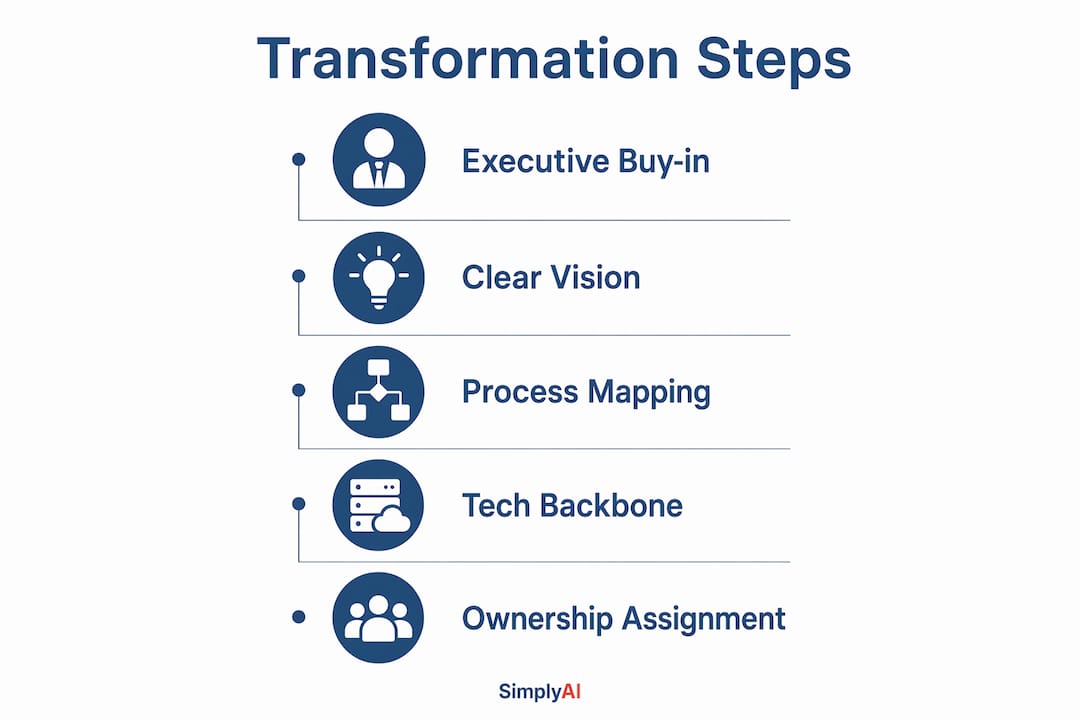
Every successful digital transformation program begins with two non-negotiable inputs: executive buy-in and a clear picture of your current operations. Without leadership commitment, budgets stall and cross-functional teams lose direction. Without an honest baseline, you end up automating broken processes instead of fixing them.

The technology backbone most experts recommend starting with is a centralized CRM. A unified CRM serves as the data brain of your business, connecting marketing, sales, and customer support into a single workflow. Salesforce, HubSpot, and Zoho CRM are the three platforms most commonly deployed at this stage. Choosing one before layering on other tools prevents the fragmented technology silos that derail so many programs. You can learn more about how this works in practice in this CRM automation guide.
Before selecting any technology, map your existing processes manually. Identify where handoffs break down, where data gets duplicated, and where your team spends the most manual effort. This process mapping exercise produces the bottleneck inventory that will drive your prioritization decisions later.
The table below shows the core tool categories and their roles in a typical digital transformation program.
| Tool Category | Example Platforms | Primary Role |
|---|---|---|
| CRM | Salesforce, HubSpot, Zoho CRM | Unified customer data and workflow coordination |
| Project Management | Asana, Monday.com, Jira | Initiative tracking and cross-team visibility |
| Analytics | Google Analytics 4, Tableau, Power BI | Performance measurement and decision support |
| Automation | Zapier, Make, custom AI agents | Eliminating manual, repetitive tasks |
| Communication | Slack, Microsoft Teams | Real-time collaboration across departments |
Pro Tip: Assign a named transformation owner, not a committee, to each initiative. Committees create consensus; owners create accountability.
How do you define vision and assess readiness?
Vision definition and readiness assessment determine 80% of program outcomes, yet most businesses rush through them to get to the "real work" of buying software. That is the single most common and costly mistake in the business digitalization process.
A strong transformation vision is specific and tied directly to a business outcome. "We will reduce order processing time by 40% within 12 months by automating our fulfillment workflow" is a vision. "We want to be more digital" is not. The difference between these two statements determines whether your team has a north star or a vague aspiration.
Readiness assessment covers five dimensions: technology infrastructure, existing processes, organizational culture, workforce skills, and data maturity. Each dimension gets a current-state score and a target-state score. The gap between those scores defines your transformation agenda. Common frameworks for this assessment include McKinsey's Digital Quotient, the MIT CISR Digital Maturity Model, and Gartner's Digital Business Acceleration model.
The output of a solid assessment is a prioritized gap list, not a wish list. You are looking for the gaps that, if closed, will produce the greatest operational and financial impact. That output feeds directly into the design phase.
What are the critical steps for designing, piloting, and scaling?
The phases of digital transformation follow a specific sequence: vision, assessment, design, pilot, scale, and optimization. Skipping any phase does not save time. It creates rework that costs more than the phase itself would have.
Here is how to execute the design, pilot, and scale phases in sequence.
-
Prioritize initiatives by value, feasibility, and strategic fit. Effective prioritization separates programs that deliver results from those that drain resources. Score each initiative on expected revenue impact, implementation complexity, and alignment with your stated vision. The top three scores become your pilot candidates.
-
Design your technology and process architecture before purchasing anything. Sketch the future-state workflow on paper or in a tool like Lucidchart or Miro. Define data flows, integration points, and governance rules. This step prevents the expensive mistake of buying a platform that does not fit your actual process.
-
Run time-boxed pilots on your top 2–3 use cases. Successful programs focus the first 90 days on foundation and momentum, selecting a small number of high-impact pilots with clear KPIs. A 90-day pilot for an accounts payable automation, for example, should have a defined baseline, a target cycle time, and a weekly review cadence.
-
Document everything into a playbook before scaling. The playbook captures the process design, the technology configuration, the training materials, and the governance rules. Without it, scaling a pilot to the full organization produces inconsistent results.
-
Scale with a phased rollout, not a big-bang launch. Roll out to one department or region first. Measure results against the pilot KPIs. Adjust. Then expand. This approach limits risk and builds organizational confidence at each stage.
Pro Tip: Set a hard stop date for each pilot. Open-ended pilots never end. They drift into permanent experiments that consume resources without producing decisions.
A typical enterprise transformation roadmap takes 4–8 weeks to develop, while full implementation for a small business can span 1–18 months depending on scope. Plan your timeline honestly, not optimistically.
How do you continuously optimize for lasting results?
Transformation does not end at scale. Continuous optimization turns a one-time program into a permanent business capability. The organizations that sustain transformation benefits treat optimization as a standing function, not a project phase.
The mechanics of continuous optimization rest on three practices. First, implement feedback loops at every process touchpoint. Collect data from your CRM dashboards, your analytics platforms, and direct employee input on a regular cadence. Second, review KPIs monthly against the targets set during the pilot phase. When a metric drifts, investigate the root cause before adjusting the process. Third, build a culture where teams feel safe flagging what is not working. Psychological safety is not a soft concept in this context. It is the mechanism that surfaces the operational intelligence you need to course-correct.
The comparison below shows how three common optimization frameworks differ in approach.
| Framework | Primary Focus | Best Suited For |
|---|---|---|
| OKRs (Objectives and Key Results) | Goal alignment and quarterly tracking | Strategic initiative management |
| Lean / Kaizen | Waste elimination and process efficiency | Operational and manufacturing workflows |
| Agile Sprints | Iterative delivery and rapid feedback | Technology and product development |
For most small and mid-sized businesses, a hybrid of OKRs for strategic tracking and Agile sprints for technology delivery produces the best results. The best AI tools for small businesses can accelerate this optimization cycle significantly by automating data collection and surfacing anomalies before they become problems.
You should also track revenue leakage as part of your optimization program. Monitoring metrics for lost revenue gives you a direct financial signal when a transformed process starts underperforming, which is far more useful than lagging indicators like annual profit reports.
Key takeaways
A step by step digital transformation succeeds only when vision, assessment, prioritization, piloting, and continuous optimization are executed in sequence, with named owners and measurable KPIs at every stage.
| Point | Details |
|---|---|
| Start with executive buy-in | Transformation programs without leadership commitment stall at the budget and resourcing stage. |
| Build on a unified CRM | A centralized CRM prevents data silos and connects marketing, sales, and support from day one. |
| Pilot before scaling | Run 90-day pilots on 2–3 use cases with clear KPIs before committing to organization-wide rollout. |
| Sequence the phases | Vision, assessment, design, pilot, scale, and optimization must run in order. Skipping steps creates costly rework. |
| Treat optimization as permanent | Continuous measurement and feedback loops sustain transformation value long after the initial program ends. |
Where most digital transformation programs actually break down
I have seen a consistent pattern across businesses that struggle with transformation: they treat it as a technology project managed by the IT department. The moment that framing takes hold, the program is already in trouble. Technology is the vehicle. Strategy, people, and process are the engine.
The second failure mode is chasing quick wins at the expense of structural change. Quick wins matter. They build momentum and demonstrate ROI to skeptical stakeholders. But if you spend 18 months collecting quick wins without redesigning the underlying process architecture, you end up with a faster version of a broken system.
What actually works is a deliberate balance. Deliver one visible win in the first 90 days to maintain organizational confidence. Then use that credibility to push through the harder, slower work of process redesign and cultural change. Cross-functional collaboration is not optional at this stage. Finance, operations, sales, and IT need to be in the same room making decisions together, not passing requirements back and forth through email chains.
The businesses I have seen succeed at this are not the ones with the biggest budgets. They are the ones with the clearest vision, the most disciplined prioritization, and the willingness to measure everything honestly, including the things that are not working.
— Theodor
How Simplyai accelerates your transformation program
Simplyai designs and deploys AI automations and AI agents that integrate directly into your digital transformation roadmap, reducing manual work and improving operational efficiency from day one.
Whether you are in the pilot phase testing a single workflow or scaling automation across your entire operation, Simplyai builds solutions tailored to your business, not generic templates. Our AI automations cover workflow automation, CRM integrations, AI-powered chatbots, and custom data pipelines. Our AI agents handle decision support and intelligent task execution that traditional software cannot manage. If you are ready to move from planning to execution, Simplyai delivers measurable results at every stage of your program.
FAQ
What is step by step digital transformation?
Step by step digital transformation is a structured process of integrating technology, process, and people changes in a defined sequence, covering vision, assessment, design, piloting, scaling, and optimization. It differs from ad hoc technology adoption because each phase builds on the previous one with measurable outcomes.
Why do most digital transformation programs fail?
70% of programs fail because organizations treat transformation as a technology purchase rather than a strategic change program. Poor strategy execution, lack of governance, and skipping foundational phases are the primary causes.
How long does a digital transformation take?
Timeline depends on scope and business size. Enterprise roadmap development takes 4–8 weeks, while full implementation for a small business typically spans 1–18 months.
Where should a small business start its digital transformation?
Start with a centralized CRM to unify customer data across marketing, sales, and support. A unified CRM prevents fragmented technology silos and gives you the data foundation every subsequent initiative depends on.
What is the most important phase in the process?
Vision definition and readiness assessment are the most critical phases. They determine 80% of program outcomes and set the strategic direction that every downstream decision depends on.